|
VOOZH | about |
|
VOOZH | about |
Motion under gravity is the motion of an object moving under the influence of gravity. gravity is the constant pull of Earth's surface that pulls every object to its centre. The motion of a fruit falling from the branch of the tree is considered motion under gravity.
In this article, we will learn about Motion under gravity, Equation of motion under gravity and others in detail.
Table of Content
Gravity, described as acting by Isaac Newton, is the force that brings things with mass towards each other. Here on Earth, gravity gives an impressive force that pushes everything away from its centre, resulting in, for instance, falling objects and throwing projectiles. Understanding the nature of satellites' motion under gravity assuming gravitational acceleration and determination of future orbits is very critical.
An item that experiences a change in motion which is in vertical motion due to the gravitational force is known as motion under gravity. GRAVITY is an ordinary yet powerful force which makes things move down in a free fall.
The gravitational acceleration is the objects' rate at which they have been accelerating towards the Earth due to the gravitational force. Somewhere near the ground, as one approaches the Earth's surface, this acceleration is approximately 9.8 m/s^2. The latter statement implies that in every second, what falls significantly increases its velocity by 9.8 m/s in the direction of fall. The gravitational acceleration is rather a constant value near the Earth's surface while it may change with altitude or with the location just a bit. This is because it plays a central role in the application of this theory to diverse areas such as free fall and projectile motion.
Gravitational acceleration is typically denoted by the symbol g, and its formula is:
g = W/m
where,
Gravitational acceleration is approximately 9.8m/s2.
Motion of an object under gravity is explained below in this article.
Characteristics of an object under free fall is explained as:
Acceleration = -g = -9.8 m/ss
Gravitation motion equations are the results of applying the dynamic and kinematics laws. It expresses the connections between an object's location, velocity, acceleration, and time of movement all influenced by gravity.
In free fall, an object does not experience outside forces, except for gravity. This acceleration is constant at the rate of 9.8 m/s2 toward the centre of Earth.
Displacement: Displacement 'h' of an object under gravity can be calculated using the equation:
h = ut + 1/2gt2
Velocity: Velocity 'v' of the object at any given time t can be calculated using:
v = u + gt
Final Velocity at Displacement (h): Final Velocity at Displacement 'h' is calculated using the equation,
v2 = u2 + 2gh
where,
If an object moves under the influence of gravity then its velocity is calculated as:
v2 = u2 + 2gh
Value of g is taken to be positive as it is moving downward
v2 = (0)2 + 2gh
v2 = 2gh
v = √(2gh)
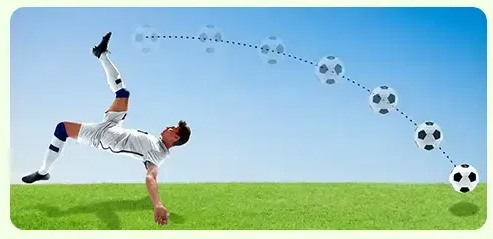
Projectile motion is the motion of an object that moves under the influence gravity and also has a vrticla motion. Motion of bullet fried from a gun, motion of ball thrown in air, etc are considered as projectile motion.
Horizontal Motion: If there is no external force applied to an object, the object will keep moving with the same speed. Thus, the equation for horizontal displacement (x) is simply:
x = ut
Vertical Motion: In case of vertical motion gravity plays a crucial role, and its equation is given as,
y = ut + 1/2gt2
where sign of g can vary accordingly
Maximum Height: Maximum height (H) attained by the projectile is obtained from the formula:
H = v2sin2(θ)/2g
Time of Flight: Formula to find total flight time(T) is calculated by the formula:
T = 2vsin(θ)/g
where,
Some examples of motion under gravity force are:
Read More: