|
VOOZH | about |
|
VOOZH | about |
Photoelectric effect refers to the phenomenon in which electrons are emitted from a material when it is exposed to light (electromagnetic radiation) of sufficient energy. Photoelectric effect provided evidence for the quantized nature of light and supported the wave-particle duality of electromagnetic radiation. The dual nature of matter and the dual nature of radiation are important concepts states that a matter can exhibit both particle like and wave like properties.
In this article, we will read in detail about photoelectric effect, its principle, photoelectric equation, threshold energy and applications.
Table of Content
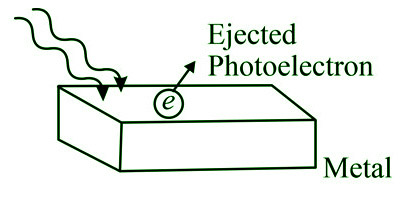
When a metal is exposed to light, the photoelectric effect occurs, in which the metal emits electrons from its valence shell. The emitted electron is known as photoelectron, and this phenomenon is commonly known as photoemission.
Wilhelm Ludwig Franz Hallwachs was the first to notice the photoelectric effect, which Heinrich Rudolf Hertz later confirmed. This phenomenon, as well as the quantum nature of light, were explained by Einstein. In 1921, Einstein was awarded the Nobel Prize for Physics for his work on the Photoelectric Effect.
👁 ImageThe photons that strike the metal's surface must have enough energy to overcome the attractive forces that bind the electrons to the nuclei in order for the photoelectric effect to occur. The threshold energy (represented by the symbol Φ) is the least amount of energy required to remove an electron from a metal. A photon's frequency must be identical to the threshold frequency in order for it to have the same energy as the threshold energy (which is the minimum frequency of light required for the photoelectric effect to occur). The corresponding wavelength (called the threshold wavelength) is generally denoted by the sign λth, and the threshold frequency is usually denoted by the symbol νth. The following is the link between the threshold energy and the threshold frequency.
Φ = hνth = hc / λth
Relationship between the Frequency of the Incident Photon and the Kinetic Energy of the Emitted Photoelectron
Ephoton = Φ + Eelectron
hν = hνth + 1/2 mev2
where,
- Ephoton signifies the incident photon's energy, which is equal to hν.
- Φ signifies the metal surface's threshold energy, which is equal to hνth.
- Eelectron is the photoelectron's kinetic energy, which is 1/2mev2 (me = mass of electron = 9.1 x 10⁻³¹ kg).
There will be no emission of photoelectrons if the photon's energy is less than the threshold energy (since the attractive forces between the nuclei and the electrons cannot be overcome). As a result, if ν < νth , the photoelectric effect will not occur. There will be an emission of photoelectrons if the photon frequency is exactly equal to the threshold frequency (ν=νth), but their kinetic energy will be zero.
A photon is the smallest discrete amount of electromagnetic energy, also known as a quantum. It's the fundamental unit of all light.
Photons are continually in motion and travel at a constant speed of 2.998 x 10⁸ m/s to all observers in a vacuum. The speed of light, indicated by the letter c. Every photon has a specific quantity of energy and momentum. The photon's energy is provided by,
E = hν
where,
The momentum of a photon is given by,
p = h/λ
where,
Photons have the following basic properties:
If γ = frequency of incident photon and γth= threshold frequency, then,
λth = c/γth
For λ = wavelength of the incident photon, then
Φ = hγth = hc/λth
If E = energy of an incident photon, then
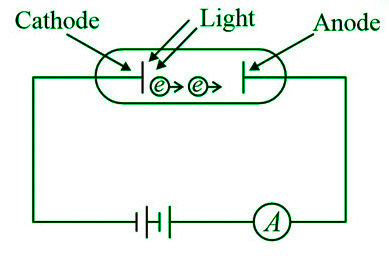
A metal surface is irradiated with light in the photoelectric effect, and when light falls on the metal's surface, photoemission occurs, and photoelectrons are ejected from the metal's surface. The energy of the wave's photon is transmitted to the metal atom's electrons, which causes the electrons to get excited and expelled with a certain velocity.
The photon's energy is equal to the sum of the metal's threshold energy and the photoelectron's kinetic energy.
👁 Photoelectric Effect EquationThus, the equation of photoelectric wave is given by,
KEmax = hv–ϕ
where,
Work function is determined by the metal in question, and it will change if the metal is changed. The work function is sometimes defined in terms of threshold frequency, which is the frequency of light for which the emitted Photoelectron's maximal kinetic energy is zero.
ϕ = hv0
where,
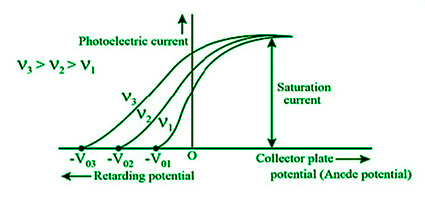
The maximum kinetic energy remains constant as the light intensity increases, but the value of photocurrent increases.
👁 ImageThe photoelectric effect depends on :
Also, Check
Example 1: Light of wavelength 4000Å is incident on a metal plate whose work function is 2eV. What is the maximum kinetic energy of emitted photoelectron?
Solution:
The wavelength of light is λ=4000Å and work function, φ0=2eV
From the Einstein Photoelectric equation, the maximum kinetic energy of photoelectron is given by,
Kmax=(hc/λ–φ0)
where ‘h′ is Planck’s constant and ‘c′ is the speed of light in a vacuum.
Kmax=(6.6×10–34×3×108/4000×10–10–(2×1.6×10–19))
Kmax=4.95×10⁻¹⁹/1.6×10–19eV–2eV=1.1eV
The maximum kinetic energy 1.1eV.
Example 2: The value of retarding potential needed to stop the photoelectrons ejected from a metal surface of work function 1.2eV with the light of energy 2eV is
Solution:
Work function of the metalφ=1.2eV and energy of the photons is hν=2eV.
The maximal kinetic energy of photoelectrons is given by the Einstein photoelectric equation:
eV=hv–φ
Where ‘V′ is retarding potential or stopping potential.
h is the Planck’s constant.
φ is the work function of the metal.
V=(2eV–12eV)/e=0.8V
Thus, the retarding potential is 0.8V