|
VOOZH | about |
|
VOOZH | about |
In kinematics, describing the motion of an object requires knowing where the object is and how its position changes with time. These ideas are explained using two important vector quantities: the position vector and the displacement vector. Both play a fundamental role in understanding motion, velocity, and acceleration.
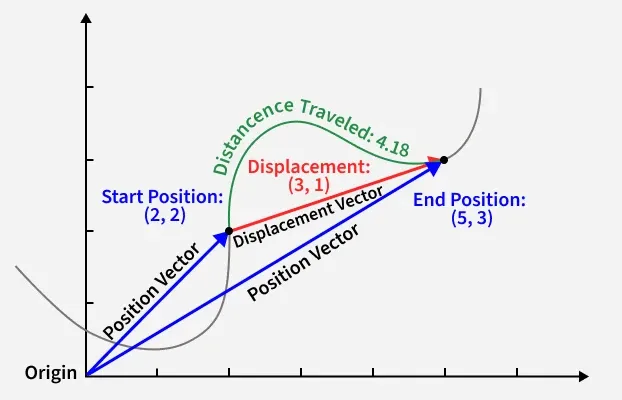
The position vector specifies the location of an object with respect to a fixed reference point, usually taken as the origin of a coordinate system. It is a vector that starts from the origin and points toward the position of the object.
If a point has coordinates (x, y) in a two-dimensional plane, its position vector () is given by
The magnitude of the position vector is given by
In three dimensions, for a point (x, y, z), the position vector is
The magnitude of the position vector represents the distance of the object from the origin, while its direction indicates where the object is located.
The displacement vector describes the change in position of an object. If an object moves from an initial position A to a final position B, the displacement vector is the vector drawn from A to B.
If the coordinates of A and B are (x1, y1) and (x2, y2), respectively, the displacement vector () is
The magnitude of the displacement vector is given by
The magnitude of displacement is the shortest distance between the initial and final positions, and its direction is always from the initial point to the final point. Displacement depends only on these two positions and not on the path taken.
Distance is a scalar quantity that depends on the actual path followed by the object, while displacement is a vector quantity that depends only on the initial and final positions.
The position vector helps determine where an object is at a given instant, while the displacement vector is used to define important kinematic quantities such as velocity and acceleration. These vectors form the foundation for the mathematical description of motion.
Displacement depends only on the initial and final positions of the particle.
Given:
Position at t = 1sec :
Position at t = 4sec :
Displacement vector:
Initial position:
Final position:
Displacement magnitude:
Velocity:
Speed:
Distance travelled:
Required ratio: