|
VOOZH | about |
|
VOOZH | about |
In our daily lives, we constantly observe objects being pushed, lifted, or moving across surfaces. Whether it is walking on the ground, swimming in water, or an airplane taking off, these actions are made possible by forces acting on surfaces. One such important force is thrust.
Thrust is defined as the force acting perpendicular (normal) to a surface. It plays a crucial role in many real-life situations and technologies, from simple activities like standing and walking to advanced applications such as rockets and aircraft. It is closely related to pressure.
Pressure =
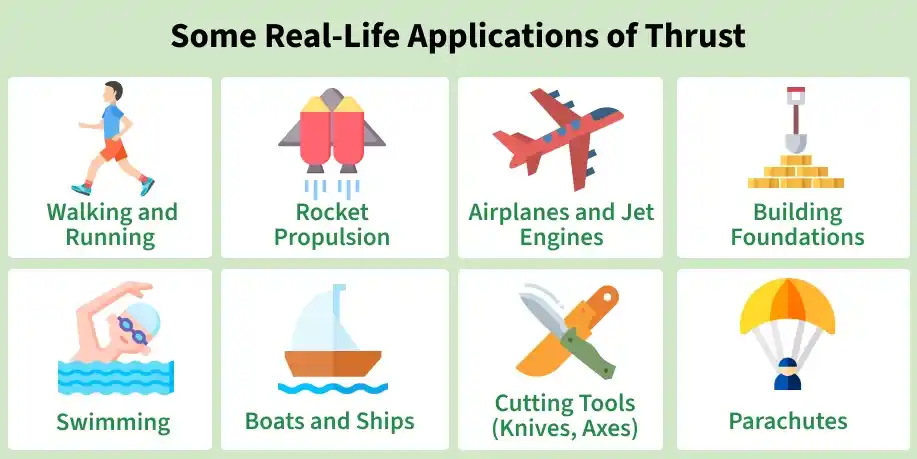
When we walk, our feet push the ground backward. In response, the ground exerts a force (thrust) that pushes us forward. Helps in movement. Based on the action-reaction principle
Rockets work on the principle of thrust.
Gases are expelled downward at high speed. This creates an upward thrust which allows rockets to move in space (even without air)
Airplanes move forward due to thrust produced by engines.
Engines push air backward and Air pushes the plane forward and Wings use thrust to help in lift and motion
Swimmers push water backward with hands and feet. Water exerts thrust forward which helps the swimmer move ahead
Boats move through water using thrust. Oars or propellers push water backward. Water provides forward thrust
When we apply force on a knife. The thrust acts on a small area. This increases pressure that makes cutting easier
Buildings are designed to distribute thrust over a large area. Prevents sinking into the ground, which ensures stability and safety
When a parachute opens, Air exerts upward thrust. Slows down the fall of a person Ensures safe landing