|
VOOZH | about |
|
VOOZH | about |
Ray Optics is a branch of optics that describes light propagation in the form of rays. Ray Optics is also called geometrical optics which deals with the geometry of falling lights. this article is about refraction, its laws, refraction through glass slab and its various causes, and practice tracing the path of light rays passing through glass slab. Refraction is the property of the change in direction of the wave while entering from one medium to another medium. This change in direction is due to a change in the speed of the wave.
Refraction is the phenomenon of change in direction of a wave passing from one medium to another medium because of the change in its speed. Refraction refers to the bending of a wave when it is passed from one medium to another medium.
The wave bends because of the change in its speed from one medium to another medium. Here are two laws of Refraction that can be stated as:
sin i / sin r = constant
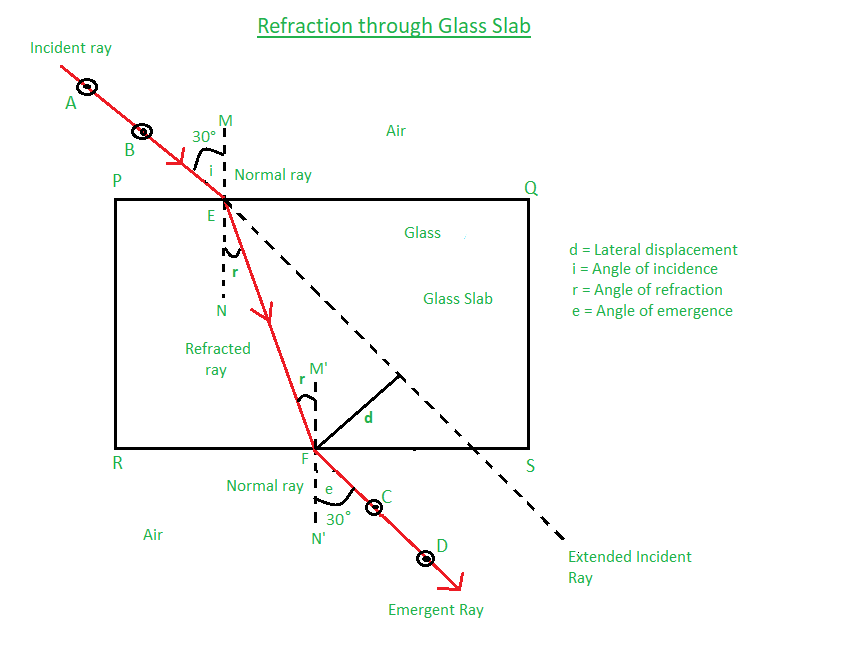
A glass slab is a substance with a cuboidal shape that is made of glass. A glass slab is made of glass with three dimensions length, breadth, and height.
Some important properties of a glass slab can be stated as:
Therefore, the formula for the lateral displacement d is given by,
d = [t sin(i - r)]/ cos r = t sin(i - r) sec r
where t is the thickness of the glass slab, i is the angle of incidence, r is the angle of refraction.
Aim: Tracing the path of a ray of light passing through the glass slab.
Materials Required:- Drawing board, all pins, white paper, rectangular glass slab, protractor, scale, pencil, thumb pins.
Procedure:
Conclusion:
Case 1: Refraction when the object is in a denser medium and the observer is in a rarer medium
Consider a glass slab with refractive index and thickness μ and t respectively. The observer (eye) is in the air and the object (O) is in the glass slab.
Hence for this case,
Virtual Depth = t / μ
and
Virtual displacement (OI) = OA - AI = t[1-(1/ μ)]
Case 2: Refraction through the successive slabs with different thicknesses and refractive index
Consider three successive slabs s1, s2, and s3 with thickness t1, t2, t3, and refractive indices μ1, μ2, and μ3 respectively. These slabs are arranged one after the other with s1 at the top, s2 at the middle, and s3 at the bottom. The object(O) is in s3 and the observer (eye) is outside in the air (rarer medium).
Hence for this case,
Virtual depth (AI) = (t1/ μ1) + (t2/ μ2) + (t3/ μ3) + .......
and
Virtual displacement (OI) = t1[1 - (1/ μ1)] + t2[1 - (1/ μ2)] + t3[1 - (1/ μ3)] + .........
Case 3: Refraction when object and observer both are in a rarer medium
Consider a glass slab with thickness t and refractive index μ. In this case, the object (O) and observer(eye) both are in a rarer medium (air) separated by the glass slab.
Hence for this case,
Virtual displacement (OI) = [t - (1/ μ)]
Case 4: Refraction when the object is in a rarer medium and the observer is in a denser medium
Consider the observer(eye) is in water(denser medium) and the object (O) is in the air (rarer medium).
Hence for this case,
Real height / Virtual height = 1 / μ
or
Virtual displacement (OI) = AI - AO = (μ - 1)AO
Question 1: Determine the position of the object kept at bottom of the glass slab with the thickness of 12 cm and the refractive index of glass is 1.5.
Answer:
The given case is refraction when the object is in a denser medium and the observer is in the rarer medium.
We have to find virtual depth i.e. position of the object.
Here, t = 12cm and μ = 1.5
Position of the object = t / μ
= 12/1.5
= 120/15
Position of the object = 8 cm
Question 2: Two immiscible liquids of refractive indices 3/2 and 4/3 filled in the vessel up to 9 cm and 12 cm then, What will be the virtual depth of the bottom of the vessel.
Answer:
The given case is like refraction through successive slab with different thickness and refractive index.
Here, t1 = 9cm, μ1 = 3/2, t2 = 12cm, and μ2= 4/3
Virtual depth = (t1/μ1) + (t2/μ2)
= (9/(3/2)) + (12/(4/3))
= (18/3) + (36/4)
= 6 + 9
Virtual depth = 15 cm
Question 3: An object is kept at the bottom of the empty vessel and a microscope is focused to observe it. Now, water is filled in it up to 16cm then, at what amount microscope should move so that it can again focus on the object. The Refractive index is 4/3.
Answer:
The given case is refraction when the object is in a denser medium and the observer is in the rarer medium.
Here, t = 16 cm , μ = 4/3
The amount microscope should be moved so that it can again focus the object = Virtual displacement = t[1- (1/μ)]
= 16[1 - {1/(4/3)}]
= 16 [1 - 3/4]
= 16 × (1/4)
The amount of microscope should be moved so that it can again focus the object = 4 cm.
Question 4: An air bubble in a glass slab (μ = 1.5) is 5 cm deep when viewed from one face and 2cm deep when viewed from the opposite face then find the thickness of the slab.
Answer:
Given:
μ = 1.5
Virtual depth v1 when observed from one face = 5 cm
Virtual depth v2 when observed from opposite face = 2 cm
We have to find the real depth. This case is when the object is in a denser medium and the observer is in the rarer medium.
When observed from one face:
v1 = r1/μ
r1 = v1 × μ
= 5 × 1.5 = 7.5 cm
When observed from opposite face:
v2 = r2/μ
r2 = v2 × μ
= 2 × 1.5 = 3.0 cm
Thickness of the glass slab = r1 + r2 = 7.5 + 3.0
= 10.5 cm
Question 5: What is lateral displacement. State the factors on which it depends.
Answer:
The perpendicular distance between the incident ray and the resulting emergent ray is called the lateral displacement.
Factors on which lateral displacement depends:
Question 6: Why emergent ray is parallel to the incident ray in the refraction through the glass slab.
Answer:
The emergent ray is parallel to the incident ray in the refraction through the glass slab because the angle of incidence and the angle of refraction are equal.
Question 7: Find the lateral displacement when refraction through a glass slab takes place where the angle of incidence is 45° and angle of refraction is 30° and the thickness of the glass slab is 10 cm.
Answer:
Here, t = 10cm, i = 45°, r = 30°
Lateral displacement (d) = [t sin(i - r)]/ cos r
= [10 sin( 45° - 30°)]/ cos 30°
= [10 sin 15°]/ cos 30°
= 10 × (sin 15° / cos 30°)
= 10 × (0.25/0.86)
= 10 × 0.29
Lateral displacement (d) = 2.9 cm