|
VOOZH | about |
|
VOOZH | about |
Scattering of light is the phenomenon in which light interacts with particles of a medium and gets redirected in different directions. The amount of scattering depends on the wavelength of light, due to which different colors scatter differently. Shorter wavelengths like blue scatter more in the atmosphere, making the sky appear blue, while longer wavelengths like red scatter less, making the Sun appear red during sunrise and sunset.
👁 Scattering of LightScattering of light mainly depends on the wavelength of light and the size of particles in the medium. Shorter wavelengths scatter more, while longer wavelengths scatter less and pass easily through the medium.
The colour or wavelengths of the particle scattered depend upon the size of the particles, such as
Scattering is inversely proportional to the wavelength.
Scattering ∝ 1/λ
where λ denotes the wavelength of the ray.
As there is inverse proportionality of the wavelength and scattering, this means that the light with a higher wavelength scatters more than light with shorter wavelengths.
Light dispersion takes place in many forms that are discussed below:
When the energy of the incident and scattered beams of light is the same, then the scattering is called elastic scattering.
When the energy of the incident beam of light and the dispersed beam of light differ. Inelastic scattering is further classified into four types:
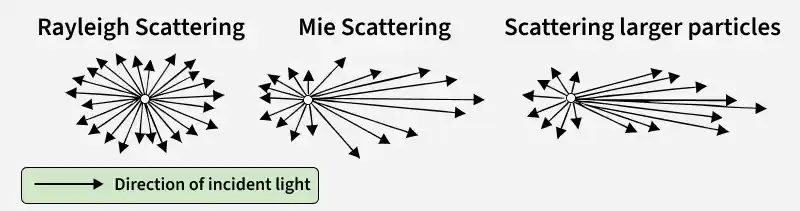
Rayleigh scattering is the scattering of light by very small particles, where shorter wavelengths scatter more than longer wavelengths.
Mie scattering occurs when the size of particles in the atmosphere is nearly equal to the wavelength of light. It usually takes place in the lower atmosphere where larger particles such as dust, smoke, and pollen are present, and it scatters all wavelengths almost equally.
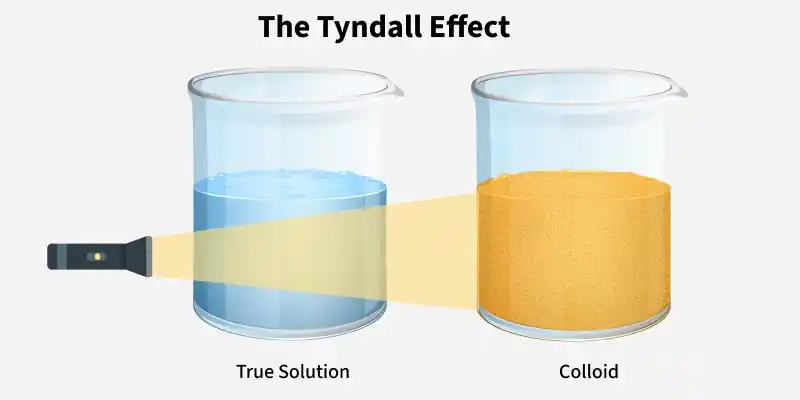
The Tyndall effect is the scattering of light by fine particles such as smoke, dust, or tiny water droplets suspended in a medium, which makes the path of light visible.
The color of scattered light depends on particle size:
Common observations of the Tyndall effect include:
Raman effect is the inelastic scattering of light in which photons interact with molecules and exchange energy, resulting in a change in the energy of scattered light. This leads to the formation of Stokes and anti-Stokes lines.
The sky appears blue due to scattering of sunlight by tiny particles in the atmosphere. Blue light, having a shorter wavelength, scatters more strongly than other colors. Hence, blue light spreads in all directions, making the sky look blue.
Red light has the longest wavelength, so it scatters the least in dust, smoke, or fog. Hence, it travels farther and is clearly visible from a long distance, making it suitable for danger signals.
During sunrise and sunset, sunlight travels a longer path, so shorter wavelengths scatter away. Longer wavelengths like red reach our eyes, making the Sun appear reddish. At noon, less scattering occurs, so the Sun looks white.
Clouds appear white because their large water droplets scatter all colors of sunlight equally. When these colors combine, they appear white to our eyes.
Question 1: Why does sunlight appear white when the Sun is overhead but red during sunrise and sunset?
Solution:
- When the Sun is overhead, sunlight travels a shorter distance through the atmosphere, so only a small amount of shorter-wavelength blue and violet light is scattered. Most wavelengths reach our eyes, making the Sun appear white.
- At sunrise and sunset, sunlight travels a longer path through the atmosphere. Most of the blue and violet light is scattered out, leaving longer wavelengths (red and orange), which makes the Sun appear reddish.
Question 2: How does the size of particles in a medium affect the color of scattered light? Give examples.
Solution: Smaller particles scatter shorter wavelengths (blue) more efficiently, while larger particles scatter longer wavelengths (red) or even appear white.
- Example : Air molecules scatter blue light, giving the sky its color.
- Example : Mist or smoke with larger water droplets may scatter white light, making the path of sunlight visible as a bright beam.
Question 3: A colloidal solution scatters light of wavelength 500 nm. Another wavelength of 600 nm is also present. Using p ∝ 1/λ4, find the ratio of scattered intensity of 500 nm light to 600 nm light.
Solution: Rayleigh's law states:
Question 4: Sunlight contains blue (450 nm) and green (550 nm) light. Using Rayleigh’s law, calculate how many times more blue light is scattered than green light.
Solution: According to Rayleigh's law:
Question 1. Explain why the sky appears blue during the day and why it turns red during sunrise and sunset.
Question 2. Describe how the size of particles affects the color of scattered light. Give two examples from daily life.
Question 3. Explain why some people have blue eyes using the Tyndall Effect.
Question 4. Blue light has a wavelength of 450 nm, and red light has a wavelength of 650 nm. Using Rayleigh’s law p ∝ 1/λ4, calculate how many times more blue light is scattered than red light.
Question 5. A colloidal solution scatters light of wavelengths 500 nm and 600 nm. Calculate the ratio of the scattering intensity of 500 nm light to 600 nm light.