|
VOOZH | about |
|
VOOZH | about |
In today's world, we need speed in our work along with efficiency. To achieve both of them using a Japanese technique called Kanban. It is a tool that is been making waves in all sorts of industries, not just the tech ones. So, what's the deal with Kanban? It started in the car company, but now it is everywhere.
Table of Content
In Japanese Kanban means "visual board". It's all about managing the work by actually seeing what's going on. It's super handy for keeping track of what everyone's doing and spotting any hold-ups before they become big headaches.
Implementing Kanban is straightforward, requiring no significant modifications to existing processes. The method depends on a visual framework, typically represented by a board divided into columns. These columns reflect various stages of task completion, such as "To Do," "In Progress," and "Done." This setup offers immediate insight into the workflow and task statuses.
As teams adapt to Kanban, they may customize their boards with additional columns or rules, tailoring the system to their specific needs.
Kanban boards can be physical (like whiteboards) or digital (using tools like Trello). While physical boards are simple and tangible, digital boards offer advantages like remote collaboration and easier modifications.
These principles lead to practices like visualizing workflows, managing workloads, and continuous collaborative improvement.
The visual nature of a Kanban board is incredibly l for several reasons:
Visualization is a key aspect of the Kanban method and it's incredibly helpful for several reasons. Let's break it down into simple terms:
Imagine a large board in your workspace, physical or digital, with neatly arranged columns and cards. Each card represents a task, and the columns signify different stages like "To Do," "In Progress," and "Done." This is your Kanban board, a visual roadmap of your work. You can instantly grasp the workflow – tasks pending, in progress, and those completed. It's a refreshing change from sifting through lengthy lists or reports.
With a Kanban board, you can easily move tasks (cards) from one column to another as work progresses. This is like playing a board game where you move pieces along the board. It makes it super clear to see how tasks move from start to finish.
Spotting issues becomes straightforward. A cluster of cards in one stage, say "In Progress," flags a bottleneck. It’s akin to noticing a traffic jam – you immediately know where the problem lies and can start troubleshooting.
Overburdened team members stand out on a Kanban board, similar to someone struggling with too many groceries. This visibility makes it easier to redistribute tasks and balance the workload, ensuring no one is overwhelmed.
With a Kanban board, the entire team has a communal view of the workflow. It's like a collective strategy chart for a sports team – everyone is on the same page, drastically reducing the need for constant meetings or update emails.
The Kanban board is inherently adaptable. New tasks or changes can be incorporated seamlessly, much like updating a to-do list on the go. This flexibility ensures that the workflow remains relevant and responsive to the team's needs.
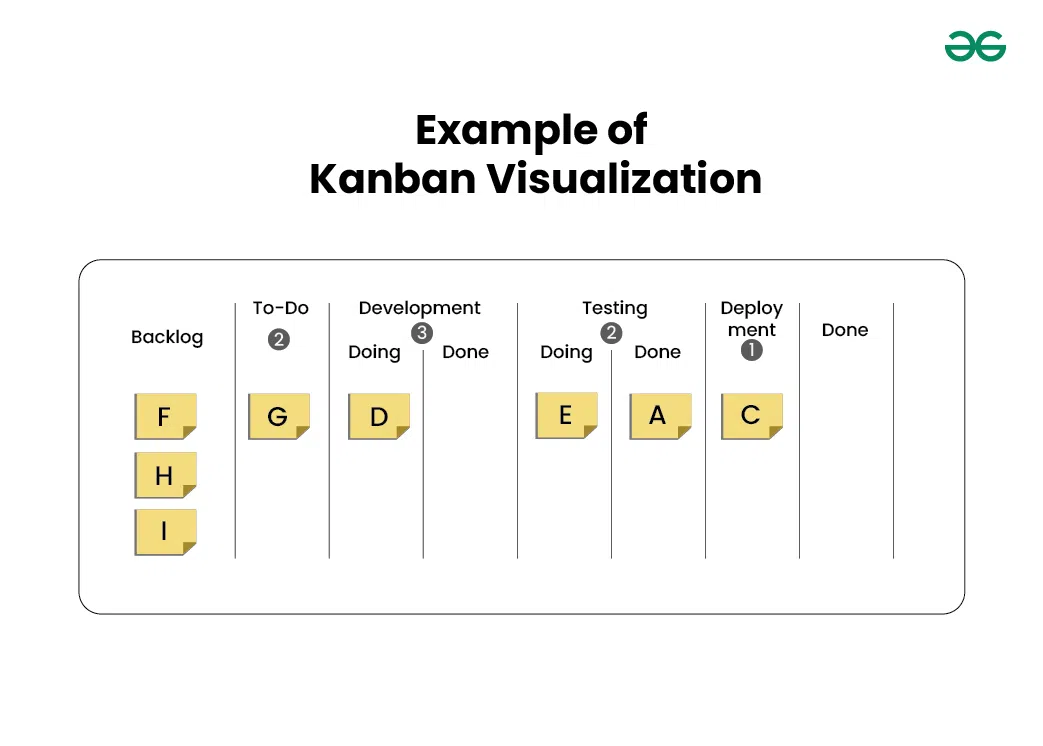
Here is a simple Kanban board to illustrate how visualization aids in the Kanban process.
The above Kanban board is divided into three columns, 'To-Do','In Progress', and 'Done'. Each task is represented by a sticky note, making it easy to see at a glance what needs to be done, what is currently being worked on, and what has already been completed.
By using this simple yet effective tool, teams can manage their workflow more efficiently, leading to increased productivity and better project management.
Kanban has truly revolutionized the way teams handle their workflows, significantly enhancing productivity across various sectors. Its core strength lies in visualizing tasks and effectively managing work progress, which in turn fosters a culture of continuous improvement. Adopting Kanban can be a game-changer for teams in any field, introducing a more streamlined and agile approach to their work.