|
VOOZH | about |
|
VOOZH | about |
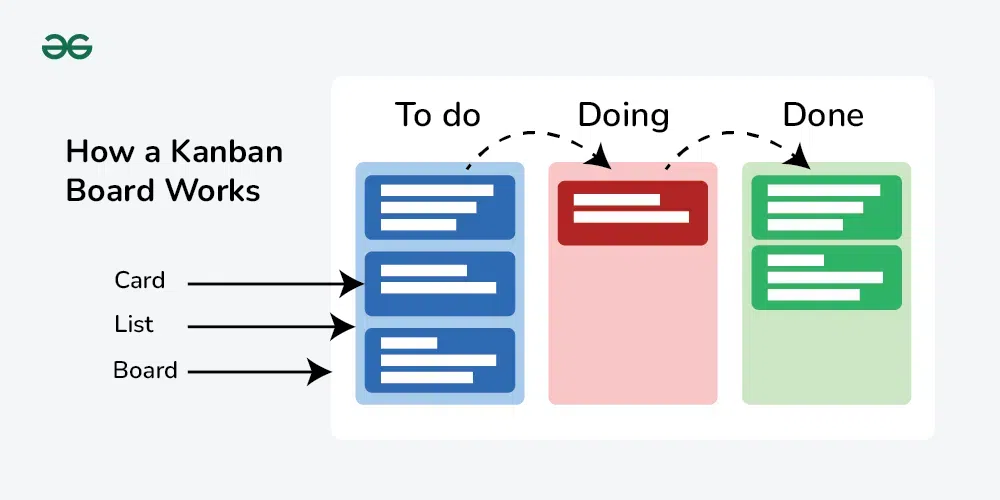
Kanban is one of the project management methodologies under the Agile Framework. It mainly focuses on the continuous delivery of the project rather than delivering the project at the end of the sprint. Also, it follows a visual approach in which tasks are managed and executed using visual cards. All these visual cards are managed using a digital board called the Kanban Board. Thus, it allows the teams to practice the agile principles of project management with a more adaptive and dynamic workflow.
Table of Content
A Kanban pull-system approach is a demand-centric approach in which the project tasks are taken into progress when there is an actual need for it.
Kanban’s pull system is one of the great ways to practice the Agile Principles that help the users to track and reduce waiting time along with preventing team burnout. Thus, the team takes up the work only as much as they can manage. Generally, there are four main steps through which Kanban promotes the Pull system Approach namely. They are workflow visualization, WIP Limits, the Pull System, and finally, the implementation of the Pull Signals.
In Kanban, the project is broken down into smaller processes that contain multiple tasks. These multiple tasks are visualized in the Kanban board using the columns and swimlanes. Each task contains essential information such as the assignee, task type and deadline. These tasks are moved from left to right on the board according to the progress of the project.
We can also relate workflow visualization to a term called ‘Value Stream Mapping,’ which is a Lean Manufacturing technique to analyze and manage the flow of materials. However, in the Kanban, the "Value Stream Mapping" outlines the definition of various processes, their states and their transition throughout the project lifecycle. So, the Pull System starts with the identification of the process flow.
The project team has a particular capacity to take the tasks under execution and, your work will get stuck if there are too many tasks, more than the team’s capacity. Thus, Kanban allows us to limit the number of tasks in each column so that the team can manage the work according to their capacity.
In addition to this, WIP Limits also reduce the risks of task switching which happens when there are a lot many tasks to do in the project. Team members switch from one task to another to meet deadlines but indeed, they end up with a complex workflow. Hence, WIP helps them in preventing this.
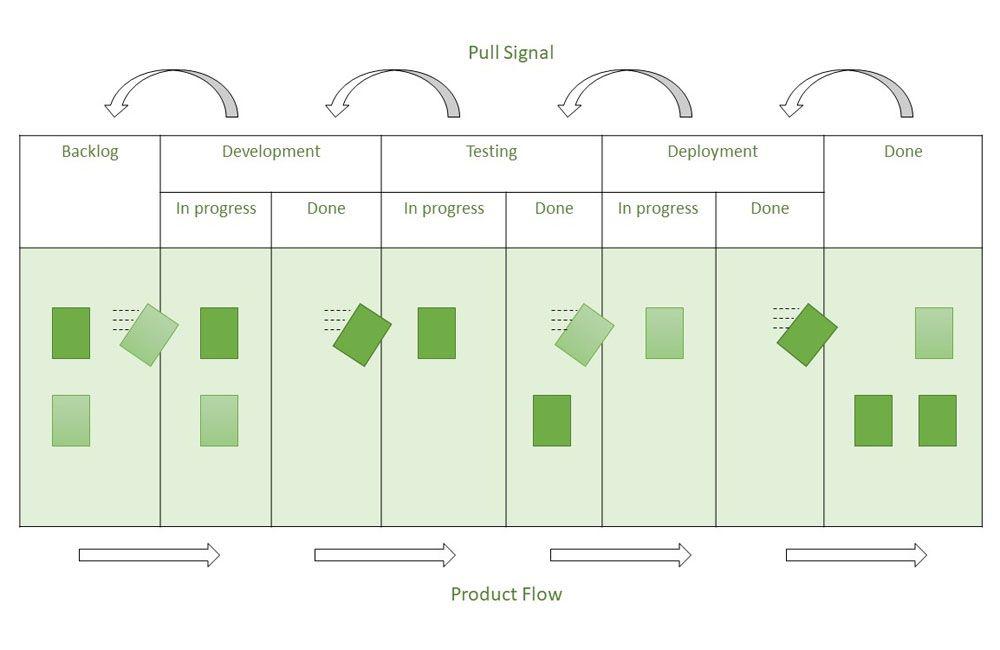
Kanban’s Pull System can be observed in two ways. First, the tasks are moved into the various processes from left to right in the Kanban board. For example, swimlanes containing the task or issues can move between the columns, from ‘To-do’ to ‘In-progress’ and finally to ‘Done.’ Another form of Pull System is between the backlog list and the Kanban board. Backlog maintains the upcoming tasks that are pulled into the Kanban board when they are needed or when team capacity allows them.
Both these scenarios form Kanban’s Pull System approach in which the primary goal is to take up the task only when there is a requirement. This approach is similar to the old Kanban technique that is used in Manufacturing systems to supply and produce only whenever market demand occurs. This helps reduce waste and increase resource utilization.
Pull Signals are the triggers that tell us that the number of tasks in the column is less than the WIP limit. Therefore, more tasks can be pulled into the workflow. The pull signal can be applied to the previous column to indicate that the task can move further. Along with this, it can also be applied to pull tasks from the backlog when they are required.
One important use of the pull signals is to handle the dependencies among the various subtasks. If the execution of a task requires another task to be completed first, we can easily apply the pull signals for the task in the backlog. Also, we can ensure that no task remains neglected. Thus, the approach to handling the dependency becomes structured and efficient.
Parameter | Pull-System Approach | Push-System Approach |
|---|---|---|
Task Prioritization | It prioritizes tasks based on requirements to prevent work overload | This approach lists all tasks at once which slows down the process. |
Customer Value | It can deliver better customer value as tasks are prioritized. | It focuses less on end-user experience. Thus, it cannot create much customer value. |
Adaptability | It allows us to improve adaptability with continuous delivery and real-time requirements. | This is less efficient in handling continuous delivery and real-time changes |
Efficiency for Agile Teams | It enables Agile teams to be more adaptable and efficient | Push System is less efficient in fulfilling the dynamic needs of Agile teams |
Real-time Project Management | It allows for real-time updates and scalability to multiple teams | There is limited functionality for real-time updates and project scaling |
Workload Management | It is capable of controlling workload by limiting the number of tasks in the workflow | It may lead to work overload as all tasks are pushed into the workflow |
Kanban’s pull-system approach to work focuses on keeping the relevant and required tasks under execution and keeping the irrelevant things away from our project. Therefore, you can achieve the project targets in a shorter time by allowing the tasks to flow between the business processes in the pull System.