|
VOOZH | about |
|
VOOZH | about |
A zero matrix, or null matrix, is a matrix whose all elements are zeros. A matrix is defined as a rectangular array of numbers that are arranged in rows and columns. The size of a matrix can be determined by the number of rows and columns in it. A matrix is said to be an "m by n" matrix when it has "m" rows and "n" columns and is written as an "m × n" matrix. For example, the matrix given below is a "2 × 3" matrix, i.e., a matrix that has two rows and three columns. We have different types of matrices, such as rectangular matrices, square matrices, triangular matrices, symmetric matrices, etc.
Table of Content
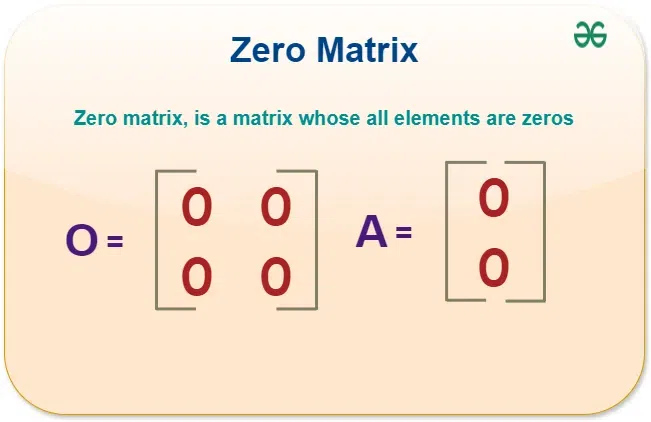
A zero matrix, or null matrix, is a matrix whose all elements are zeros. As a null matrix has all zeros as its elements, it is referred to as a zero matrix. A zero matrix can be a square matrix, or it can also have an unequal number of rows and columns.
A zero matrix is represented as "O." If we add a zero matrix to another matrix A of the same order, then the resultant matrix is A. So, a zero matrix is known as the additive identity of that particular matrix. The matrix given below represents a zero matrix of order "m by n."
Some common examples of zero matrices of the different orders are given below:
Important properties of a Zero Matrix are:
A + O = O + A = A
A × O = O × A = O
A − A = O
When a zero matrix of order "m by n" is added to another non-zero matrix A of the same matrix, then the resultant matrix is A.
Let A = [aij]m×n be a non-zero matrix and O be a zero matrix of order "m by n," then
A + O = O + A = A
Example:
Example 1: Give an example of a zero matrix that has three rows and four columns.
Solution:
Order of a zero matrix that has three rows and four columns is "3 × 4" and all its elements are zero. The matrix given below represents a zero matrix of order "3 × 4."
O3×4 =
Example 2: Prove that if the product of two matrices is a zero matrix, then one of the matrices doesn't need to be a zero matrix.
Solution:
Let A = and B = be two non-zero matrices.
A × B =
A × B = = O
Hence proved.
Example 3: Prove that a zero matrix is a singular matrix.
Solution:
To prove that a zero matrix is a singular matrix, let us consider a zero matrix of order "2 × 2."
O2×2 =
We know that,
The determinant of a matrix = ad - bc
So, the determinant of O2×2 = 0 × 0 - 0 × 0 = 0 − 0 = 0
We know that a singular matrix is a matrix whose determinant is zero. As the determinant of a zero matrix is zero, a zero matrix is a singular matrix.
Hence proved.
Example 4: Prove that the additive identity of A = is a zero matrix.
Solution:
To prove that, additive of the given matrix A is a zero matrix, we need to prove that
A + O = A
Given matrix A =
=
= \left[\begin{array}{ccc} 1 & 5 & 9\\ 2 & 8 & 3 \end{array}\right] = A
Hence proved.