|
VOOZH | about |
|
VOOZH | about |
In this article, we will demonstrate how to create a simple RESTful Employee Management Application using Micronaut. This article will guide you through saving employee information in a database and handling HTTP requests using Micronaut's powerful features. We will compare Micronaut with Spring Boot to highlight key differences and use cases.
Micronaut is a JVM-based framework designed for developing lightweight, modular applications. Developed by Oracle Cloud Infrastructure (OCI), it simplifies the process of building microservices by offering faster startup times, reduced memory usage, and more efficient performance compared to other frameworks like Spring Boot.
Micronaut shines in specific environments, and here are a few key scenarios where it excels:
This example walks through building a simple Employee Management API that allows users to save employee details in a database.
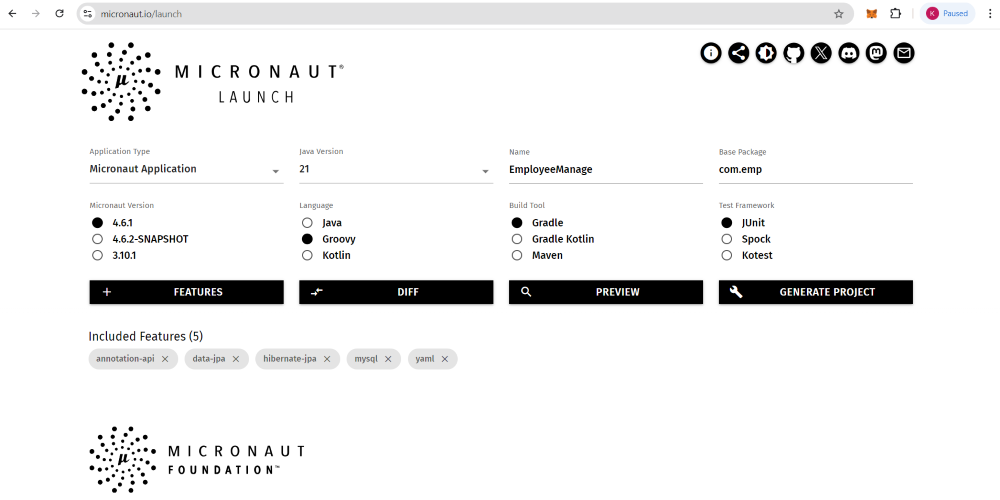
Go to Micronaut Launch and create a Micronaut project. Download the ZIP file, extract it, and open it in IntelliJ IDEA or your preferred IDE.
Open Micronaut Project in Intellij IDEA IDE.
This domain class represents the Employee entity, which will be used to map the employee data to the database.
The EmployeeRepository provides basic CRUD operations for the Employee entity by extending JpaRepository.
This DTO (Data Transfer Object) is used to receive the employee information from the client in the API request.
This DTO is used to send the employee data back as a response after saving the employee to the database.
The service class handles the business logic, such as converting the DTO to an entity and saving it to the database.
The EmployeeController class defines the API endpoint /api/employee/save to handle HTTP POST requests for saving employee details.
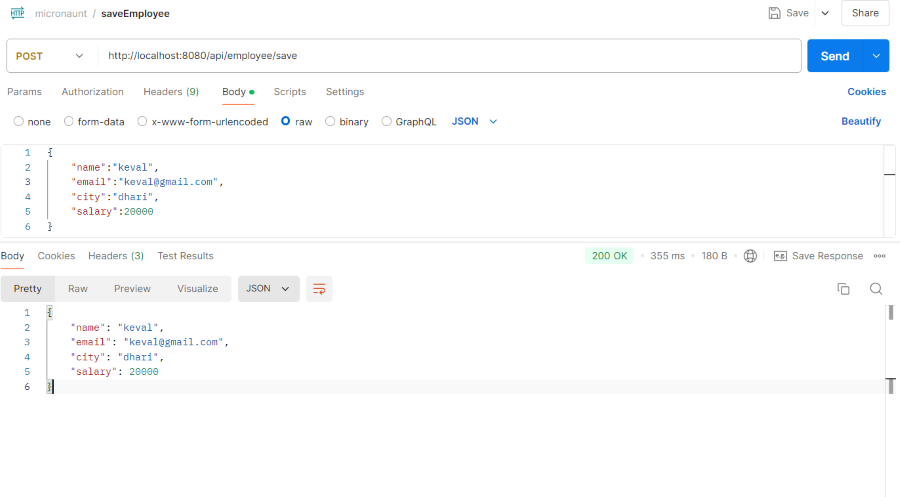
Run the application and test the API using Postman. Use a POST request with the following URL:
http://localhost:8080/api/employee/saveProvide the employee details in JSON format in the request body and check the response.
Features | Micronaut (AOT Compilation) | Spring Boot (Runtime Reflection) |
|---|---|---|
Startup Time | Faster, due to compile-time dependency injection | Slower, as it relies on runtime reflection |
Memory Footprint | Smaller | Larger |
Dependency Injection | Compile-time | Runtime reflection |
Reactive Programming | Natively supported | Supported, but with more setup complexity |
Configuration | Less verbose, simpler setup | Requires extensive annotations and configurations. |
Performance | Highly optimized for microservices | Optimized but heavier due to runtime ops |
Community | Smaller community | Larger community |
Documentation | Well-written records | Outstanding record-keeping |
In this article, we have created a simple employee management API using Micronaut with a detailed comparison of its features against Spring Boot. Micronaut's fast startup times and low memory usage make it a great choice for microservices, serverless, and cloud-native applications.