|
VOOZH | about |
|
VOOZH | about |
Java Persistence API (JPA) can facilitate the development of Java applications by providing a framework for managing relational data in Java applications and JPA is one of the key concepts in entities. Entities can represent and use persistent data stored in a relational database map to corresponding database tables.
JPA entities are Java classes that can be mapped to database tables and these classes define the structure of the data and act as a bridge between the object-oriented world of Java and the relational world of the database.
Steps to Create a JPA Entity:
We can develop a simple JPA project that can use entity and address entity mapped both of entities that can save the user data into the MYSQL database.
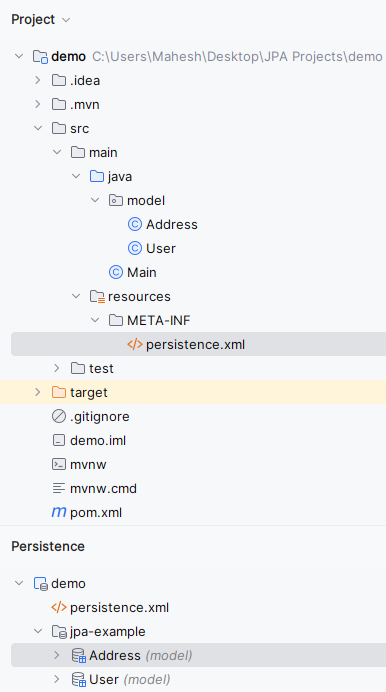
Step 1: Create the new JPA project using the InteljIdea named as a demo once create the project then the file structure looks like the below image.
Step 2: Open the open.xml and add the below dependencies into the project.
Step 3: Open the persistence.xml and put the below code into the project and it can configure the database of the project.
Step 4: Create the Java package named as the model in that package create the Java class named as the User.
Go to src > main > java > model > User and put the below code.
Step 5: Create the one newer Java class named as the Address.
Go to src > main > java > model > Address and put the below code.
Step 6: Create the Main class and put the below code for the Entity manager of the class.
Go to src > main > java > Main and put the below code.
pom.xml:
Step 7: Once the project is completed, run the application then show the User and address as output. Refer the below image for the better understanding of the concept.
If we follow the above procedure, then we can successfully build the JPA application of the demonstration of the Entity Concept of the JPA.
JPA entities are the fundamental building blocks for the developing the Java applications with database interaction and understanding the entities is the crucial for the effective utilization of the JPA in application development. By following the proper steps and utilizing the appropriate annotations and developers can be seamlessly integrate the entities into the application therefore the improving the code maintainability and database interaction efficiency.