Scaling laws in AI are simple rules that describe how the performance of an AI model changes when the model becomes bigger or trained with more data. They show how key factors like the number of model parameters, the size of the training dataset or the amount of computing power affect the model’s accuracy or error.
These laws help predict how improving one or more of these factors will affect the AI’s capabilities making it easier to plan and build better systems.
Scaling laws in AI describe how model performance improves as factors like model size, training data or compute increase.
Mathematically, scaling laws often follow a power-law form:
is the dependent variable such as a performance metric (e.g., accuracy, loss or capability).
is the independent variable, representing a size factor like dataset size, model parameters or compute power.
(alpha) is the scaling exponent that indicates how rapidly performance changes as the size factor increases.
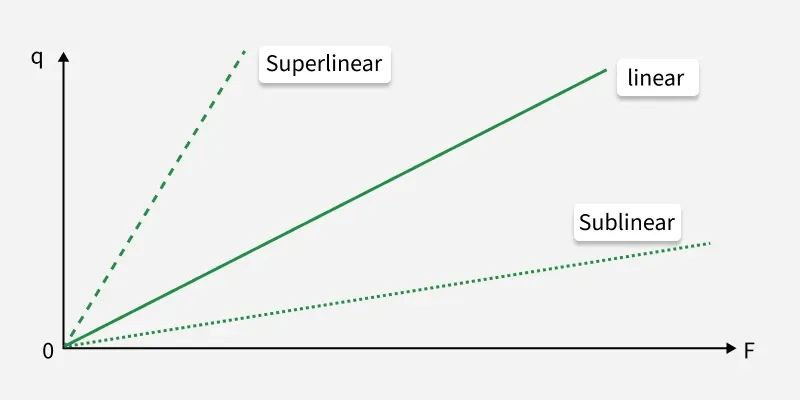
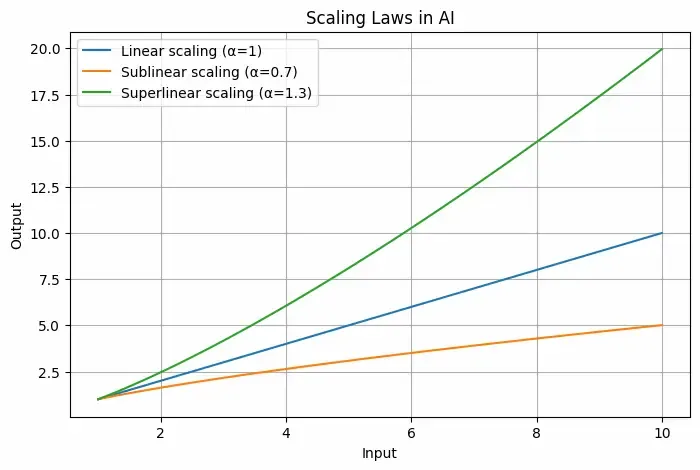
Linear scaling means the output increases in direct proportion to the input. If we double the input, the output also doubles. It shows a simple, balanced relationship between input and output.
Efficiency stays the same as the system grows.
Linear scaling is rare for performance gains but common for resource usage like compute and memory.
Example: If a computer processes 100 images in 1 second, it will process 200 images in 2 seconds.
2. Sublinear scaling ()
Sublinear scaling happens when the output still increases as the input grows, but at a slower rate. In this case, doubling the input does not double the output—the gains get smaller as we add more.
Very common in AI and machine learning.
Known as the “law of diminishing returns.”
Example: Doubling parameters still improves accuracy, but less than before because the model is already quite capable.
3. Superlinear scaling ()
Superlinear scaling occurs when the output grows faster than the input. Here, even a small increase in input can create a much larger increase in output.
Rare, but powerful when it happens.
Often seen as “emergent abilities” in very large AI models.
Example: A huge jump in model size and data can suddenly give the model new skills that smaller models didn’t have.
Importance of Scaling in AI
Predict Performance: Scaling laws help estimate how much better an AI model will perform when using more data, larger models or extra compute.
Guide Resource Allocation: They inform whether adding more data, parameters or compute is cost-effective and worthwhile.
Optimize Model Design: Scaling laws show whether to focus efforts on increasing model size, gathering more data or improving training techniques.
Reduce Training Risks: By predicting outcomes from smaller-scale experiments, they lower the risks and costs associated with training very large models.
Enable Breakthroughs: Scaling has driven major advancements and emergence of new AI capabilities by pushing the boundaries of model size and data use.
Implementation
This code demonstrates how different scaling laws affect the relationship between an input variable X and an output variable Y, where Y changes according to a power-law function with different exponents ().
Step 1: Import Libraries
We will import the required libraries,
numpy: A numerical computing library used here to create arrays of evenly spaced values.