Acetaldehyde Formula - Structure, Properties, Uses, Sample Questions
Last Updated : 30 Jul, 2024
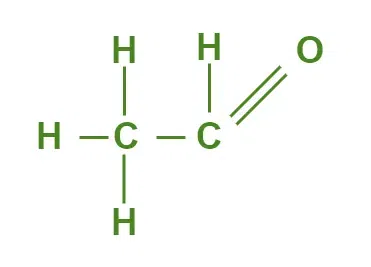
Acetaldehyde also known as Ethanol is a chemical compound that has the formula CH3CHO. Chemists sometimes abbreviate it as MeCHO, where 'Me' stands for methyl. Acetaldehyde is a very significant aldehyde. It is manufactured on a big scale in a variety of sectors. Acetaldehyde is found in a variety of foods, including coffee, bread, and ripe fruit, and is produced by plants.
Acetaldehyde dissolves quickly in naphtha, gasoline, xylene, ether, turpentine, alcohol, and benzene. It's a colourless, flammable liquid with a stifling odour. Although acetaldehyde is non-corrosive to many metals, its narcotic impact might provoke mucosal irritation.
Acetaldehyde has the chemical formula CH3CHO or C2H4O. 44.053 g mL-1 is the molar mass. The acetaldehyde molecule contains the normal functional group of an aldehyde H-C=O linked to a methyl group (-CH3), making it the second most simple aldehyde after formaldehyde.
Furthermore, the C atom from the aldehyde has a hybridization sp2, whereas the methyl group has sp3, resulting in a molecule with planar-trigonal and tetrahedral geometry.
Acetaldehyde is a white liquid with a strong odor.
Furthermore, its boiling point is 20.20°C, and its melting point is -123°C.
It has a density of 0.784 g mL-1.
Acetaldehyde, on the other hand, is soluble in miscible water, ethanol, benzene, acetone, and toluene.
It is also mildly soluble in chloroform.
Chemical Properties of Acetaldehyde
Some chemical properties of Acetaldehyde are:
Acetaldehyde has chemical characteristics comparable to formaldehyde.
It is used as an electrophile precursor in organic synthesis.
Condensation reactions provide intermediates such as pentaerythritol, which can be utilized in chemical synthesis.
It may also be used to make hydroxyethyl derivatives via a reaction with a Grignard reagent.
Acetaldehyde is a building block used in the production of heterocyclic compounds such as imines and pyridines.
Preparation of Acetaldehyde
The approach used nowadays is the Wacker process, which uses copper or palladium as a catalyst to hydrate acetylene or ethylene :
2CH2=CH2 + O2 → 2CH3CHO
Before the Wacker method, acetaldehyde was synthesized by the hydration of acetylene with the use of mercury (II) salts as a catalyst :
C2H2 + Hg2+ + H2O → CH3CHO + Hg
The reaction is carried out at 90-95°C, and the produced acetaldehyde is isolated from water and mercury and cooled to 25-30°C.
Another approach is ethanol oxidation, which involves partial dehydrogenation of ethanol in the presence of copper as a catalyst to yield acetaldehyde,
CH3CHO + H2 + CH3CH2OH
Ethanol vapor is carried through this process at temperatures ranging from 260 to 290°C.
Uses of Acetaldehyde
Acetaldehyde is a compound which has great significant in our life. Some of its common uses are:
Acetaldehyde is largely utilized in the manufacture of other chemicals.
It is utilized in the production of acetic acid.
It is used in the production of various polymer resin.
It is used in the production of disinfectants, pharmaceuticals, and fragrances.
It is used in the production of polyvinyl acetate.
It is used to make pyridine derivatives, crotonaldehyde, and pentaerythritol.
Acetaldehyde is also employed as a preservative for fruit and fish in the production of vinegar, yeast, and other products.
It is employed as a solvent in several industrial processes such as papermaking, tanning, and rubber production.
It is also used in the manufacture of n-butyraldehyde.
It is used in the tanning of leather, as an alcohol denaturant, in fuel mixes, and as a hardener for gelatin fibers, glue, and casein products.