|
VOOZH | about |
|
VOOZH | about |
Atoms are the basic units of matter, but most atoms do not exist independently in nature. They combine with other atoms to form molecules and compounds. The force that holds atoms together in a molecule or compound is called a chemical bond. Chemical bonding occurs because atoms try to achieve a more stable electronic configuration, usually by completing their outermost shell (octet rule).
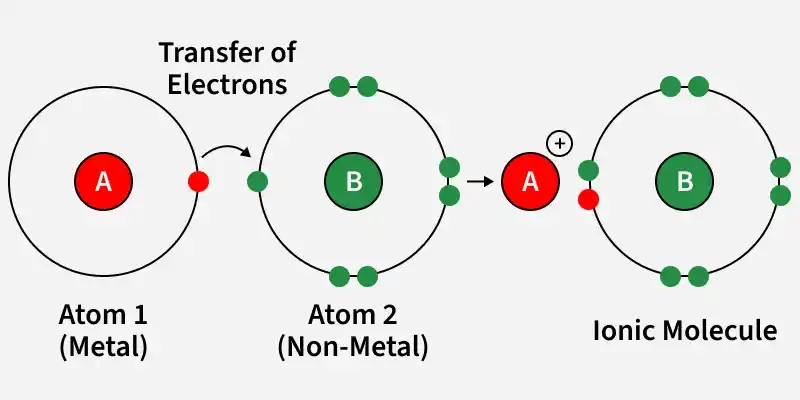
👁 transfer_of_electronsAn ionic bond or electrovalent bond is a type of chemical bond formed when one atom completely transfers one or more electrons to another atom. This transfer of electrons usually happens between a metal and a non-metal.
Example: Formation of NaCl
Ionic bonds are formed by the complete transfer of electrons, resulting in positively and negatively charged ions. Because of the strong electrostatic attraction between these ions, ionic compounds show the following properties:
1. High Melting and Boiling Points
Example: NaCl melts at about 801°C.
2. Hard and Brittle Nature
Example: Common salt (NaCl) crystals break easily when hit.
3. Solubility in Water
Example: NaCl dissolves in water.
4. Electrical Conductivity
Example: Molten NaCl conducts electricity.
5. Formation of Crystalline Solids
6. Strong Electrostatic Forces
Example:
MgO has stronger ionic bond than NaCl (because Mg²⁺ and O²⁻ have higher charges).
The formation of an ionic bond depends on several important factors that make electron transfer possible and stable.
1. Low Ionisation Energy
Example:
Sodium (Na) easily loses one electron:
Na → Na⁺ + e⁻Because Na has low ionisation energy, ionic bond formation becomes easier.
2. High Electron Affinity
Example:
Chlorine (Cl) gains one electron:
Cl + e⁻ → Cl⁻Chlorine has high electron affinity, so it readily forms Cl⁻ ion.
3. Large Difference in Electronegativity
Example:
Na (low electronegativity), Cl (high electronegativity) → Forms ionic bond in NaCl.
4. High Lattice Energy
5. Stable Electronic Configuration (Octet Rule)
Example:
Na (2,8,1) → becomes 2,8 after losing 1 electron.
Cl (2,8,7) → becomes 2,8,8 after gaining 1 electron.Both become stable.
An ionic bond is formed when one atom completely transfers one or more electrons to another atom. This usually happens between a metal and a non-metal.
The formation of an ionic bond takes place in three main steps:
The metal atom loses one or more electrons to become a positively charged ion.
Metals have:
The non-metal atom gains the electron lost by the metal and becomes negatively charged.
Non-metals have:
Now the oppositely charged ions attract each other due to strong electrostatic force. This attraction forms the ionic bond.
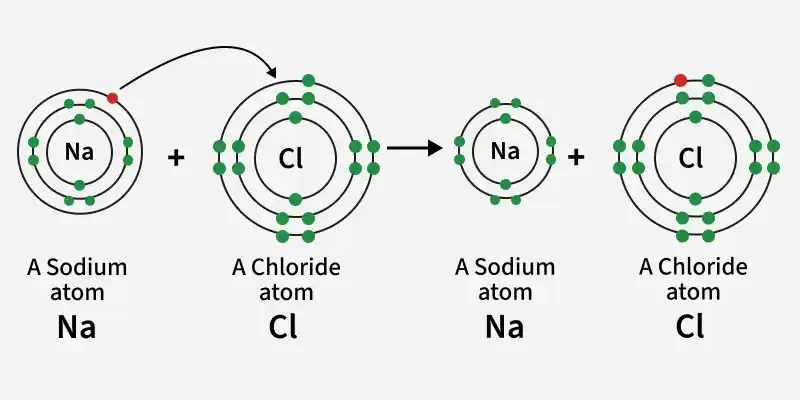
In NaCl, sodium (Na), a metal, loses one electron to achieve a stable noble gas configuration, while chlorine (Cl), a non-metal, gains that electron to complete its octet. The resulting oppositely charged ions (Na⁺ and Cl⁻) are held together by strong electrostatic forces of attraction, forming a stable ionic lattice.
Both want to achieve stable noble gas configuration (octet).
b) Loss of Electron by Sodium
Sodium easily loses one electron because it has low ionisation energy.
Na → Na⁺ + e⁻
Now sodium becomes stable like Neon.
c) Gain of Electron by Chlorine
Chlorine needs one electron to complete its octet.
Cl + e⁻ → Cl⁻
Now chlorine becomes stable like Argon.
d) Formation of Ionic Bond
Now Na⁺ and Cl⁻ are oppositely charged ions.
Na⁺ (+ charge)
Cl⁻ (– charge)
They attract each other due to strong electrostatic force.
Na⁺ + Cl - → NaCl
This attraction forms the ionic bond.
There are various compounds which are formed by ionic bonds and these compounds are called ionic compounds. Various examples of the ionic bond are discussed in the table below,
| Compound | Cation | Anion | Reaction | Electronic Configuration |
|---|---|---|---|---|
| NaCl | Na+ | Cl- |
|
|
| CaCl2 | Ca2+ | 2Cl- |
|
|
| CaO | Ca2+ | O2- |
|
|
Ionic Bond | Covalent Bond |
|---|---|
| Ionic bonds are formed by the attraction of positive and negative ions in a crystal, and compounds held together by ionic bonds are known as ionic compounds. | When two atoms share one or more electron pairs, they form a covalent bond. Each atom contributes an equal number of electrons to the formation of the bond. |
| In the formation of ionic bonds cations and anions are formed and held together by electrostatic attraction. | No such intermediates are formed in the formation of covalent bonds. |
| Ionic bonds are formed between two atoms in which one atom is electronegative and the other is electropositive. | As atoms with higher ionization potential do not lose their valence electrons easily, they prefer to form covalent bonds by sharing electrons. |
| If the electronegativity difference between the atom is very high they form ionic bonds. For instance, bonds formed in the KCl compound. | If the electronegativities of the combining atoms are not significantly different, the bond formed between them is most likely covalent. For instance, bonds formed in the HCl compound |
Examples of the compound with ionic bonds are,
| Examples of the compound with covalent bonds are,
|