|
VOOZH | about |
|
VOOZH | about |
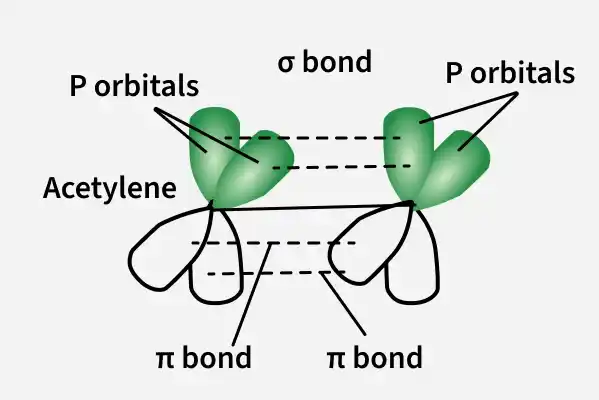
Alkynes are unsaturated hydrocarbons containing at least one carbon–carbon triple bond (C≡C). They have the general formula CnH2n-2. In alkynes, the carbon atoms involved in the triple bond are sp-hybridised and exhibit linear geometry with a bond angle of 180°. Due to the presence of multiple bonds, alkynes are more reactive than alkanes and undergo mainly addition reactions.
Alkynes are named according to the IUPAC system by considering the presence of a carbon–carbon triple bond in the parent chain.
| Formula | IUPAC name |
|---|---|
C2H2 | Ethyne |
C3H4 | Propyne |
C4H6 | Butyne |
C5H8 | Pentyne |
C6H10 | Hexyne |
C7H12 | Heptyne |
C8H14 | Octyne |
C9H16 | Nonyne |
C10H18 | Decyne |
Alkynes show structural isomerism due to different arrangements of carbon atoms and position of the triple bond.
Alkynes are non-polar hydrocarbons, so their physical properties are mainly governed by weak intermolecular forces.
Alkynes are reactive due to the presence of a carbon–carbon triple bond (two π bonds). They mainly undergo addition reactions.
1. Addition of Hydrogen (Hydrogenation)
Alkynes add hydrogen in the presence of catalysts (Ni, Pd, Pt) to form alkenes and then alkanes. Partial hydrogenation can give alkenes.
2. Addition of Halogens (Halogenation)
Alkynes react with halogens (Cl2, Br2) to form dihaloalkenes and then tetra haloalkanes.
3. Addition of Hydrogen Halides (Hydrohalogenation)
Addition of HX (HCl, HBr, HI) follows Markovnikov Rule, where hydrogen attaches to the carbon with more hydrogens.
4. Addition of Water (Hydration)
In the presence of acid and catalyst (HgSO4), alkynes form enols which rearrange to carbonyl compounds (aldehydes/ketones).
5. Oxidation
Alkynes are oxidised by KMnO₄ or ozone leading to formation of diketones or carboxylic acids depending on conditions.
6. Acidic Character of Alkynes
Terminal alkynes (–C≡CH) are weakly acidic and can form salts (acetylides) with strong bases or metals like sodium.
Alkynes are generally prepared by elimination reactions of dihalides or from simple inorganic compounds.
1. From vicinal dihalides (double dehydrohalogenation)
Vicinal dihalides have halogen atoms on adjacent carbon atoms. On heating with alcoholic KOH or strong bases, two molecules of HX are eliminated in two steps, first forming an alkene and then an alkyne.
2. From geminal dihalides
Geminal dihalides have both halogens on the same carbon atom. They also undergo double dehydrohalogenation to form alkynes.
3. Preparation of ethyne from calcium carbide
Ethyne is prepared by reacting calcium carbide with water.
4. From terminal alkynes (formation of higher alkynes)
Terminal alkynes (–C≡CH) are slightly acidic. They react with strong bases like sodium amide (NaNH₂) to form acetylide ions, which can further react with alkyl halides to form higher alkynes. This method is useful for chain extension (increasing carbon length)