|
VOOZH | about |
|
VOOZH | about |
A spontaneous process is one that takes place naturally under given conditions without continuous external intervention once initiated. For example, ice melting at room temperature or heat flowing from a hot object to a cold object are spontaneous processes. Spontaneity is related to the feasibility of a process, not its speed. Some spontaneous reactions may occur very slowly, while some non-spontaneous processes require energy to proceed.
In thermodynamics, processes are classified based on whether they occur naturally or require external energy.
A spontaneous process is one that occurs on its own under given conditions without continuous external energy.
Examples:
- Flow of heat from hot to cold body
- Melting of ice at room temperature
- Expansion of gas in a vacuum
A non-spontaneous process is one that does not occur on its own and requires external energy to take place.
Examples:
- Flow of heat from cold to hot body
- Freezing of water at room temperature
- Electrolysis of water
To understand Spontaneity properly, we use the concept of entropy. Entropy is a measure of the degree of disorder or randomness in a system. It tells us how spread out or disordered the particles are.
Entropy change is represented as ΔS.
For a reversible process:
Where:
Examples:
Melting of ice: Disorder increases, ΔS is positive, spontaneous at room temperature
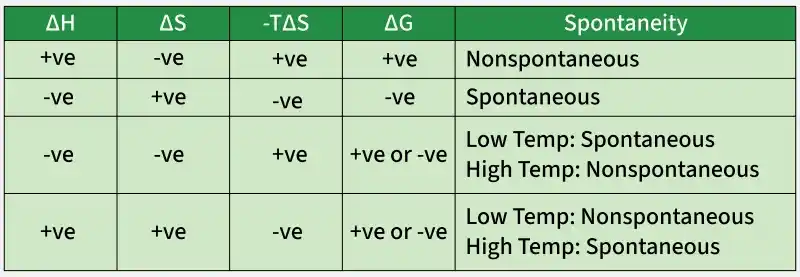
In Spontaneity, whether a process occurs naturally depends mainly on two important thermodynamic factors: enthalpy (ΔH) and entropy (ΔS).
Enthalpy represents the heat change during a reaction.
Example:
Combustion of fuel releases heat (ΔH < 0), so it is spontaneous.
Entropy measures the disorder of a system.
Example:
Melting of ice increases disorder, so ΔS > 0.
Temperature plays an important role in deciding spontaneity.
Gibbs Free Energy (G) is a thermodynamic quantity that helps us predict whether a chemical or physical process can occur spontaneously at constant temperature and pressure. It combines the concepts of enthalpy (ΔH) and entropy (ΔS) into a single term that indicates the “useful energy” available to do work.
The change in Gibbs free energy is given by the formula:
Where:
Example:
- Melting of ice at 0°C , ΔG = 0 (equilibrium)
- Melting of ice at 25°C , ΔG < 0 (spontaneous)
- Freezing of water at 25°C , ΔG > 0 (non-spontaneous)