|
VOOZH | about |
|
VOOZH | about |
Thermodynamics is a branch of physics that deals with energy, heat, work, and temperature and explains how thermal energy is transformed into other forms of energy. It studies the relationships between these quantities and their effects on the physical properties of matter.
Thermodynamics focuses on the principles that govern energy transfer and transformation within a system and examines a system’s ability to perform useful work on its surroundings. The behaviour of heat, work, temperature, and entropy is described by the four laws of thermodynamics, which provide a fundamental framework for understanding energy interactions.
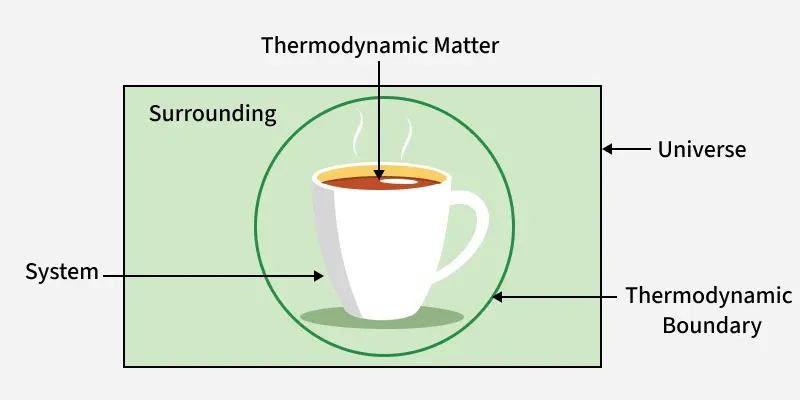
Creating a clear boundary makes thermodynamics much simpler. The "system" refers to everything contained within the boundary, and the "surroundings" refers to everything outside of it. Once the boundary diagram has been created, the flow across system boundaries can be used to describe the movement and transfer of energy. The word "universe" refers to both the surroundings and the system.
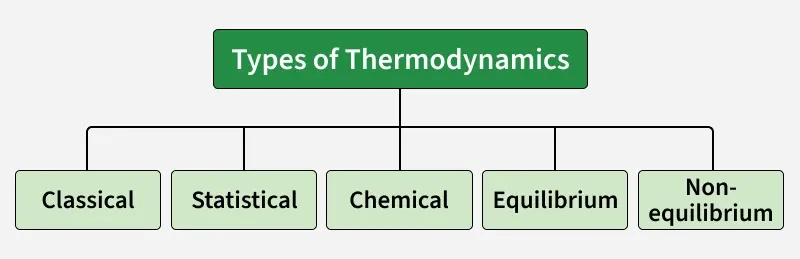
The study of Thermodynamics is classified into several branches listed below:
There are various concepts in thermodynamics, some of these concepts are explained as follows:
A collection of an extremely large number of atoms or molecules confined within certain boundaries such that it has certain values of pressure (P), volume (V) and temperature (T) is called a thermodynamic system.
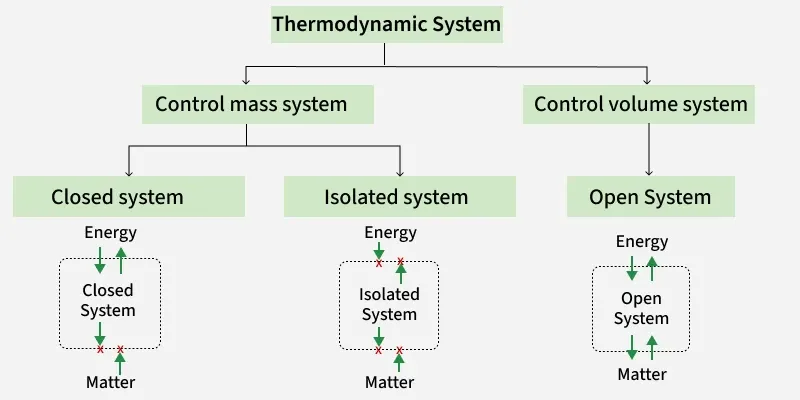
👁 thermodynamic_systemAnything outside the thermodynamic system to which energy or matter is exchanged is called its surroundings. Taking into consideration the interaction between a system and its surroundings, a system said to be an open system if it can exchange both energy and matter with its surroundings may be divided into three classes-
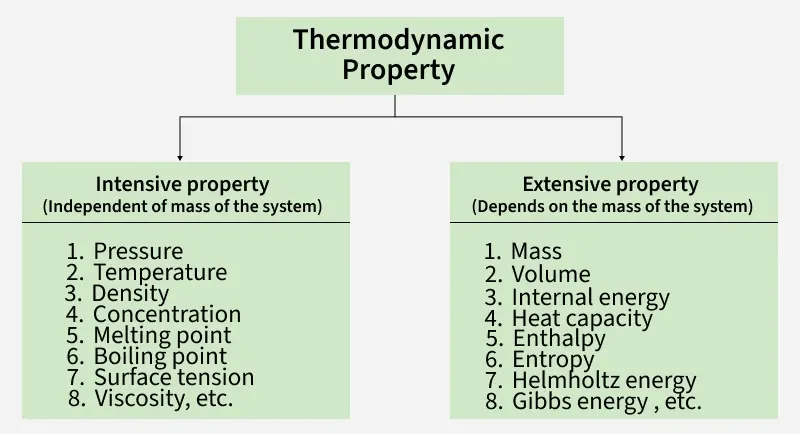
A thermodynamic system can be described by specifying its pressure, volume, temperature, internal energy, enthalpy, and the number of moles. These parameters or variables are called thermodynamic variables.
Thermodynamic variables are the measurable properties used to describe the state of a thermodynamic system.
1. Pressure (P):Pressure is the force exerted per unit area by the molecules of a system on its boundaries.
2. Temperature (T): Temperature indicates the degree of hotness or coldness of a system and determines the direction of heat flow.
3. Volume (V):Volume is the space occupied by a thermodynamic system.
4. Internal Energy (U): Internal energy is the total microscopic energy of a system due to the motion and interaction of its molecules.
5. Entropy (S): Entropy is a measure of the degree of disorder in a system and indicates the unavailability of energy for useful work.
6. Enthalpy (H): Enthalpy is the sum of internal energy and pressure–volume energy of a system. (H = U + P.V)
7. Gibbs Free Energy (G): Gibbs free energy represents the maximum useful work obtainable from a system at constant temperature and pressure.
8. Helmholtz Free Energy (A): Helmholtz free energy is the energy available to do work at constant temperature and volume.
9. Number of Moles (n): Mass or number of moles represents the amount of substance present in the thermodynamic system.
Thermodynamic equilibrium is a state of a system in which there is no net change occurs within the system over time i.e., the state of a thermodynamic system in which macroscopic properties such as temperature, pressure, and chemical composition, remain constant. There are different types of thermodynamic equilibrium:
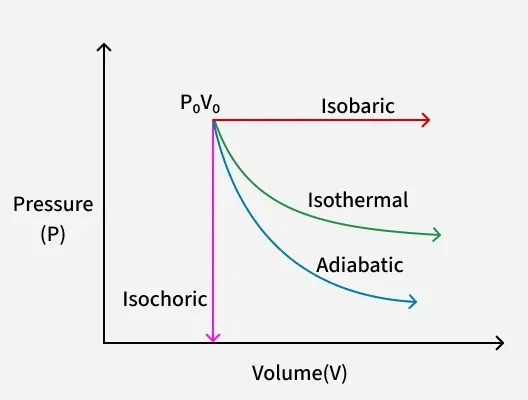
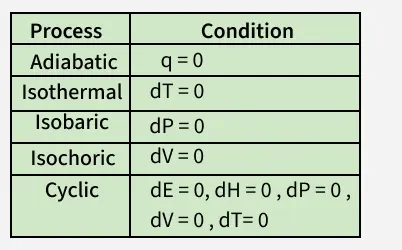
Any process in which the thermodynamic variables of a thermodynamic system change is known as the thermodynamic process.
The stored energy in a system is measured by its thermodynamic potentials. Potentials measure how a system's energy transforms from its initial state to its final one. Depending on the constraints of the system, such as temperature and pressure, different potentials are used.
Different forms of thermodynamic potentials are mentioned below:
In a thermodynamic system, energy is measured by enthalpy. Enthalpy is a measure of a system's total heat content and is equal to the system's internal energy plus the sum of its volume and pressure.
Enthalpy is a property or state function that resembles energy; it has the same dimensions as energy and is therefore measured in joules or ergs. The value of enthalpy is entirely dependent on the temperature, pr13essure, and composition of the system, not on its history.
Entropy is the measurement of the amount of thermal energy per unit of temperature in a system that cannot be used for useful work.
Entropy is a measure of a system's molecular disorder or randomness since work is produced by ordered molecular motion. Entropy theory offers a deep understanding of the direction of spontaneous change for many common events.
The laws of thermodynamics are fundamental principles that govern energy, heat, temperature, and entropy in a system. They explain energy transfer, transformation, and the conditions required for thermodynamic equilibrium, and apply universally to all physical and chemical processes.
There are four laws of thermodynamics, namely:
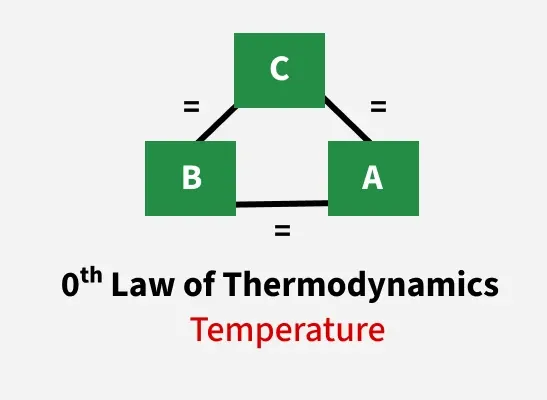
According to the Zeroth Law of Thermodynamics, if two bodies are separately in thermal equilibrium with a third body, then the first two bodies are likewise in thermal equilibrium with each other.
This indicates that if system A is in thermal equilibrium with system B, and system C is likewise in thermal equilibrium with system B, then both systems A and C are in thermal equilibrium.
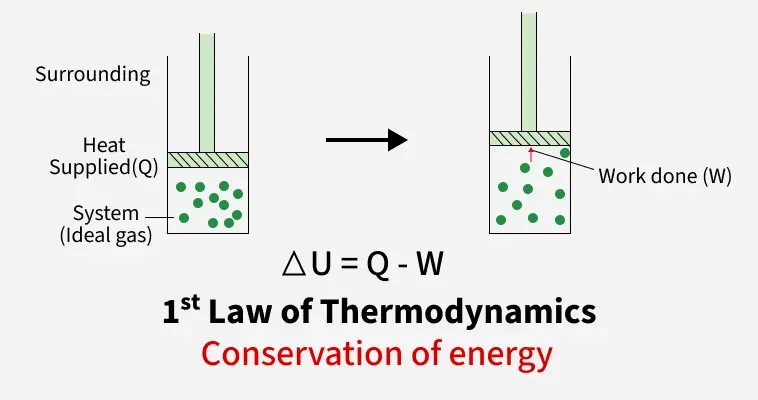
Energy cannot be generated or destroyed, according to the first law of thermodynamics, but it can be converted from one form to another. According to this law, some of the heat provided to the system is utilized to change the internal energy, while the remaining is used to perform work.
First law of thermodynamics is also known as the law of conservation of energy.
Mathematically, it may be expressed as
Where,
- ΔQ =The heat given or lost
- ΔH = The change in internal energy
- W =stands for work done.
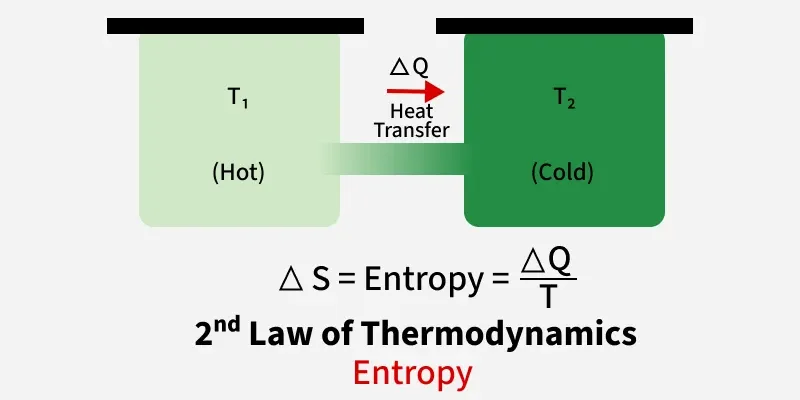
The Second Law of Thermodynamics states that the state of entropy of the entire universe, as an isolated system (no energy or matter transfer with its surrounding), will always increase in any natural and spontaneous process.
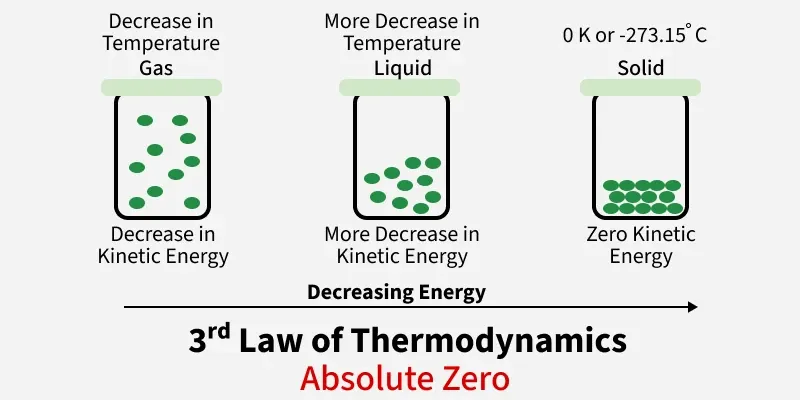
The third law of thermodynamics states that when the temperature approaches absolute zero (0 Kelvin) temperature, the entropy of a system approaches a constant value. At absolute zero temperature, the entropy of a pure crystalline solid is zero.
We came across various examples in our daily life which can be explained using thermodynamic properties. Some of them are,
Example 1: Calculate ΔG at 280 K for the reaction, 2NO + O2 → 2NO2
when ΔH and ΔS of the reaction are -100 J and -0.25 J/K respectively
Given,
ΔH = -100 J
ΔS = -0.25 J/K
T = 280 KWe know that,
ΔG = ΔH - TΔS
⇒ ΔG = (-100) -280(-0.25)
⇒ ΔG = -100 + 70
⇒ ΔG = -30 J
Example 2: Calculate the temperature at which ΔG of the given reaction is 200 J when ΔH and ΔS of the reaction are -150 J and -0.5 J/K respectively: H2 + I2 → 2HI
Given,
ΔG = 200 J
ΔH = -150 J
ΔS = -0.5 J/KT =?
We know that,
ΔG = ΔH - TΔS
Thus,
⇒ 200 = (-150) - T(-0.5)
⇒ 200 = -150 + T/2
⇒ 200 + 150 = T/2
⇒ T = 700 K
Example 3: If an ideal heat engine operates in a Carnot cycle between 600 K and 400 K and if it absorbs 6000 J of heat at a higher temperature then find the heat supplied from the source.
Given,
T1 = 600 K
T2 = 400 K
Heat Absorbed at High Temperature = 6000 J
Heat Supplied from Source =?
Efficiency of Heat Engine (E) = 1 - (T2 / T1)
⇒ Efficiency of Heat Engine (E) = 1 - 400/600 = 1- 2/3
⇒ Efficiency of Heat Engine (E) = 1/3We know that,
E = Heat Supplied from Source/Heat Absorbed at High Temperature
⇒1/3 = Heat Supplied from Source/6000
Heat Supplied from Source = 2000 J
Example 4: Find the Efficiency of the Heat Engine if it operates between 700 K and 350 K.
T1 = 700 K
T2 = 350 K
Efficiency of Heat Engine (E) = 1 - (T2 / T1)
⇒ Efficiency of Heat Engine (E) = 1 - 350/700 = 1- 1/2
⇒ Efficiency of Heat Engine (E) = 1/2
⇒ E = 1/2 × 100 % = 50%
Q1. 28.0 L of CO2 is produced on complete combustion of 16.8 L gaseous mixture of Ethene and methane at 25 ℃ and 1 atm. Heat evolved during combustion process is ___ kJ. Given: ΔHc(CH4) = -900 kjmol-1, ΔHc(CH4) = -1400 kjmol-1
Q2. When 2 litre of Ideal gas expands isothermally into vacuum to total of 6 litre, the change in internal energy is ___J. (Nearest Integers).
Q3. 1 mole of Ideal gas is allowed to expands reversibly and adiabatically from a temperature of 27 ℃. the workdone is 3 kJmol-1. The final temperature of the gas is ___ K (Nearest Integer). Given Cv = 20 J mol-1K-1.
Q4. Enthalpies of formation of CCl4(g), H2O(g), CO2(g) and HCl(g) are -105, -242, -394, and -92 kJmol-1 respectively. The magnitude of enthalpy of the reaction given below is kJmol-1. (Nearest Integer)
CCl4(g) + 2H2O(g) --> CO2(g) + 4HCl(g)
Q5. The value of log K for the reaction A ⇋ B at 298 K is -----(Nearest Integers). Given: ΔH° = -54.07 kJmol-1, ΔS° = 10 JK-1mol-1.