|
VOOZH | about |
|
VOOZH | about |
Entropy is a thermodynamic quantity that measures the degree of disorder or randomness in a system. It helps us understand how energy is distributed and how the arrangement of particles changes during a physical or chemical process. Entropy is a key concept in thermodynamics for explaining the behaviour and spontaneity of different processes.
Entropy has certain important characteristics that help us understand the behaviour of systems and the direction of physical and chemical processes.
Entropy change refers to the increase or decrease in the disorder of a system during a physical or chemical process.
Example: Melting of ice, evaporation of water
Example: Freezing of water
Entropy change can be calculated using:
Where:
The entropy of a system depends on several factors that influence the degree of disorder or randomness in the system.
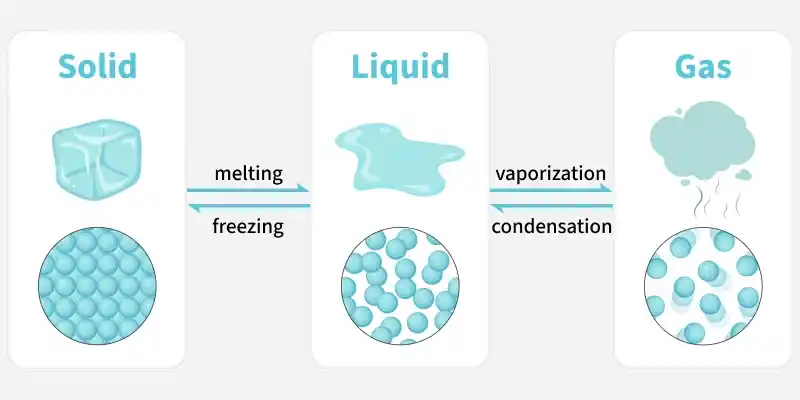
1. Physical state of the substance: Entropy depends on the state of matter. Gases have the highest entropy, followed by liquids, and solids have the lowest entropy because particles in gases have maximum freedom of movement.
Example: Ice (solid) → Water (liquid) → Steam (gas), entropy increases.
2. Temperature: Entropy increases with increase in temperature because particles move faster and disorder increases.
Example: Hot gas has higher entropy than cold gas.
3. Number of particles (or moles): An increase in the number of particles increases entropy due to more possible arrangements.
Example: When one molecule breaks into two, entropy increases.
4. Volume (or expansion): Increase in volume increases entropy as particles get more space to move randomly.
Example: Expansion of a gas in a container increases entropy.
5. Nature of the substance: Complex molecules have higher entropy than simple molecules due to more possible arrangements.
Example: A large organic molecule has higher entropy than a simple molecule like oxygen.
During a phase transition (change of state), the entropy of a substance changes due to a change in the arrangement and movement of its particles.
Formula:
The entropy of fusion is the increase in entropy when melting a solid substance. It is almost always positive since the degree of disorder increases in the transition from a solid to a liquid state. The entropy of fusion is denoted as ΔSfus and is typically expressed in joules per mole-kelvin (J/(mol·K))
The entropy of fusion is related to the heat of fusion and the melting point. The entropy of fusion can be calculated using the equation:
Where:
Entropy of Vaporization is the increase in entropy when a liquid substance evaporates. It is always positive since the degree of disorder increases in the transition from a liquid in a relatively small volume to a gas in a larger volume. The entropy of vaporization is denoted as ΔSvap and is typically expressed in joules per mole-kelvin (J/(mol·K))
Where:
Example 1. Calculate the entropy change when 10 moles of an ideal gas expands reversibly and isothermally from an initial volume of 10L to 100L at 300K.
Solution:
First we will see the given information in the question:
Number of moles = 10
Initial volume of gas (V1) = 10L
Final volume of gas (V2) = 100L
Now, we will calculate the entropy of the gas using the formula:
ΔS = 2.303 nRlog(V2/V1)
On putting the values, we get,
log(100/10) = log(10) = 1
ΔS = 2.303 × 10 × 8.314 × 1
ΔS = 191.4 J K-1
Example 2. Calculate the entropy change for 1.00 mol of an ideal gas expanding isothermally from a volume of 24.4 L to 48.8 L.
Solution:
ΔS = nRln (V2/V1)
= (1.00mol) (8.314J/(molK)) ln(48.8L/24.4L)
ΔS = 5.76J/K
Example 3. The enthalpy of fusion for water is 6.01 kJ/mol. Calculate the entropy change for 1.0 mole of ice melting to form liquid at 273 K.
Solution:
This is a phase transition at constant pressure (assumed)
ΔS = (1 mol) (6010 J/mol)/273 K
= 22 J/K