|
VOOZH | about |
|
VOOZH | about |
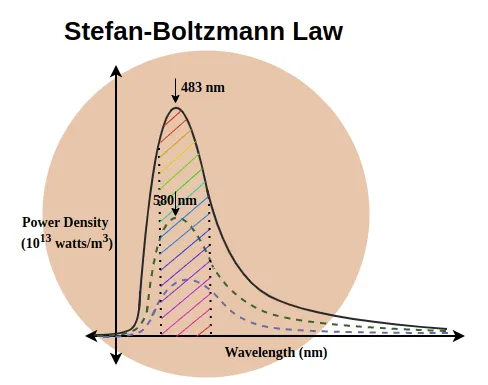
Stefan-Boltzmann Law relates the power radiated by the black body to its temperature and surface area. In the study of thermodynamics and astrophysics, the Stefan-Boltzmann Law is widely used to better our understanding of the subject.
Other than this, Stefan-Boltzmann Law helps scientists understand the the of objects that emit radiation, such as stars and planets. Stefan-Boltzmann Law also has some applications in the real world as well such as Stefan-Boltzmann in designing solar panels and other energy conversion instruments.
This law states that the total energy emitted per unit surface area of a black body across all wavelengths per unit of time is directly proportional to the fourth power of the black body's thermodynamic temperature and emissivity. It expresses the power emitted by a black substance as a function of temperature and emissivity.
Mathematically, Stefan Boltzmann's law for the black body is given by
P/A ∝T4
OR
P = σAT4
Where,
- P is the power radiated,
- A is the surface area of the black body,
- T is the temperature of the body and
- σ is the Stefan-Boltzmann constant.
Objects which are not black bodies emit less radiation as they can absorb radiation as well. For such objects, Stefan Boltzmann's law is as follows:
P/A ∝ eT4
OR
P = σeAT4
Where, e is the emissivity of the object and can have value from 0 to 1.
Stefan-Boltzmann Constant is the physical constant that is named after Josef Stefan and Ludwig Boltzmann, an Austrian and Dutch physicist respectively. The Stefan-Boltzmann Constant is denoted by the Greek alphabet σ. Stefan-Boltzmann Constant is the proportionality constant in Stefan-Boltzmann law.
The value of Stefan-Boltzmann contact in SI units is approximately 5.67 ×10⁻⁸ Watt per square meter per Kelvin to the fourth power and other units and the values in other systems of the unit are given as follows:
Unit system | Value of σ | Units |
|---|---|---|
SI | 5.670367×10⁻⁸ | W/(m2K4) |
CGS | 5.6704 x 10⁵ | erg/(cm2 s1 K4) |
Thermochemistry | 11.7 x 10⁸ | cal/(cm2 day K4) |
U.S. Customary Units | 1.714 x 10⁹ | BTU/(ft2 hr ˚R4) |
The dimension of the Stefan-Boltzmann Constant is [M]1[L]0[T]-3[K]-4, where [M], [L], [T], and [K] are the dimension of mass, length, time, and temperature respectively.
Also Read, Value Of Boltzmann Constant | Terms and Units
Other than the Stefan-Boltzmann law, there are some more formulas involving the Stefan-Boltzmann Constant. One such formula can be derived from Planck's law of radiation i.e., integrating Planck's Radiation formula, and is given as follows:
Where,
- R is Universal Gas Constant which is equal to 8.3144598 J per mole per K (J x mol-1 x K-1)
- NAis Avogadro constant which is equal to 6.02214076 x 10²³ mol-1
- h is the Planck's constant which is equal to 6.62607015 × 10⁻³⁴ m2 kg / s,
- c is the speed of light which is equal to 299,792,458 m / s
- kb is the Boltzmann Constant which is equal to 1.380649 × 10⁻²³ m2 kg s-2 K-1
Black Body Radiation is the electromagnetic radiation by the Black Body which is an opaque ideal body that absorbs all the radiation and is also a perfect emitter of radiation i.e., an object that can emit radiation of all the wavelengths depending on the temperature of the surface of the body.
Planck’s Law or Planck’s Radiation Law states the relationship between temperature and radiation emitted by the black body and is given as follows:
Where,
- B(ν, T) is the energy radiated per unit area per unit time form the body,
- ν is Frequency,
- kb is Boltzmann Constant,
- h is Planck’s Constant, and
- c is speed of light in vacuum.
The formula for the Stefan-Boltzmann constant can be derived from the integral of Plank's Radiation Law, as integrating Planck's Radiation Formula gives a similar relation as the Stefan-Boltzmann law. From where we can compare the Stefan-Boltzmann constant in both formulas and formulate the formula for Stefan-Boltzmann Constant. The complete derivation for the same is given as follows:
On integrating both sides with suitable limits,
. . .(1)
Now, let . . .(2)
Therefore,
Putting all the results in equation (1)
As, we know the improper integral,
Therefore,
According to Stefan-Boltzmann law, energy radiated per unit area is directly proportional to the fourth power of of its absolute temperature. The proportionality constant is the Stefan-Boltzmann constant σ.
Thus, σ =( 2k4π5/15 h3c2)= ( 5.670× 10⁸ watts/m2K4)
Using the formula we derived we can calculate the value of the Stefan-Boltzmann constant i.e.,
Substituting, all the values of other constants i.e.,
- R = 8.3144598 J per mole per K (J x mol-1 x K-1)
- NA= 6.02214076 x 10²³ mol-1
- h = 6.62607015 × 10⁻³⁴ m2 kg / s,
- c = 299,792,458 m / s
In the real world, there are many applications of Stefan-Boltzmann Law. Some of those applications are as follows:
Solution:
We have, A = 100 and T = 200
Using the formula for Stefan-Boltzmann Law,
P = σ A T4
⇒ P = 5.670373 × 10−8 × 100 × (200)4
⇒ P = 9073 W
Solution:
Given: T = 100
Using the formula for Stefan-Boltzmann Law,
P/A = σ T4
⇒ P/A = 5.670373 × 10−8 × (100)4
⇒ P/A = 5.67 W m-2
Solution:
Given: P = 300, and T = 250
Using the formula we have,
P/A = σ T4
⇒ A = 300/(5.670373 × 10−8 × (250)4)
⇒ A = 1.3544 m2
Problem 4. Calculate the area of a black body with a surface temperature of 350 K and radiation power of 400 W.
Solution:
Given, P = 400 and T = 350
Using the formula we have,
P/A = σ T4
⇒ A = 400/(5.670373 × 10−8 × (350)4)
⇒ A = 0.4701 m2
Solution:
Given: P = 1000 and A = 250
Using the formula for Stefan-Boltzmann Law,
P/A = σ T4
⇒ T4 = P/σA
⇒ T4 = 1000/(5.670373 × 10−8 × 250)
⇒ T4 = 70555338.077
⇒ T = 91.65 K