|
VOOZH | about |
|
VOOZH | about |
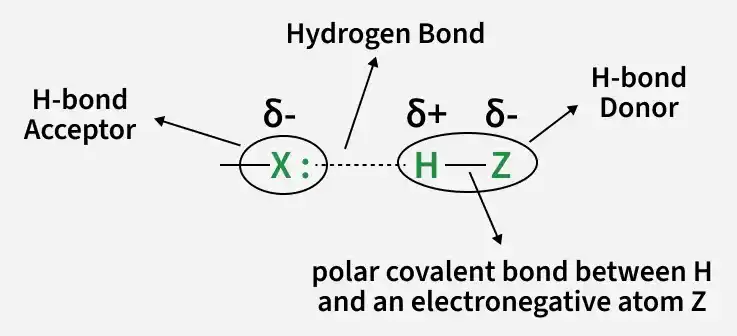
Hydrogen bonding is a special type of attractive force that exists between molecules or between different parts of the same molecule. It occurs when a hydrogen atom is covalently bonded to a highly electronegative atom such as nitrogen, oxygen, or fluorine, and is attracted to another electronegative atom nearby.
Examples of hydrogen bonds: Water, Ammonia, and Hydrogen Fluoride.
A hydrogen bond is formed when a slightly positive hydrogen ( δ⁺) attached to one atom is attracted to a slightly negative atom ( δ⁻) with a lone pair on another molecule.
Hydrogen bonding is a special type of intermolecular force that arises when a hydrogen atom, covalently bonded to a highly electronegative atom such as nitrogen (N), oxygen (O), or fluorine (F), is attracted to another electronegative atom in the same or a different molecule
Example: Water (H2O)
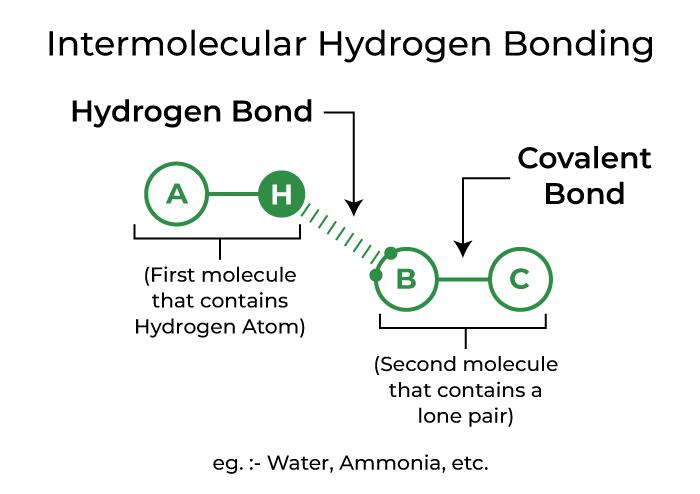
In Water, hydrogen is bonded to oxygen. Since oxygen is highly electronegative, hydrogen becomes partially positive (δ⁺). The δ⁺ hydrogen of one water molecule is attracted to the δ⁻ oxygen of another water molecule. This forms intermolecular hydrogen bonding.
For hydrogen bonding to occur, certain conditions must be satisfied:
1. Hydrogen must be bonded to a highly electronegative atom: Hydrogen should be covalently bonded to a small and highly electronegative atom such as nitrogen (N), oxygen (O), or fluorine (F). These atoms strongly attract the shared electrons, creating partial charges.
2. High Electronegativity Difference: There must be a large difference in electronegativity between hydrogen and the atom to which it is bonded. This makes hydrogen partially positive (δ⁺), which is necessary for hydrogen bond formation.
3. Presence of Lone Pair of Electrons: The electronegative atom (N, O, or F) must have at least one lone pair of electrons. The hydrogen bond is formed between the δ⁺ hydrogen and the lone pair of another electronegative atom.
4. Small Size of Electronegative Atom: The atom bonded to hydrogen should be small in size. Smaller atoms (like N, O, F) allow closer approach of molecules, resulting in stronger hydrogen bonding.
5. Proper Orientation: The molecules must be arranged in such a way that the hydrogen atom can approach the lone pair of the electronegative atom effectively.
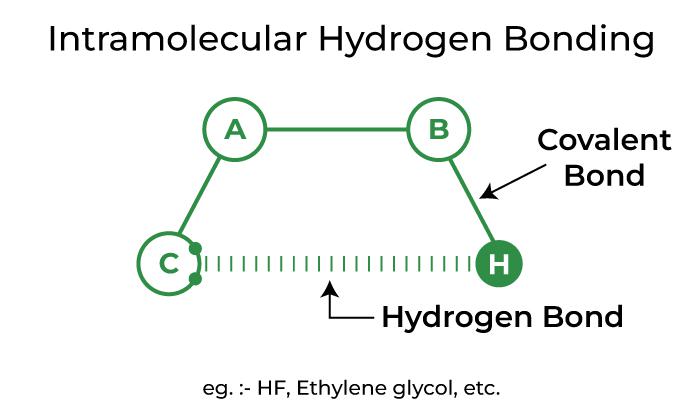
Hydrogen bonding can occur in different ways depending on where the attraction takes place. Based on this difference in location, hydrogen bonding is classified into two main types:
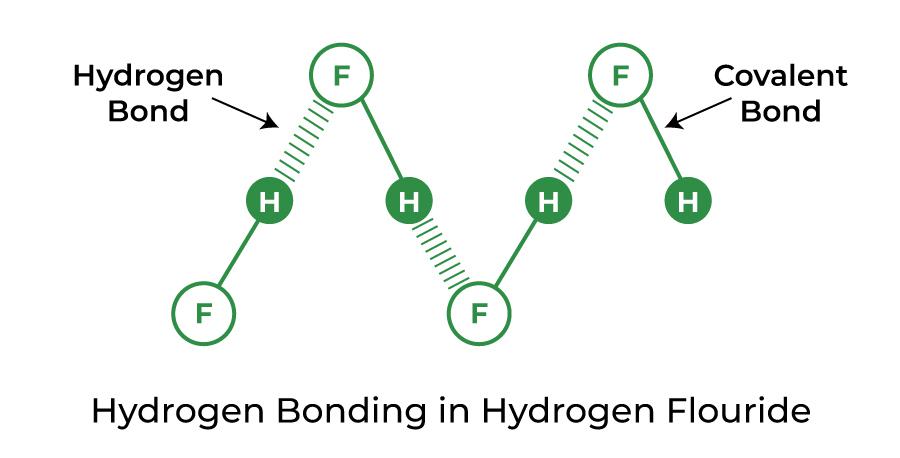
Example: Hydrogen Fluoride (HF)
In Hydrogen fluoride, hydrogen is bonded to fluorine. Fluorine is highly electronegative, so strong intermolecular hydrogen bonding occurs between HF molecules.
Example: o-Nitrophenol
In o-Nitrophenol, the –OH group forms a hydrogen bond with the oxygen atom of the –NO2 group within the same molecule.
This internal hydrogen bonding makes the molecule less associated with other molecules, so it has a lower boiling point compared to p-nitrophenol.
The following examples illustrate how hydrogen bonding occurs in different substances and how it affects their properties.
An excellent example of Hydrogen Bonding is Water. A highly electronegative oxygen atom is connected to a hydrogen atom in the water molecule. The shared pair of electrons are attracted to the oxygen atoms more, and this end of the molecule becomes negative, while the hydrogen atoms become positive.
A stronger-than-average hydrogen bond is created by hydrofluoric acid and is known as a symmetric hydrogen bond. Formic acid can also make this type of bond.
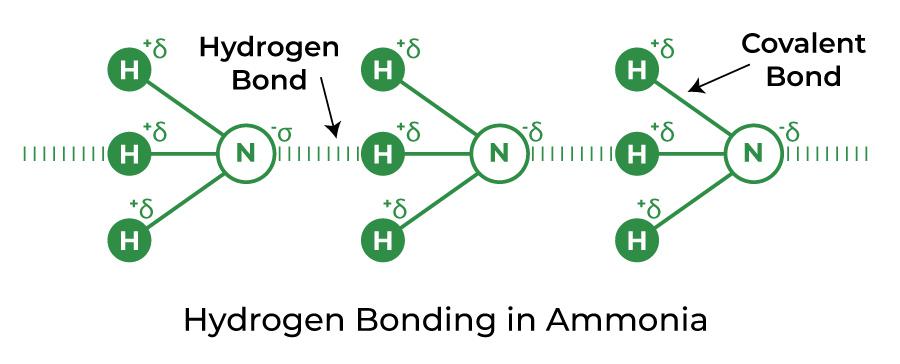
👁 Hydrogen Bonding in Hydrogen FlourideBetween the hydrogen in one molecule and the nitrogen in another, hydrogen bonds are formed. Since each nitrogen has a single electron pair, the bond that develops in the case of ammonia is relatively weak. Methylamine also has this form of hydrogen bonding with nitrogen.
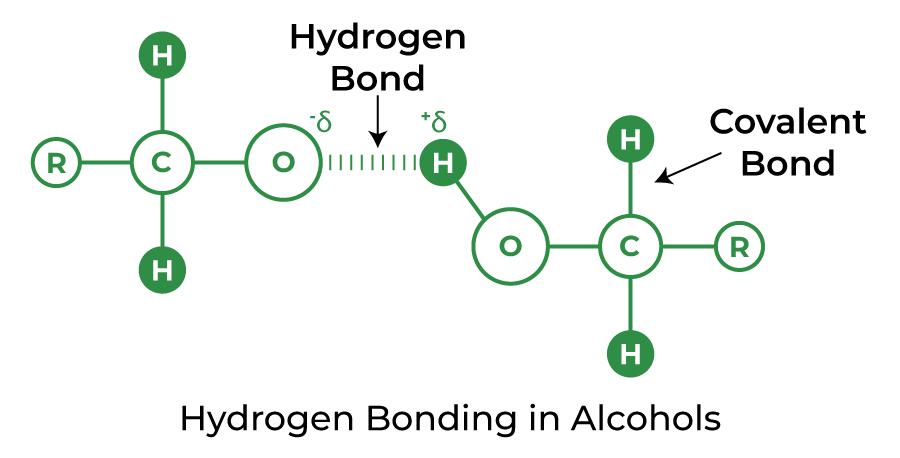
👁 Hydrogen Bonding in AmmoniaA type of chemical molecule with a -OH group is alcohol. In most cases, hydrogen bonding is easily generated if any molecule containing the hydrogen atom is immediately coupled to either oxygen or nitrogen.
Hydrogen Bond in Alcohol
Hydrogen Bond in Carboxylic Acid
| Hydrogen Bond | Covalent Bond |
|---|---|
| It is a weak force of attraction between molecules or within a molecule. | It is a strong chemical bond formed within a molecule. |
| It is formed due to attraction between δ⁺ hydrogen and a lone pair of an electronegative atom (N, O, F). | It is formed by sharing of one or more pairs of electrons between two atoms. |
| No sharing of electrons takes place. | Electrons are shared between atoms. |
| It is weaker than a covalent bond. | It is much stronger than a hydrogen bond. |
| Example: Hydrogen bonding between water molecules in Water. | Example: O–H bond inside a water molecule is a covalent bond. |