|
VOOZH | about |
|
VOOZH | about |
Organic chemistry deals with a large number of compounds, many of which have the same molecular formula but differ in their structures and properties. This phenomenon is known as isomerism. It arises due to differences in the arrangement of atoms within the molecule or in the spatial orientation of atoms. Isomerism is an important concept that helps in understanding the diversity and behaviour of organic compounds.
Isomerism is classified into structural isomerism and stereoisomerism depending on how atoms differ in a molecule.
In this type, compounds have the same molecular formula but differ in the connectivity of atoms. This difference in structure leads to changes in physical properties like boiling point and sometimes chemical properties as well.
Further classified into various types:
a) Chain Isomerism
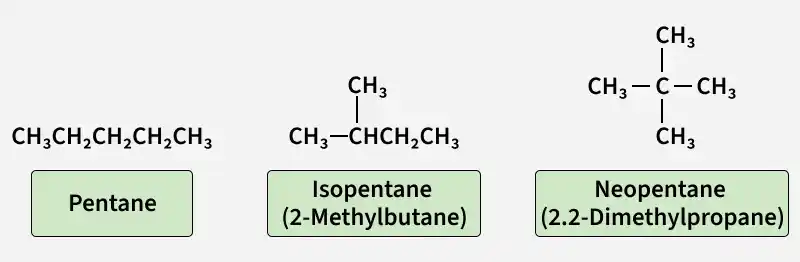
Chain isomerism arises due to different arrangements of the carbon skeleton. One isomer may have a straight chain, while another has a branched chain.
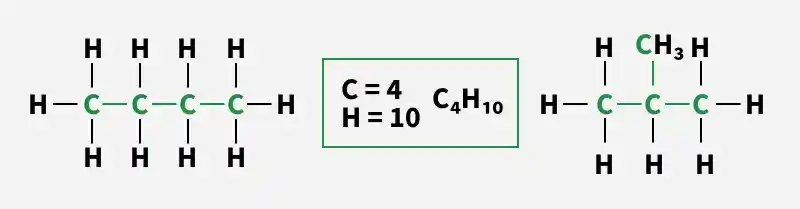
Example: Butane and 2-methylpropane
Same formula (C4H10), but different chain arrangement.
b) Position Isomerism
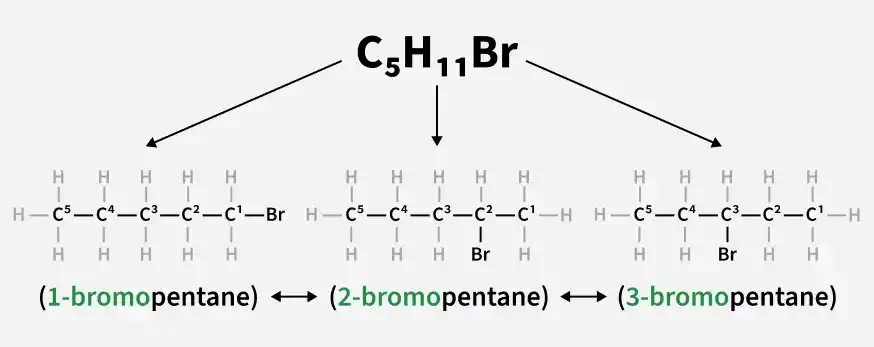
In position isomerism, the position of a functional group, substituent, or multiple bond differs, while the carbon skeleton remains unchanged.
Example: 1-butanol and 2-butanol
Only the position of –OH group is different.
c) Functional Group Isomerism
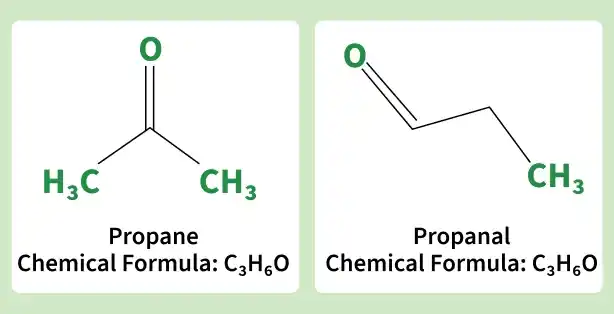
This occurs when compounds have the same molecular formula but different functional groups.
Example: Ethanol (alcohol) and dimethyl ether (ether), C2H6O
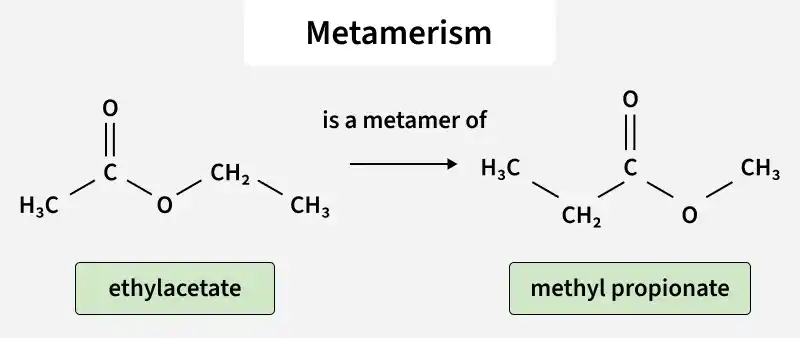
d) Metamerism
Metamerism is shown by compounds having a divalent functional group such as –O–, –NH–, etc.
Example: CH3–O–C3H7 and C2H5–O–C2H5
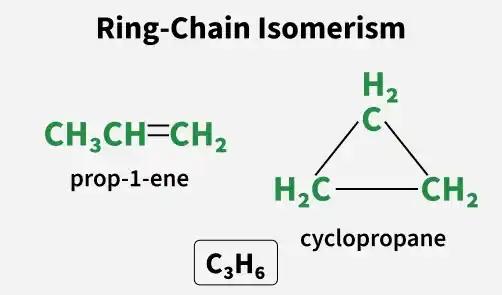
e) Ring-Chain Isomerism
In this type, one compound has an open-chain (acyclic) structure, while the other has a closed-ring (cyclic) structure.
Example: Propene and cyclopropane
In stereoisomerism, compounds have the same molecular formula and same connectivity, but differ in the three-dimensional arrangement of atoms in space. These differences affect properties like polarity and optical activity.
Further classified as:
a) Geometrical Isomerism
This type arises due to restricted rotation around a double bond or in cyclic structures.
They are further classified into two types:
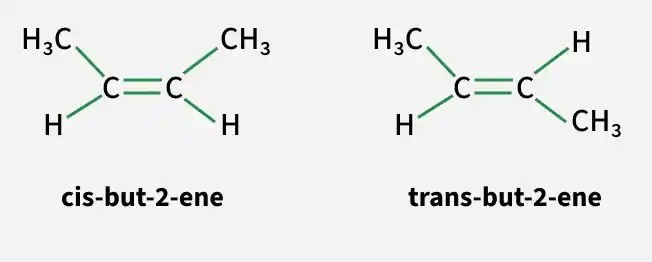
Example: But-2-ene
Geometrical isomers are named using two systems: the cis–trans system and the E–Z system. These systems help to distinguish isomers based on the relative positions of groups around a double bond.
1. Cis–Trans Nomenclature
This is the simpler and commonly used system for compounds having similar groups attached to the double-bonded carbons. This system works only when we can clearly identify similar groups on both carbons.
Example: But-2-ene
- In cis-but-2-ene, both methyl (–CH₃) groups are on the same side
- In trans-but-2-ene, the methyl groups are on opposite sides
2. E–Z Nomenclature System
The E–Z system is a more accurate and universal method based on priority rules.
Step 1: Assign Priority
Step 2: Compare Positions
Example: Consider a compound where
- One carbon has –Cl and –H
- Other carbon has –CH3 and –H
Priority order:
b) Optical Isomerism
Optical isomerism occurs in compounds having a chiral carbon atom (a carbon attached to four different groups). These compounds form mirror-image isomers called enantiomers.
Example: Lactic acid