|
VOOZH | about |
|
VOOZH | about |
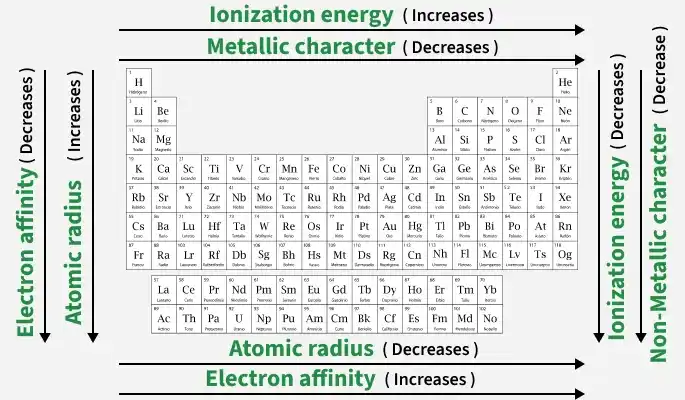
The periodic table is arranged according to increasing atomic number, and as we move across a period or down a group, the properties of elements change in a regular pattern. These regular and gradual changes in properties are called periodic trends. Periodic trends help us understand how and why elements differ in size, reactivity, metallic nature, and other chemical properties.
Atomic radius is the distance between the centre of the nucleus and the outermost shell of an atom. It tells us the size of an atom.
a) Trend Across a Period (Left to Right →)
Atomic radius decreases as we move from left to right in a period because:
Example:
Li > Be > B > C > N > O > F
Lithium is largest, Fluorine is smallest in Period 2.
b) Trend Down a Group (Top to Bottom ↓)
Atomic radius increases as we move down a group because:
Example:
Li < Na < K < Rb < Cs
Cesium is the largest.
Exception in Atomic Radius
Ionisation enthalpy is the energy required to remove the outermost electron from an isolated gaseous atom.
M → M⁺ + e⁻
a) Trend Across a Period (Left to Right →)
Ionisation enthalpy increases across a period because:
Example:
Li < Be < B < C < N < O < F
Fluorine has high ionisation enthalpy.
b) Trend Down a Group (Top to Bottom ↓)
Ionisation enthalpy decreases down the group because:
Example:
Li > Na > K > Rb > Cs
Cesium has lowest ionisation enthalpy.
Exceptions in Ionization Enthalpy
1. Beryllium and Boron (Be & B)
Be has higher ionisation enthalpy than B.
Reason:
Be = 1s² 2s² (stable filled s-subshell)
B = 1s² 2s² 2p¹ (electron in p-orbital is easier to remove)
So, IE(Be) > IE(B)
2. Nitrogen and Oxygen (N & O)
N has higher ionisation enthalpy than O.
Reason:
N = 2p³ (half-filled stable configuration)
O = 2p⁴ (one paired electron, more repulsion)
So, IE(N) > IE(O)
The electrons in an atom's outermost shell are referred to as the atom's valence electrons. Valence electrons are the electrons present in the outermost shell of an atom.
a) Trend Across a Period (Left → Right)
Number of valence electrons increases from 1 to 8 as we move across a period because:
Example:
Li → 1
Be → 2
B → 3
C → 4
N → 5
O → 6
F → 7
Ne → 8So, valence electrons increase from 1 to 8.
b) Trend Down a Group (Top ↓ Bottom)
Number of valence electrons remains the same down a group because:
Example:
Li = 1
Na = 1
K = 1
Rb = 1All have 1 valence electron.
Valency is the combining capacity of an atom.
a) Trend Across a Period (Left → Right)
Valency first increases from 1 to 4, then decreases from 4 to 0 because:
Atoms try to complete their octet (8 electrons).
Example:
Li → 1
Be → 2
B → 3
C → 4
N → 3
O → 2
F → 1
Ne → 0So pattern is:
1 → 2 → 3 → 4 → 3 → 2 → 1 → 0
b) Trend Down a Group (Top ↓ Bottom)
Valency remains the same down a group.
Example:
Group 1 → All have valency 1
Group 2 → All have valency 2
Group 17 → All have valency 1
Exception in Valency
In transition elements (d-block), valency can vary.
Example:
- Iron (Fe) → Valency 2 and 3
- Copper (Cu) → Valency 1 and 2
This is called variable valency.
a) Trend Across a Period (Left → Right)
Melting and boiling points first increase, then decrease across a period because:
From Group 1 to Group 14:
Melting point generally increases because bonding becomes stronger (metallic → covalent network).
After Group 14:
Melting point decreases because elements form simple molecules with weak intermolecular forces.
Example:
Li < Be < B < C → Increasing
(C has very high melting point due to strong covalent network)After Carbon:
N < O < F < Ne → DecreasingNeon has very low melting and boiling point because it is a noble gas with weak forces.
b) Trend Down a Group (Top ↓ Bottom)
The trend depends on the type of element.
In Metals (Group 1 & 2)
Example :
Li > Na > K > Rb > Cs
Lithium has highest melting point in Group 1.
In Non-metals (Like Halogens)
Example:
F₂ < Cl₂ < Br₂ < I₂
Iodine has higher melting and boiling point than fluorine.
Exceptions in Melting and Boiling point
Example: Iron has high melting point.
a) Trend Across a Period (Left → Right)
Metallic character decreases across a period and Non-metallic character increases across a period because:
Example:
Na → Mg → Al → Si → P → S → Cl
- Sodium (Na) is highly metallic.
- Chlorine (Cl) is highly non-metallic.
So, metallic nature decreases and non-metallic nature increases from Na to Cl.
b) Trend Down a Group (Top ↓ Bottom)
Metallic character increases down a group and Non-metallic character decreases down a group because:
Example:
Li < Na < K < Rb < Cs
Cesium (Cs) is more metallic than Lithium (Li).
Example (Group 17):
F > Cl > Br > I
Fluorine is more non-metallic than iodine.
Exception in Metallic and Non Metallic Character
These exceptions occur due to special reasons such as small atomic size, unusual electronic configuration, metalloids nature, and the presence of transition elements. Because of these factors, certain elements show properties that are slightly different from the expected periodic trend. These are:
Electronegativity is the tendency of an atom to attract shared electrons towards itself in a chemical bond. The higher the electronegativity, the stronger the atom attracts electrons.
a) Trend Across a Period (Left → Right)
Electronegativity increases across a period because:
Example :
Li < Be < B < C < N < O < F
Fluorine has the highest electronegativity in the periodic table.
b) Trend Down a Group (Top ↓ Bottom)
Electronegativity decreases down a group because:
Example:
F > Cl > Br > I
Fluorine is more electronegative than iodine.
The following table is the summary of all the periodic trends in the properties of different elements.
Property | Across the Period | Down the Group |
|---|---|---|
Atomic Radius | Decreases | Increases |
Valence Electrons | Increases | Remains constant |
Valency | First Increases then decrease | Remains constant |
Metallic Character | Decreases | Increases |
Non-Metallic Character | Increases | Decreases |
Reactivity | Decreases | Increases after Group 13 |
Melting Point | Varies (General trend: Decreases for Metals) | Varies (General trend: Increases for Metals) |
Boiling Point | Varies (General trend: Decreases for Metals) | Varies (General trend: Increases for Metals) |
Ionization Enthalpy | Increases | Decreases |
Electron Gain Enthalpy | Increases | Decreases |