|
VOOZH | about |
|
VOOZH | about |
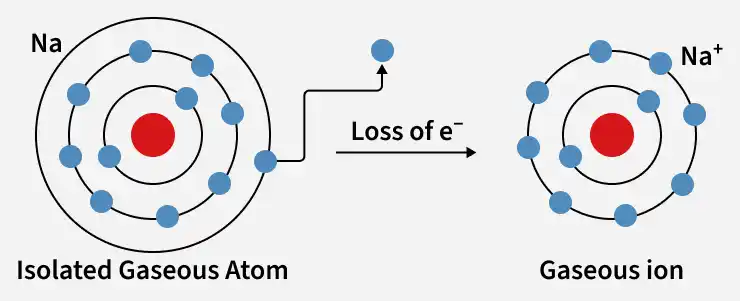
Ionization energy is an important periodic property that explains how easily an atom can lose an electron. It is defined as the minimum amount of energy required to remove the most loosely bound electron from an isolated gaseous atom. When an electron is removed, the atom forms a positively charged ion called a cation.
👁 naIonization energy is usually expressed in kilojoules per mole (kJ/mol).
The ionization process can be represented as:
X (g) → X + (g) + e−
where:
The important characteristics of ionization energy are as follows:
An atom can lose more than one electron. Therefore, ionization energy occurs in successive stages depending on the number of electrons removed. Each successive ionization energy is greater than the previous one because after the removal of an electron.
The successive ionization energies follow the order: IE1 < IE2 < IE3
This increase occurs because each electron is removed from a more positively charged species.
The minimum amount of energy required to remove the outermost electron from an isolated gaseous atom is called the first ionization energy. The first ionization energy is generally the lowest because the electron is removed from a neutral atom.
The process is represented as: X (g) → X + (g) + e−
Example: Na (g) → Na + (g) + e−
The energy required to remove the second electron from a singly charged positive ion is called the second ionization energy. The second ionization energy is always greater than the first ionization energy because the electron is removed from a positively charged ion.
The process is represented as: X+ (g) → X2+ (g) + e−
Example: Na+ (g) → Na 2+ (g) + e−
The energy required to remove the third electron from a doubly charged positive ion is called the third ionization energy. The third ionization energy is greater than the second ionization energy because the attraction between the nucleus and the remaining electrons becomes stronger.
The process is represented as: X2+ (g → X3+ (g) + e−
Example: Al 2+ (g) → Al 3+ (g) + e−
Ionization energy depends on the force of attraction between the nucleus and the outermost electron. The important factors affecting ionization energy are:
1. Atomic Size: Atomic size refers to the distance between the nucleus and the outermost electron.
2. Nuclear Charge: Nuclear charge is the positive charge present in the nucleus due to protons.
3. Shielding Effect: Inner-shell electrons block the attraction between the nucleus and the outermost electron. This reduction in attraction is called the shielding effect or screening effect.
4. Electronic Configuration: Atoms having completely filled or half-filled orbitals are more stable.
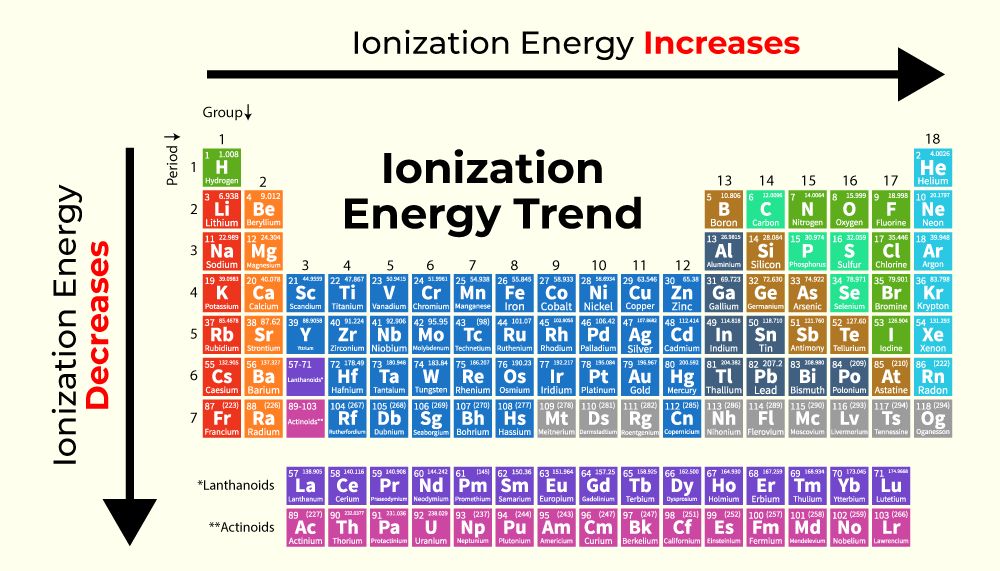
Ionization Energy follows a specific trend while moving from Left to Right and Top to Bottom in the periodic table.
1. Across a Period
Ionization energy generally increases from left to right across a period.
Example: Lithium has lower ionization energy than fluorine because fluorine has a smaller atomic size and stronger nuclear attraction.
2. Down a Group
Ionization energy generally decreases from top to bottom in a group.
Example: Lithium has higher ionization energy than sodium and potassium because lithium is smaller in size and its outermost electron is more strongly attracted by the nucleus.
Although ionization energy generally increases across a period, some elements do not follow this regular trend. These exceptions arise due to differences in electronic configuration and the extra stability of completely filled and half-filled orbitals.
1. Exception between Beryllium and Boron
According to the general trend, boron should have higher ionization energy than beryllium because ionization energy increases across a period. However, beryllium has higher ionization energy than boron.
IE (Be) > IE (B)
2. Exception between Nitrogen and Oxygen
Generally, ionization energy increases from nitrogen to oxygen, but nitrogen has higher ionization energy than oxygen.
IE (N) > IE (O)
| Ionization Energy | Ionization Enthalpy |
|---|---|
| Ionization energy is the minimum energy required to remove the outermost electron from an isolated gaseous atom. | Ionization enthalpy is the enthalpy change required to remove the outermost electron from one mole of isolated gaseous atoms. |
| It is an older and commonly used term. | It is the modern scientific term preferred by IUPAC . |
| It mainly focuses on the energy required for electron removal. | It describes the enthalpy change involved in the process. |
| Usually expressed as energy needed to remove an electron. | Expressed as enthalpy change per mole in kJ/mol. |
| Simpler and more general term. | More thermodynamically accurate term. |