|
VOOZH | about |
|
VOOZH | about |
Valence electrons are the electrons present in the outermost shell of an atom. They take part in chemical bonding by being lost, gained, or shared during reactions. These electrons help atoms achieve a stable configuration, usually like noble gases. Elements having the same number of valence electrons show similar chemical behaviour and are placed in the same group in the periodic table.
Examples:
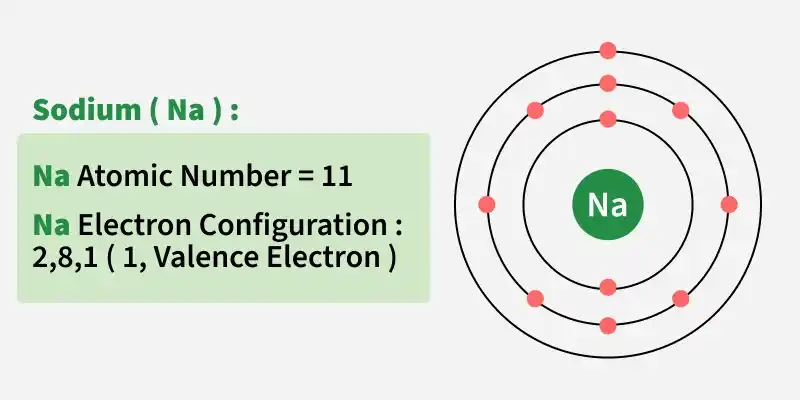
- Sodium (Na) → Electronic configuration: 2, 8, 1, Valence electrons = 1
- Oxygen (O) → Electronic configuration: 2, 6, Valence electrons = 6
Valence electrons have some important features that explain their role in the chemical behavior of elements.
The number of valence electrons in an atom can be determined by using its electronic configuration or its position in the periodic table.
Examples:
- Sodium (Na) , Electronic Configuration: 2, 8, 1 → Valence electrons = 1
- Oxygen (O), Electronic Configuration: 2, 6 → Valence electrons = 6
- Magnesium (Mg), Electronic Configuration: 2,8,2→ Valence electrons = 2
Examples:
- Group 1 , 1 valence electron (Na, K)
- Group 2 , 2 valence electrons (Mg, Ca)
- Group 17 , 7 valence electrons (Cl, F)
- Group 18 , 8 valence electrons (noble gases, except He = 2)
Valency is the combining capacity of an atom, that is, the number of electrons an atom loses, gains, or shares to form chemical bonds and achieve a stable electronic configuration. Atoms try to complete their outermost shell (octet) to become stable like noble gases.
Valency depends on the number of valence electrons:
Examples:
- Sodium (Na): 2, 8, 1 → Valency = 1
- Oxygen (O): 2, 6 → Valency = 2 (8 − 6)
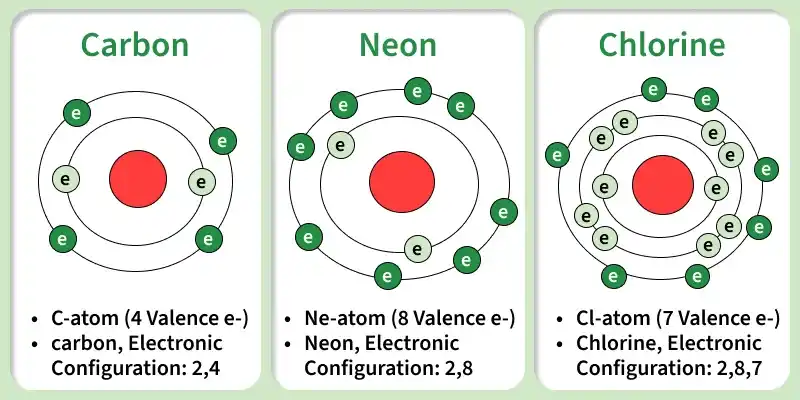
- Chlorine (Cl): 2, 8, 7 → Valency = 1 (8 − 7)
- Neon (Ne): 2, 8 → Valency = 0
Atoms combine with other atoms by losing, gaining or sharing valence electrons to attain a stable electronic configuration. For transition elements, valence electrons may vary and are not strictly equal to group number.
Atomic Number | Element | Valence Electrons |
|---|---|---|
1 | Hydrogen (H) | 1 |
2 | Helium (He) | 2 |
3 | Lithium (Li) | 1 |
4 | Beryllium (Be) | 2 |
5 | Boron (B) | 3 |
6 | Carbon (C) | 4 |
7 | Nitrogen (N) | 5 |
8 | Oxygen (O) | 6 |
9 | Fluorine (F) | 7 |
10 | Neon (Ne) | 8 |
11 | Sodium (Na) | 1 |
12 | Magnesium (Mg) | 2 |
13 | Aluminium (Al) | 3 |
14 | Silicon (Si) | 4 |
15 | Phosphorus (P) | 5 |
16 | Sulphur (S) | 6 |
17 | Chlorine (Cl) | 7 |
18 | Argon (Ar) | 8 |
19 | Potassium (K) | 1 |
20 | Calcium (Ca) | 2 |