|
VOOZH | about |
|
VOOZH | about |
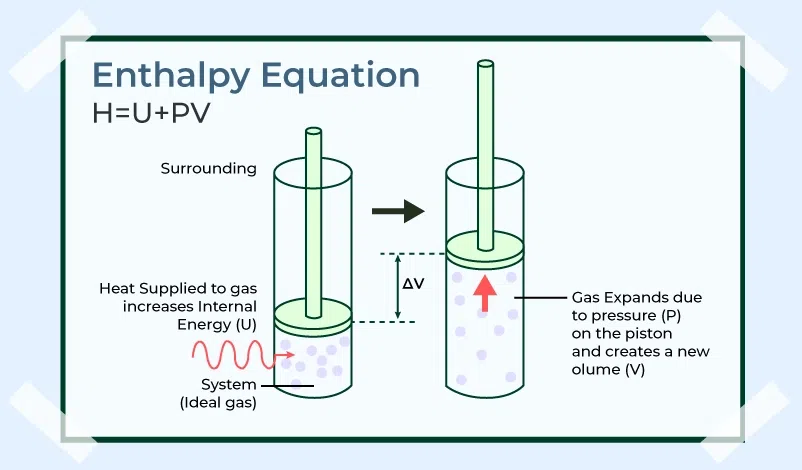
Enthalpy is a thermodynamic quantity defined as the sum of the internal energy of a system and the product of its pressure and volume. It represents the heat content of a system at constant pressure. The system has internal energy due to the motion and arrangement of its molecules. The motion of molecules contributes to kinetic energy, while interactions such as vibrations and electrostatic forces between atoms contribute to potential energy.
In addition, internal energy also includes energy stored in chemical bonds. Breaking of chemical bonds requires energy (endothermic), whereas formation of bonds releases energy (exothermic).
In thermodynamics, Enthalpy is denoted by H. The enthalpy change (ΔH) plays a crucial role in quantifying the heat exchange between a system and its surroundings.
Enthalpy is typically measured in units of energy per mole, such as joules per mole (J/mol) in the International System of Units (SI) or calories per mole (cal/mol) in the calorie-based system.
Enthalpy can be represented as:
H = U + PV
where,
Enthalpy is a state function (those functions which are only dependent on the initial and final state of the process, not the path taken by the process) as its constituents U, P, and V are state functions. As enthalpy is a state function, change in enthalpy (ΔH) will depend on the initial and the final states of the system.
Thus, change in enthalpy is represented by ΔH and is given by the following formula:
ΔH = H2 - H1
Where,
As we know, the formula for Enthalpy is H = U + PV, and then
H1 = U1 + P1V1
H2 = U2 + P2V2
Using, the values of H1 and H2, value of ΔH will be,
ΔH = (U2 + P2V2) - (U1+ P1V1)
⇒ ΔH = U2 + P2V2 - U1 -P1V1
⇒ ΔH = (U2 - U1) + (P2V2 -P1V1)
ΔH = ΔU + Δ(PV)
where,
Now, at a constant pressure P1 = P2 = P (Isobaric Process)
ΔH = ΔU + PΔV
Consider pressure inside and outside are the same for this isobaric process (i.e. Pex = P) then the formula for the isobaric process will become,
Qp = ΔU +PΔV
Thus from the above two equations, we get,
ΔH = Qp
Thus from this derived formula, we understand that the increase in enthalpy of a system is equal to the heat absorbed by it at a constant pressure.
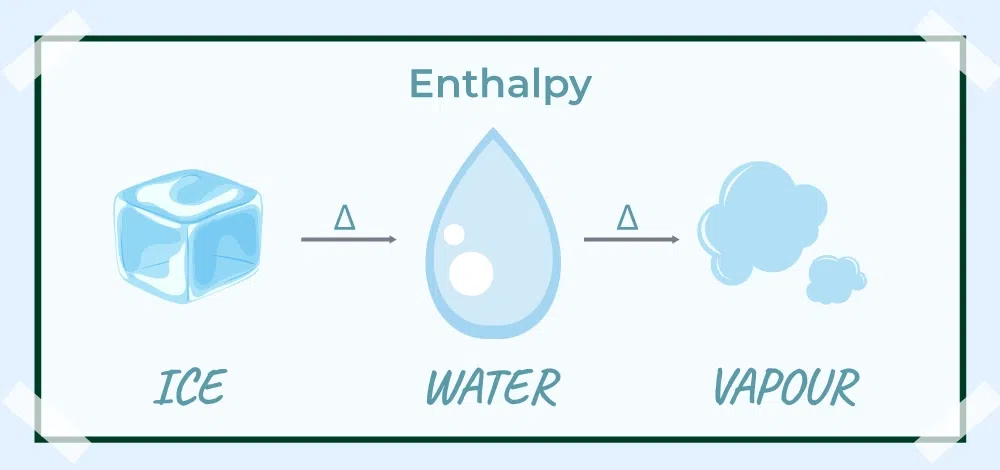
Enthalpy of Fusion is the amount of heat energy required to convert a unit mass of a solid at its melting point into a liquid without an increase in temperature. It changes with the increase in temperature and other parameters.
Enthalpy of Vaporization is the amount of heat energy required to convert a unit mass of a liquid at its boiling point into a vapor state without an increase in temperature. Its symbol is ∆H vap. The value of enthalpy of vaporization generally decreases with increase in temperature and becomes zero at the critical temperature.
Enthalpy of freezing water is the heat release when liquid water changes into solid ice at its freezing point. Its value is –6.0 kJ/mol.
Ionization Enthalpy of an element is defined as the amount of energy required to remove an electron from an isolated gaseous atom. Ionization energy depends on the force of attraction of electrons and the nucleus.
Activation Enthalpy of the reaction is defined as the energy required to proceed with a reaction. It is the minimum amount of energy that is necessary for the reactants in a chemical reaction to proceed and form the product.
As we already established that ΔH and ΔU are related by the equation ΔH = ΔU + PΔV, at constant pressure. For reactions between solids and liquids, ΔV is very small because as pressure varies, solids or liquids won't get affected significantly. So, for these reactions remove PΔV from the equation and write ΔH = ΔU
However, for the reactions involving gases, which are easily affected by the change in pressure, ΔV should strictly be considered.
ΔH = ΔU + PΔV
⇒ ΔH = ΔU + P(V2 - V1)
⇒ ΔH = ΔU + PV2 - PV1
where,
Here we consider the reactants and the product to be ideal, so we can use the ideal gas equation (PV = nRT). Let's consider there are n1 moles of gaseous reactants that produce n2 moles of gaseous products. The ideal gas equation becomes
PV1 = n1RT and PV2 = n2RT
⇒ ΔH = ΔU + n2RT - n1RT
⇒ ΔH = ΔU + RT (n2 - n1)
⇒ ΔH = ΔU + RT Δn
There are two cases when ΔH and ΔU become equal, which are as follows:
There reaction in which the moles of gaseous products and reactants are the same (i.e. n2 = n1). So, ΔH =ΔU
A reaction is a process in which two or more two reactants react to form some products we can have a reaction in which we are required to give some energy on the other hand some reactions can give energy to the products. So on this basis, we can have two types of reactions that include
If in any chemical reaction heat is absorbed by the system for it to proceed this reaction is called the Endothermic Reactions. Thus, an endothermic reaction takes heat from the surrounding and makes the surroundings cooler.
If in any chemical reaction heat is released by the system of the reaction then it is called the Exothermic Reactions. Thus, an exothermic reaction gives heat to the surrounding and makes the surroundings warmer.
The work done at constant pressure and temperature by a system is given by
W = - Pex × ΔV
Assume Pex = P, then the equation becomes
W = -P( V2 - V1)
⇒ W = PV1 - PV2
Using the Ideal gas equation,
⇒ W = n1RT - n2RT
⇒ W = -RT (n2 - n1)
⇒ W= - RT Δn
Problem 1: For a reaction, the system absorbs 10 kJ of heat and does 3 kJ of work on its surroundings. What are the changes in the Internal energy and Enthalpy of the system?
Solution:
According to the First law of thermodynamics,
ΔU = Q + W
Q = +10 kJ and W = -3 kJ
(W = -3 kJ because the work is done on the surrounding by the system so the system has loses that energy)
ΔU = 10 kJ - 3 kJ
∴ ΔU = +7 kJ
and, Qp = ΔH
∴ Qp = +10kJ
Thus, the Internal energy increases by 7 kJ and Enthalpy by 10 kJ.
Problem 2: An Ideal gas expands from a volume of 5 dm3 to 15 dm3 against a constant external pressure of 3.036 x 10⁵Nm-2. Find ΔH if ΔU is 400 J.
Solution:
ΔH = ΔU + PΔV
ΔH = ΔU + P(V2 - V1)
Assume that Pex = P, P =3.036 *105 N m-2
ΔU = 400 J
V1 = 5 dm3 = 5 × 10⁻³ m3
and V2 = 15 dm3 = 10 × 10-3 m3
Substituting the values in the equation
ΔH = 400 J + 3.036 × 10⁵ Nm-2 * (15 × 10-3 m3 - 5 × 10⁻³ m3)
⇒ ΔH = 400 J + 3.036 ×10⁵ Nm-2 * (15 - 5) × 10-3 m3
⇒ ΔH = 400 J + 3.036 × 10³ J
⇒ ΔH = 3436 J.
Problem 3: Calculate the work done in the following reaction when 2 moles of HCl are used at Constant pressure at 420 K.
4HCl (g) + O2 (g) → 2Cl2 (g) + 2H2O (g)
State, whether the work done, is by the system or on the system.
Solution:
According to the Formula to calculate the work done in chemical reactions,.
W = - Δn RT
⇒ W = - RT ( n2 - n1 )
2 moles of HCl react with 0.5 mole of O2 to give 1 mole of Cl2 and 1 mole of H2O
Hence, n1 = 2.5, n2 = 2, R = 8.314 JK-1 mol-1 , T = 420 K
Substituting the values in the equation,
W = - 8.314 J K-1 mol-1 × 420 K × (2 - 2.5) mol
⇒ W = -8.314 × 420 × (-0.5) J
⇒ W = 1745.94 J
Problem 4: Calculate the change in enthalpy (ΔH) for the combustion of methane (CH4) if the standard enthalpy of formation of methane is -74.8 kJ/mol.
The combustion reaction of methane is:
CH4(g) + 2O2(g) → CO2(g) + 2H2O(l)
The standard enthalpy of the formation of CO2(g) is -393.5 kJ/mol and the standard enthalpy of the formation of H2O(l) is -285.8 kJ/mol.
Solution:
To calculate the ΔH for the combustion of methane, we need to use the standard enthalpies of formation of the reactants and products. The ΔH can be calculated using the formula:
ΔH = ΣnΔHf(products) - ΣnΔHf(reactants)
where n is the stoichiometric coefficient of each species in the balanced chemical equation.
ΔH = [1×(-393.5 kJ/mol) + 2×(-285.8 kJ/mol)] - [1×(-74.8 kJ/mol) + 2×(0 kJ/mol)]
[Standard enthalpy of formation of O2(g) is 0]
⇒ ΔH = -802.2 kJ/mol - (-74.8 kJ/mol)
⇒ ΔH = -727.4 kJ/mol
Therefore, the change in enthalpy for the combustion of methane is -727.4 kJ/mol.