|
VOOZH | about |
|
VOOZH | about |
The phenomenon of the congregation of the highest concentration of any molecular species on a surface than the agglomeration of a solid (or liquid) is called adsorption. It deals with the chemistry at the range which separates two bulk phases. This range is also known as surface and interface. △H and △S of adsorption are negative. Most adsorption processes are exothermic, therefore, adsorption decreases with increasing temperature.
Factors Affecting Adsorption of Gases on Solids
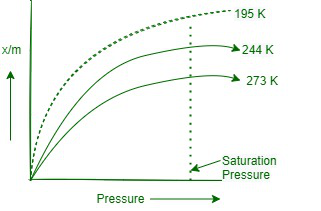
The amount of adsorption of a gas per unit mass of the adsorbent depends on the pressure of the gas. The relationship between the amount of adsorbent at a constant temperature and the pressure (or concentration for a solution) of the equilibrium gas is called the adsorption isotherm.
It can be expressed as an equation or a graphical curve (or plot). The amount of adsorption is usually expressed as x/m where x is the mass of the adsorbent and m is the mass of the adsorbent. The simplest type of adsorption is
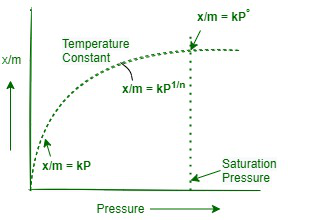
👁 ImageIt is clear from the figure that the adsorption limit (x/m) increases as the pressure increases and reaches a maximum corresponding to the pressure P, which is called the equilibrium pressure. Since adsorption is a reversible process, adsorption also does not occur simultaneously. At this pressure (P), the volume of the adsorbed gas becomes equal to the volume of the dehydrated gas, so that the extent of the adsorbent remains constant even when the pressure is increased. This state is called saturation state and P is called saturation pressure. Scientists have tried to explain adsorption in terms of some empirical mathematical relationship called adsorption isotherm.
The variation of extent of adsorption (x/m) with pressure (P) at a particular temperature was given mathematically by Freundlich in 1909. From the adsorption isotherm as drawn, the following observations can be easily made as:
x/m ∝ P
or
x/m = kP ... (i)
where k is a constant.
x/m ∝ constant
or
x/m ∝ P° (P° = 1) ... (ii)
x/m = kP°
x/m ∝ P1/n
x/m = kP1/n ... (iii)
where n can take any whole number value which depends upon the nature of adsorbate and adsorbent. The above relationship is also called Freundlich's adsorption isotherm.
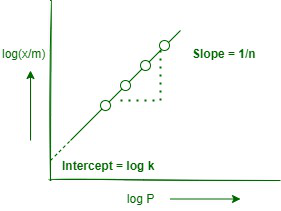
Taking logarithms on both sides of Eq. (iii), we get
log(x/m)= log k + (1/n) log P ... (iv)
Thus, if we plot a graph between log (x/m) on y (ordinate) and log P, on the x-axis (abscissa), a straight line will be obtained. This also shows the validity of Freundlich's isotherm. The slope of the line is equal to Un and the intercept is equal to log k.
Limitations of Freundlich adsorption isotherm: Freundlich's adsorption isotherm fails at the high pressure of the gas. Therefore, this relation is considered to approximate and is applicable only at low pressures. Irving Langmuir derived a simple adsorption isotherm on the theoretical considerations based on the kinetic theory of gases. This is named Langmuir adsorption isotherm.
Question 1. Distinguish between the meanings of the words adsorption and absorption. Give one example each.
Answer:
Adsorption is a phenomenon in which the concentration of another substance is greater on the surface than in the bulk. Absorption is a phenomenon in which the molecules of one substance are evenly distributed throughout the body of another substance. For example, silica gel absorbs water vapor while anhydrous calcium chloride absorbs water.
Question 2. Give cause why nicely divided material is frequent emphatic as an adsorbent.
Answer:
Finely divided materials have more surface area and hence more adsorption.
Question 3. Why are lyophilic colloidal sols much static than lyophobic colloidal sols?
Answer:
Lyophilic colloidal sols are much static because they are highly hydrated in solution
Question 4. Give one test to distinguish whether the given emulsion is oil in water type or water in oil type emulsion.
Answer:
It can be identified by dilution test. Thus, the emulsion is diluted with water. If the emulsion is diluted with water, it means that water serves as the dispersion medium and is an example of an oil in water emulsion. If, it is not dilute, the oil serves as the dispersion medium and this oil is an example of water in emulsion.
Question 5. What is observed when sodium chloride is added to a colloidal solution of ferric hydroxide?
Answer:
When sodium chloride is added to ferric hydroxide sol, the sol. accumulates. This is because Cl- ions from NaCl neutralizes the positive charge on Fe(OH) sol.
Question 6. What is the difference between sol and gel?
Answer:
In sol, the dispersion medium is liquid and the dispersion phase is solid. On the other hand, in a gel, the refraction to the solid and dispersed state is liquid.
Question 7. What is the sign in the △H and △S when gas is adsorbed by an adsorbent?
Answer:
Adsorption is an exothermic process, so △H is always negative and △S is also negative because after adsorption of gas, entropy decreases.