|
VOOZH | about |
|
VOOZH | about |
Amines are organic compounds derived from ammonia (NH₃) in which one or more hydrogen atoms are replaced by alkyl or aryl groups. They contain a nitrogen atom with a lone pair of electrons, which gives them basic properties.
In simple terms, amines are made up of nitrogen, carbon, and hydrogen arranged in different structures. They occur naturally in proteins, vitamins, and hormones and are widely used in medicines, cleaning products, and food-related compounds.
Amine Examples
- CH₃–NH₂ (Methylamine)
- C₆H₅–NH₂ (Aniline)
- CH₃–NH–CH₃ (Dimethylamine)
- (CH₃)₃N (Trimethylamine)
The nomenclature of amines can be done by naming the alkyl or aryl group as a substituent and then adding the suffix 'amine' to it. For example, CH₃NH₂ is named as methylamine.
If two or more identical alkyl groups are attached to the amine, then 'di' and 'tri' prefixes are added to its name. For example: Diethylamine ((CH₃CH₂)₂NH), Trimethylamine ((NCH₃)₃), etc.
Some aromatic amines and many cyclic amines have names that are commonly used and might be used as a base name. For example, aniline can be used as a parent name to assign other related compounds, like N, N-dimethylaniline.
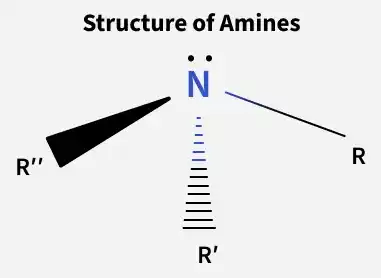
Amines are organic compounds that contain nitrogen, often derived from ammonia. Their structure consists of a central nitrogen atom bonded to hydrogen atoms and other organic groups. The general chemical structure of amines involves a nitrogen atom bonded to hydrogen atoms and/or organic groups.
👁 420851505A primary amine is the simplest type of amine. It has a nitrogen atom that is connected to two hydrogen atoms and one organic group. The structure can be represented as follows:
NH2-R
Here, NH2 represents the amine group (nitrogen bonded to two hydrogen atoms), and -R represents the organic group attached to the nitrogen.
Secondary amines have two organic groups attached to the nitrogen:
NH-R2
Tertiary amines have three organic groups attached to the nitrogen:
N-R3
These structures are general representations, and specific examples may involve different organic groups.
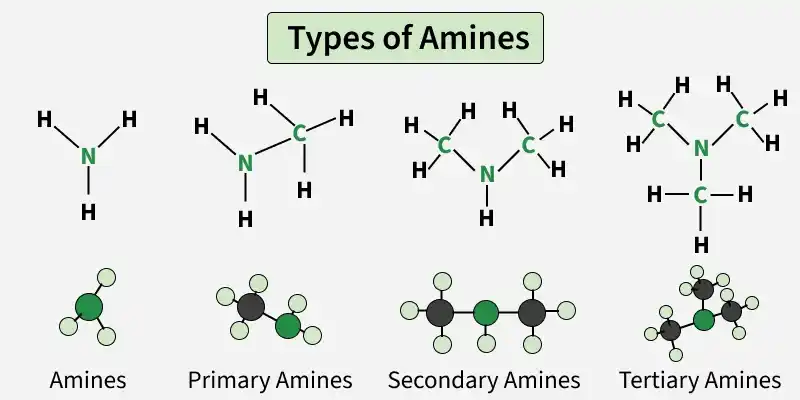
Amines are organic compounds containing nitrogen atoms. They are classified based on the number of carbon groups attached to the nitrogen atom. The classification of amine is as follows:
👁 types_of_aminesPrimary amines are molecules containing one nitrogen atom bonded to two hydrogen atoms and one carbon atom. In primary amines, only one hydrogen atom is replaced by an alkyl or aryl group. An example of a primary amine is methylamine (CH₃NH₂).
Secondary amines are molecules with a nitrogen atom bonded to two carbon atoms and one hydrogen atom. Here, two hydrogen atoms are replaced by an organic substituent. Dimethylamine ((CH₃)₂NH) is an example of a secondary amine.
Tertiary amines consist of a nitrogen atom bonded to three carbon atoms, lacking any hydrogen directly attached to the nitrogen. In tertiary amines, all the hydrogen atoms are replaced by respective alkyl or aryl groups. Trimethylamine ((CH₃)₃N) is a tertiary amine.
Aliphatic amines are amines where the nitrogen atom is part of an aliphatic carbon chain (linear or branched).
Example: Ethylamine (CH₃CH₂NH₂) is an aliphatic amine.
Aromatic amines have a nitrogen atom attached to an aromatic ring (a ring with alternating double bonds).
Example: Aniline (C₆H₅NH₂) is an aromatic amine.
The formula of amines is dependent upon the type of amine. The formula according to the number of organic groups attached to it is given below:
Type of Amine | Formula | Example |
|---|---|---|
Primary Amine | NH2-R | CH3NH2 |
Secondary Amine | NH-R2 | (CH3)2NH |
Tertiary Amine | N-R3 | (CH₃)₃N |
Property | Description |
|---|---|
Structure | Amines are organic compounds containing nitrogen. |
Classification | Classified of amines is based on the number of alkyl groups attached to the nitrogen atom: primary, secondary, or tertiary. |
Bonding | Characterized by a nitrogen atom bonded to hydrogen and/or alkyl groups. |
Physical State | Can exist as gases, liquids, or solids at room temperature. |
Odor | Often possess a distinct, often pungent, ammonia-like odor. |
Solubility | Generally soluble in water due to the ability to form hydrogen bonds. |
Basicity | Exhibit basic properties, capable of accepting protons (H⁺) in reactions. |
Amines, like ammonia, are molecules containing nitrogen atoms. "Basicity" refers to their ability to accept protons (H⁺ ions). Amines are basic because nitrogen can readily share its lone pair of electrons.
When amines react with acids, they form ammonium ions by accepting a proton. This behavior showcases their basic nature. The more available lone pairs, the stronger the base.
Primary amines, with two hydrogen atoms, are more basic than secondary amines, and secondary amines are more basic than tertiary amines.
Amines, being versatile in nature, have a wide range of applications. A few applications of amines are as follows:
The difference between Amides and Amines is given below:
Characteristic | Amides | Amines |
|---|---|---|
Functional Group | RCONH2 | RNH2 |
Composition | A carbonyl group is bonded tonitrogen atom. | Nitrogen atom bonded to one or more organic groups. |
Examples | Acetamide (CH3CONH2) | Methylamine (CH3NH2) |
Boiling Point | Amides have relatively higher boiling point. | Amines have relatively lower boiling points. |
Basicity | Amides are weak bases due to the carbonyl group. | Amines are basic because the nitrogen atom has a lone pair of electrons. |