Metals are very important for our daily life, and most of them are obtained from ores found in the Earth’s crust. These ores contain impurities along with the desired metal, so they cannot be used directly. To obtain pure metal from these ores, a series of processes is carried out, which is known as metallurgy.
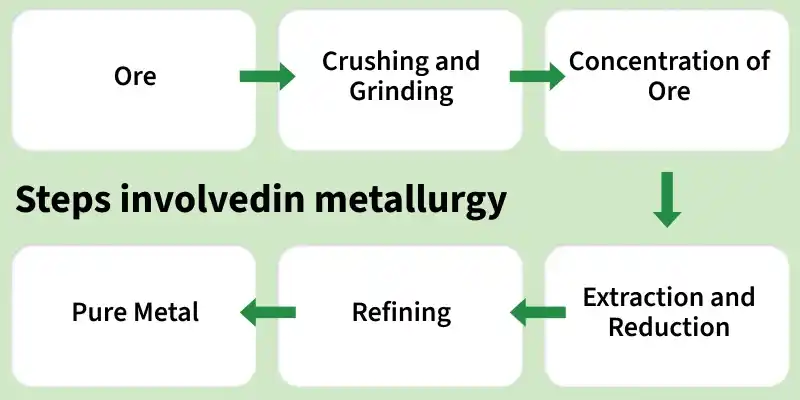
Metallurgy involves different steps that help in separating the metal from its ore and removing impurities. First, the ore is crushed and ground into smaller pieces to make it easier to process. Then, it is concentrated to remove unwanted substances called gangue. After that, the metal is extracted from the concentrated ore using suitable methods depending on its reactivity. Finally, the extracted metal is purified to obtain it in a pure form suitable for use.
Steps Involved in Metallurgy
Metallurgy involves a series of steps to extract pure metal from its ore. Since ores contain impurities, these steps are necessary to obtain the metal in a usable and pure form.
In this step, the ore obtained from the earth is first broken down into smaller pieces using crushers and grinders.
This increases the surface area of the ore, making it easier to remove impurities and carry out further processes efficiently.
2) Concentration of Ore (Ore Enrichment)
The crushed ore contains unwanted impurities called gangue.
These impurities are removed to increase the percentage of metal in the ore.
This process is called concentration or enrichment of ore.
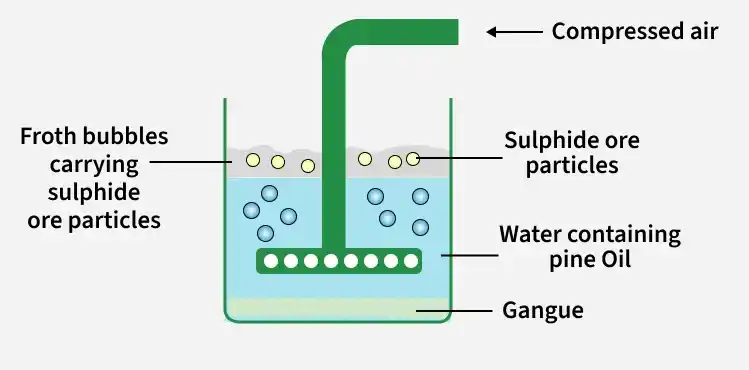
Common methods include hydraulic washing, magnetic separation, and froth flotation, depending on the nature of the ore.
3) Extraction and Reduction of Metal
After concentration, the metal is extracted from the ore.
This involves converting the ore into its oxide form by processes like roasting (heating in air) or calcination (heating in limited or no air).
The metal oxide is then reduced to obtain the metal.
The method used depends on the reactivity of the metal.
Less reactive metals are obtained by heating, while more reactive metals require electrolysis.
4) Refining (Purification of Metal)
The metal obtained after extraction is not completely pure and contains some impurities.
These impurities are removed in the refining process to obtain pure metal.
One common method is electrolytic refining, where electricity is used to separate pure metal from impurities.
Concentration of Ore
After the ore is crushed and ground into fine particles, it still contains a large amount of unwanted materials such as sand, clay, and rocky substances. These impurities are known as gangue. The process of removing gangue from the ore to increase the percentage of metal is called concentration of ore or ore enrichment. This step is very important because it improves the quality of the ore and makes the extraction of metal easier and more economical.
Methods of Concentration of Ore
Different methods are used depending on the type of ore and impurities:
1) Hydraulic Washing (Gravity Separation)
This method is based on the difference in densities of ore and gangue.
Powdered ore is washed with a stream of water.
Heavier ore particles settle at the bottom due to gravity.
Lighter impurities (gangue) are carried away by water.
Example: oxide ores like iron ores.
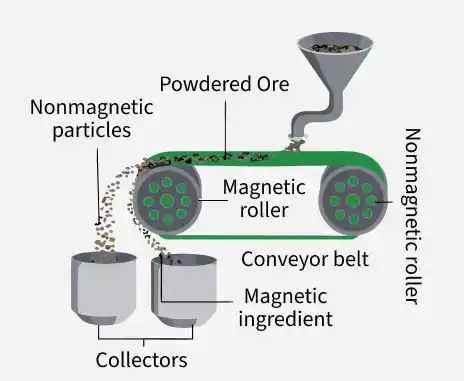
2) Magnetic Separation
This method is based on the magnetic properties of the ore or impurities.
The crushed ore is passed over a conveyor belt with a magnetic roller.
Magnetic particles are attracted towards the magnet and separated.
Non-magnetic impurities fall away separately.
Example: Separation of magnetic iron ore from non-magnetic impurities.
After the ore is concentrated, the next important step is the extraction of metals. Most metals in nature are found in the form of compounds such as oxides, sulphides, or carbonates. These compounds cannot be used directly, so the metal must be separated from them. This process mainly involves converting the ore into a suitable form (usually oxide) and then reducing it to obtain the metal.
1) Conversion of Ore into Metal Oxide
Metals are easier to extract from their oxides, so ores are first converted into oxides by heating.
(c) Reduction by Electrolysis (for highly reactive metals)
Highly reactive metals like sodium, potassium, and aluminium cannot be reduced using carbon
They are extracted by passing electricity through molten compounds
Example: Aluminium is extracted from molten aluminium oxide using electric current
Refining or Purification of Metals
After the extraction process, the metal obtained is not completely pure. It contains small amounts of impurities such as other metals, non-metals, or leftover substances from the extraction process. These impurities can affect the properties and usefulness of the metal.
Therefore, the impure metal is purified to obtain a high degree of purity. This process is called refining or purification of metal. It is the final step in metallurgy and ensures that the metal is suitable for industrial and daily use
1) Electrolytic Refining (Most Common Method)
This method uses electricity to purify metals
The impure metal is made the anode, and a thin sheet of pure metal is made the cathode
A suitable electrolyte (solution of the metal) is used
When electric current is passed, pure metal from the anode dissolves into the solution
It gets deposited on the cathode as pure metal
Impurities either settle at the bottom as anode mud or remain in solution
Example: Purification of copper
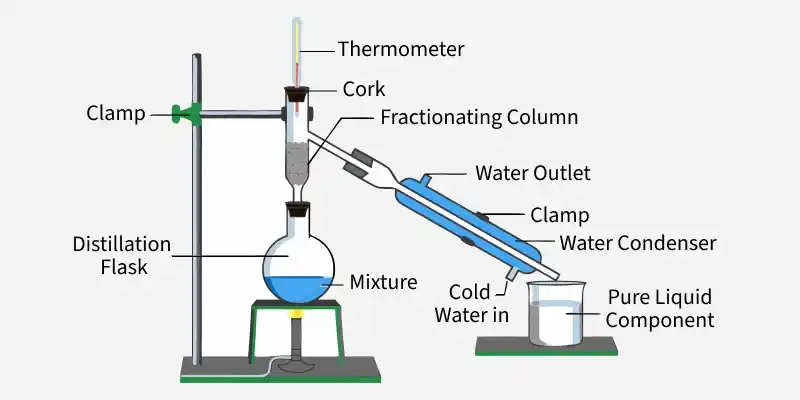
2) Distillation
Distillation is used for metals with low boiling points like zinc and mercury
The metal is heated to form vapours, which are then cooled to obtain pure metal
Impure metal is heated strongly in a furnace.
Metal with a low boiling point converts into vapour.
These vapours are then cooled and condensed to form pure metal.
Impurities, which have higher boiling points, are left behind and do not vaporize.
Example: Metals like zinc and mercury are purified by distillation