|
VOOZH | about |
|
VOOZH | about |
Beryllium is an important chemical element that occurs in Earth's surface. Beryllium does not occur freely in nature, it occurs only in the combination with other elements which forms a mineral form. Generally at room temperature, Beryllium is brittle and solid element.
In this article, we learn all the important details related to Beryllium, its physical and chemical properties, uses of Beryllium.
Symbol | Be |
|---|---|
Atomic Number | 4 |
Atomic Mass | 9.01218 g.mol-1 |
Group | 2 |
Period | 2 |
Electronic configuration | [He] 2s2 |
Discovered by | Nicholas Louis Vauquelin |
Beryllium is a chemical element that does not occur freely in nature, it occurs only in the combination with other elements. Beryllium exist in nature in form of compound as combination of various elements.
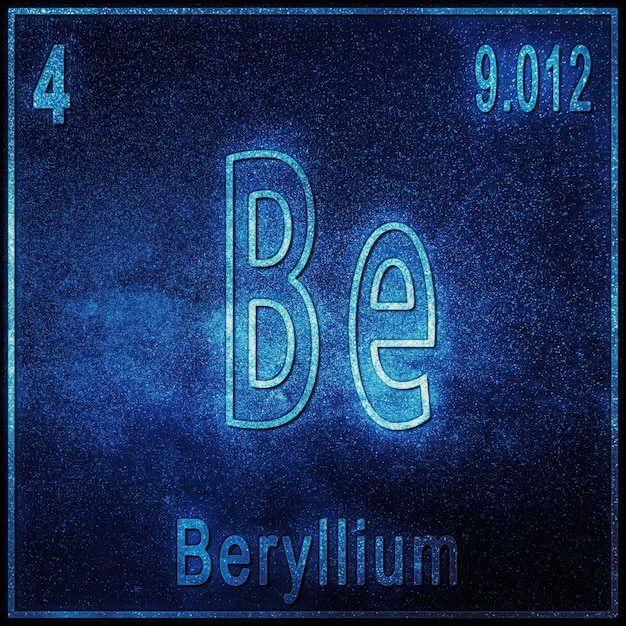
👁 Beryllium chemical element, Sign with atomic number and atomic weight, Periodic Table ElementMost important and common types of minerals of Beryllium are Beryl (Al2Be3Si6O18 , Beryllium Aluminum Silicate), Bertrandite (Be4Si2O7(OH)2,Beryllium Silicate), Phenakite (Be2SiO4), and Chrysoberyl (BeAl2O4). Atomic number of Beryllium is 4 and it's symbol is Be. Beryllium is placed in group 2 in periodic table. Beryllium is highly toxic type element, at room temperature around 20°C, Beryllium occurs as solid.
French scientist Nicholas Louis Vauquelin discovered Beryllium in 1798.
Chemical data of Beryllium of are:
Symbol | Be |
|---|---|
Group | 2 [Alkaline Earth Metal} |
Period |
2 |
Atomic Number |
4 |
Color | Steel Grey |
Block | s-block |
State at Room Temperature | Solid and brittle |
Melting Point | 1287°C, 2349°F, 1560 K |
Boiling Point | 2468°C, 4474°F, 2741 K |
Atomic Mass | 9.01218 g.mol-1 |
Density (g.cm-3) |
1.85 |
Electron Configuration | [He] 2s2 |
Oxidation State |
+2 |
Critical Point | 5205 K |
Heat of Fusion | 12.2 kJ/mol |
Heat of Vaporization | 292 kJ/mol |
Molar Heat Capacity | 16.443 J/(mol·K) |
Isotopes | 7Be, 8Be, 9Be, 10Be |
Atomic number of Beryllium is 4. It has 4 electrons and the electron configuration is 1s22s2. Beryllium forms covalent bonds and it can exhibit ionic characteristics.
Beryllium is the lightest element of alkaline earth metal group. It has very high meting point. The chemical properties of Beryllium is similar to Aluminum. Properties of Beryllium is further classified into two types that are:
Various physical properties of Beryllium are added in table below:
State at 20oc | Solid and Brittle |
|---|---|
Color | White grey or steel grey |
Taste | Sweet |
Atomic Number |
4 |
Atomic Mass | 9.01218 g.mol-1 |
Boiling point | 2468°C / 4474°F / 2741 K |
Melting point | 1287°C / 2349°F / 1560 K |
Density | 1.85 gram per cubic centimeter |
Atomic Structure |
|
Solubility |
|
Conductivity of thermal | Highly Thermal Conductor [200 W/(m·K) at 25°C] |
Electrical Conductivity | Good conductor of Electricity but less as compared to other metals. |
Magnetic Susceptibility | -9.0·10⁻⁶ cm³/mol (diamagnetic) |
Crystalline structure | Hexagonal |
Specific Heat | 1.82 J/(g·K) at 25°C |
Young’s Modulus | 287 GPa |
Tensile Strength | 370 MPa |
Elastic Modulus | 300 GPa |
Reflectivity | Approximately 67% at 600 nm (Visible Light Spectrum) |
Various chemical properties of Beryllium includes:
Beryllium does not occur free in nature, it forms alloys with the combination of other elements. There are several compounds of beryllium present in Earth crust. These are as follows -
Isotopes | Natural Abundance | Half-Life | Mode of Decay | Significance |
|---|---|---|---|---|
Be-7 | Trace | 53.12 days | Electron capture to Li-7 | Used in radiological studies and radiological dating. |
Be-8 | None (synthetic) | 6.7×10⁻¹⁷ seconds | Alpha decay to two He-4 nuclei | Used in nuclear physics. |
Be-9 | Easily occur. | Stable |
--- | Only stable isotope of beryllium. |
Be-10 | Trace | 1.39 million years | Beta decay to B-10 | Used for the dating of soils and sediments. |
Be-11 | None (synthetic) | 13.81 seconds | Beta decay to B-11 | Used in the applications of nuclear physics. |
Be-12 | None (synthetic) | 21.49 milliseconds | Beta decay to C-12 | It has importance, in nuclear physics. |
Uses and applications of Beryllium are as follows: