|
VOOZH | about |
|
VOOZH | about |
Carboxylic acids are organic compounds containing the –COOH (carboxyl) functional group, which consists of a carbonyl (C=O) and hydroxyl (–OH) group attached to the same carbon atom.
They occur naturally and can also be synthesized. Some carboxylic acids, known as fatty acids, are aliphatic compounds commonly found in natural fats as glycerol esters, typically with chain lengths from C₁₂ to C₁₈.
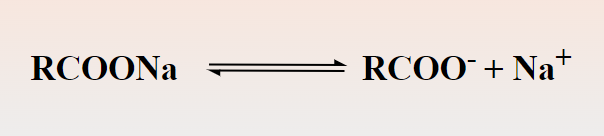
Carboxylic acids can lose a proton to form carboxylate ions (R–COO⁻), which are used to make salts such as soaps. They also serve as important precursors for compounds like esters, acid chlorides, anhydrides, and amides.
A carboxylic acid consists of a -COOH group. The open bond attached to the C atom shows that a long carbon chain can be attached to it. Among the two oxygen atoms, one is attached to the C atom with a double bond, while another O atom is attached to C with an H atom as an alcohol group.
Examples of Carboxylic Acid
To name any carboxylic acid chain, we can use the following steps:
Step 1: Identify the longest chain: Find the longest continuous carbon chain that contains the carboxyl group (–COOH). This chain serves as the parent chain for the name.
Step 2: Number the carbon atoms: Start numbering from the end closest to the carboxyl group, and assign the lowest possible numbers to the carbon atoms bearing the carboxyl group.
Step 3: Name the alkyl groups: If there are alkyl groups attached to the parent chain, identify and name them as substituents. Use prefixes like methyl, ethyl, propyl, etc., to indicate the number of carbon atoms in the alkyl group.
Step 4: Name the carboxyl group: The carboxyl group is named "oic acid." The carbon atom directly attached to the carboxyl group is numbered carbon 1. For example, a carboxyl group attached to a two-carbon chain is called "ethanoic acid."
Step 5: Use prefixes for multiple carboxyl groups: If there are multiple carboxyl groups present in the compound, use Greek numerical prefixes like "di-" (two), "tri-" (three), etc., to indicate the number of carboxyl groups. The carbon chain containing the carboxyl groups becomes the parent chain.
Step 6: Include substituents: If there are other functional groups or substituents present in the molecule, name and locate them according to the IUPAC rules.
Example: IUPAC name of compound CH₃CH₂COOH.
Solution:
This compound contains a two-carbon chain with a carboxyl group i.e., 3 carbon atoms in parent chain. The parent chain is propane, and the carboxyl group is named "oic acid." Therefore, the name of this compound is "propanoic acid."
Example: IUPAC name of compound CH₃CH₂CH₂COOH.
Solution:
This compound contains a three-carbon chain with a carboxyl group i.e., 4 carbon atoms in longest chain. The parent chain is butane, and the carboxyl group is named "oic acid." Therefore, the name of this compound is "butanoic acid."
Carboxylic can be prepared using various techniques that are discussed below.
Primary alcohols can be oxidized to carboxylic acids using strong oxidizing agents such as potassium permanganate (KMnO₄) or chromic acid (H₂CrO₄). The alcohol is initially converted to an aldehyde, which is further oxidized to the carboxylic acid. The reaction typically requires the presence of an acid catalyst.
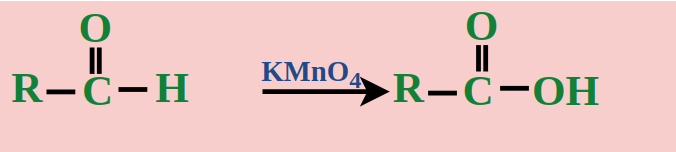
Aldehydes can be oxidized to carboxylic acids using similar oxidizing agents as mentioned above. The aldehyde is directly converted to the carboxylic acid without an intermediate step. The reaction also requires an acid catalyst.
Nitriles, which are organic compounds containing a cyano group (C≡N), can be hydrolyzed to carboxylic acids under acidic or basic conditions. In acidic conditions, nitriles are converted to amides, which are then further hydrolyzed to carboxylic acids. In basic conditions, nitriles are directly hydrolyzed to carboxylic acids.
Alkyl benzenes, which are aromatic compounds containing an alkyl group attached to a benzene ring, can be oxidized to benzoic acids using strong oxidizing agents like potassium permanganate or chromic acid. The reaction typically requires high temperatures and the presence of an acid catalyst.
Carboxylic acids can also be prepared by the reaction of a Grignard reagent (organomagnesium compound) with carbon dioxide (CO₂). The Grignard reagent reacts with CO₂ to form a carboxylate salt, which can be subsequently acidified to yield carboxylic acid.
Some physical properties of carboxylic acids are as follows:
Carboxylic acids are very reactive compounds; thus, they go through various different chemical reactions. Some of these reactions are as follows:
Carboxylic acids react with metals like potassium, sodium, magnesium, and calcium to create salts. A proton will be liberated from the carboxyl group of the carboxylic acid throughout the reaction step, which is where the metal substitution will take place. H2 gas is produced in this process.
2CH3COOH + 2Na ⇢ 2CH3COONa + H2
Carboxylic acids decompose into salts, water, and carbon dioxide gas when they come into contact with carbonates and bicarbonates.
2CH3COOH + Na2CO3 ⇢ 2CH3COONa + H2O + CO2
This reaction can also be used to see if a carboxyl group is present. Effervescence is produced when carboxylic acids combine with a saturated sodium bicarbonate solution, releasing CO₂.. In an aqueous NaHCO₃ solution, however, most phenols do not produce effervescence. As a result, the reaction of bicarbonate with carboxylic acids aids in the differentiation of phenols from carboxylic acids.
Carboxylic acids react with alkalis, forming salts and water in the process.
CH3COOH + NaOH ⇢ 2CH3COONa + H2O
Reducing Agents: LiAlH₄ in ether solution or with H₂O in the presence of a copper chromite (CuCr₂O₄) catalyst, BH₃/THF (or diborane, B₂H₆), H₂, Ru, and so on.
Carboxylic acids go through nucleophilic substitution. Some of these nucleophilic substitutions are
Acid chlorides are formed when carboxylic acids combine with thionyl chloride (SOCl₂), phosphorus pentachloride (PCl₅), or phosphorus trichloride (PCl₃). To understand the reaction, look at the examples below.
RCOOH + SOCl2 ⇢ RCOCl + SO2 + HCl
RCOOH + PCl5 ⇢ RCOCl + POCl3 + HCl
When carboxylic acids and alcohols are heated in the presence of strong sulfuric acid or dry hydrochloric acid, fruity esters result.
Sulfuric acid is used as a dehydrating agent in this reaction. An equilibrium reaction is a reaction, for example. As a result, to keep the reaction moving forward, the ester is distilled.
The generation of acid anhydrides occurs when two molecules of carboxylic acid are heated with a dehydrating agent such as phosphorus pentoxide.
2RCOOH ⇢ RCO-O-RCO + H2O
Ammonium salts are produced by treating carboxylic acids with ammonia. Ammonium salts lose a water molecule when heated, resulting in amide production.
Carboxyl group compounds, i.e., derivatives of carboxylic acids, are also very reactive compounds in nature. Thus, they also go
(RCOO)2Ca{Calcium Salt} ⇢ RCOR{Ketone} + CaCO3
Formaldehyde is produced by heating calcium formate.
(HCOO)2Ca⇢ HCHO{Formaldehyde} + CaCO3
An aldehyde is generated when a calcium salt of an acid (other than formic acid) and calcium formate are heated together.
(CH3COO)2Ca{calcimu Acetate} + (HCOO)2Ca{Calcium Formate} ⇢ 2CH3CHO{Acetaldehyde} + CaCO3
Alkane nitrile is formed by passing a combination of acid and NH₃ over overheated alumina.
R-(C=O)-OH + NH3⇢ R-CN + 2H2O
There are various name reactions that involve carboxylic acids; some of these name reactions are
Let's understand these reactions in detail.
Alkanes are produced by the electrolysis of fatty acid salts (concentrated aqueous solution).
At the anode: 2RCOO⁻⇢ R-R + 2CO₂ + 2e⁻
At Cathode: 2Na⁺ + 2e⁻ ⇢ 2Na ⇢ 2NaoH + H₂
Radial intermediates are present during the reaction.
When monocarboxylic acid's silver salt is treated with halogen, an alkyl halide is produced.
In the presence of a catalyst, a carboxylic acid with an α-hydrogen is treated with Cl₂ or Br₂.. Chlorine or bromine atoms substitute for the α-hydrogen.
RCH2COOH{Carboxylic Acid} + Cl2 ⇢ RCHClCOOH{α-Chlorinated Acid} ⇢ RCCl2COOH{α, α-dichloro Acid}
Simonini Relations refer to the reaction of silver carboxylic acid salts with iodine.
Carboxylic acids are one of the most used compounds in organic chemistry. Some of these use cases of carboxylic acid are as follows:
Carboxylic acids such as acetic acid, citric acid, lactic acid, etc. are used as food additives for flavoring and preservation. For example, synthetic white vinegar is a diluted solution of acetic acid, citric acid is used as a flavoring agent in the majority of beverages, and lactic acid is a well-known flavor enhancer.
Carboxylic acids are used in the production of pharmaceutical drugs and cosmetic products either as active ingredients, pH adjusters, or preservatives. For instance, salicylic acid is used in acne treatments, and citric acid is used in skincare products for its exfoliating properties.
Many carboxylic acids are utilized as monomers in the production of various different polymers and plastics. For example, acrylic and methacrylic acids are used in the production of acrylic polymers, which find applications in paints, adhesives, and textiles.
Long-chain fatty acids (which are examples of carboxylic acids) are used in the production of soaps, detergents, and cleaning products.
Carboxylic acids are used in agricultural applications as herbicides, fungicides, and plant growth regulators. For example, acetic acid-based herbicides are used for weed control, and auxin-like carboxylic acids are used to promote plant growth.
Carboxylic acids serve as important intermediates in the synthesis of various chemicals. They can be used to produce esters, amides, anhydrides, and other derivatives. These derivatives have diverse applications in industries such as pharmaceuticals, perfumes, and plastics.
Carboxylic acids are used in textile dyeing and printing processes. They act as mordants, which help fix the dyes onto the fabric, improving color fastness.
Carboxylic acids find applications in various industrial processes. For example, formic acid is used in leather tanning, acetic acid is used in the production of vinyl acetate for adhesives, and adipic acid is used in the synthesis of nylon.
The compounds that are derived from the carboxylic acid are called the derivatives of the carboxylic acid. Various derivatives of the carboxylic acid are,