|
VOOZH | about |
|
VOOZH | about |
A chemical reaction is a process in which one or more substances (called reactants) are converted into new substances (called products) with different physical and chemical properties.
During a chemical reaction:
- Old bonds between atoms break.
- New bonds are formed.
- A new substance is produced.
Chemical reactions are represented using chemical equations and are often accompanied by observable characteristics that help identify them.
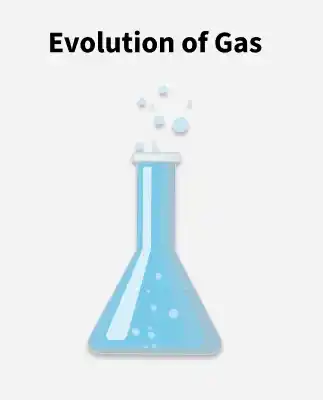
Some chemical reactions are identified by the production of a gas, which may be observed as bubbles or detected by its odour.
Example 1: Sodium sulfite reacts with dilute hydrochloric acid to produce sulfur dioxide gas.
Na2SO3 + 2HCl ⇢ 2NaCl + H2O + SO2
Example 2: Zinc reacts with sulfuric acid to produce hydrogen gas.
Zn + H2SO4 ⇢ ZnSO4 + H2
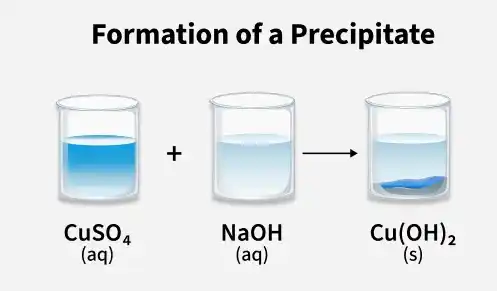
A precipitate is an insoluble solid that separates out from a solution during a chemical reaction. Its formation is a clear indicator that a chemical change has occurred.
Example 1: Copper sulfate reacts with sodium hydroxide to form a blue precipitate of copper hydroxide.
CuSO4 + 2NaOH ⇢ Na2SO4 + Cu(OH)2
Example 2: Silver nitrate reacts with sodium chloride to form a white precipitate of silver chloride.
AgNO3 + NaCl ⇢ NaNO3 + AgCl
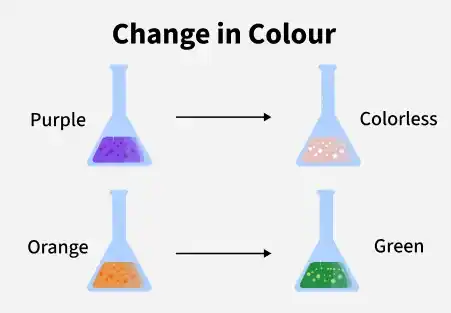
A visible change in colour during a reaction indicates the formation of a new substance with different chemical properties.
Example 1: Citric acid reacts with potassium permanganate solution, causing a colour change from purple to colourless, as citric acid acts as a reducing agent.
2MnO4− + 5C6H8O7 + 6H+→2Mn2++ 5C6H6O7 + 8H2O
Example 2: Sulfur dioxide reacts with acidified potassium dichromate solution, causing a colour change from orange to green.
SO2 + K2Cr2O7 + 3H2SO4 ⇢ K2SO4 +Cr2(SO4)3 + 3H2O
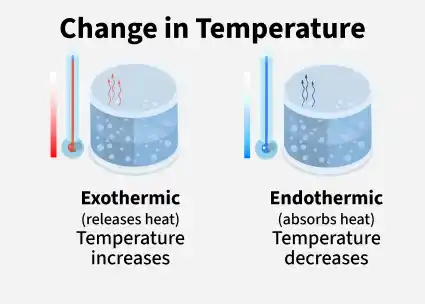
Chemical reactions are often accompanied by a change in temperature. Reactions that release heat are called exothermic, while those that absorb heat are called endothermic.
Example 1 (Exothermic): Quicklime reacts with water to form slaked lime, releasing a large amount of heat.
CaO + H2O ⇢ Ca(OH)2 + Heat
Example 2 (Endothermic): Barium hydroxide reacts with ammonium chloride, absorbing heat and causing a decrease in temperature.
Ba(OH)2 + 2NH4Cl→BaCl2 + 2NH3 + 2H2O
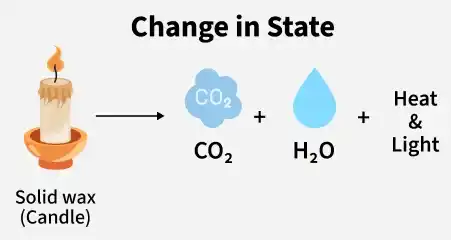
Some chemical reactions result in a change in the physical state of the substances involved, indicating the formation of new products.
Example: During the combustion of candle wax, the solid wax transforms into carbon dioxide gas and water vapour, accompanied by the release of heat and light.
CXHY + O2 ⇢ CO2 + H2O + Heat and Light