|
VOOZH | about |
|
VOOZH | about |
Matter is anything that has mass and occupies space. It is made up of tiny particles called atoms and molecules. Everything around us, such as air, water, plants, animals, and objects, is made of matter.
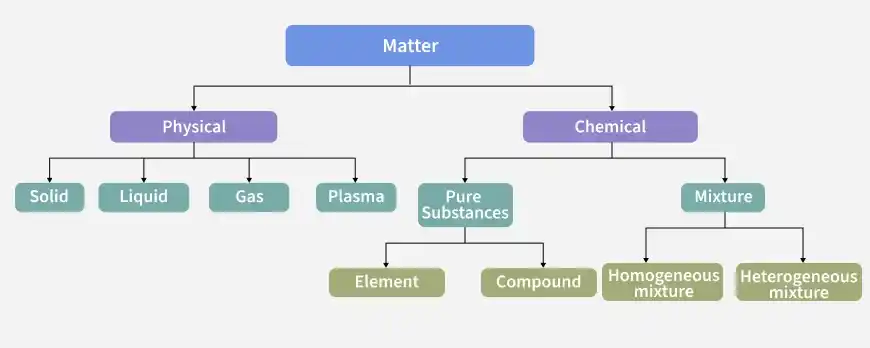
Classified into two main types:
👁 types_of_matter
In physical classification, matter is grouped based on its physical properties that can be observed without changing the substance. Based on its physical state, it is divided into solids, liquids, and gases, which differ in the arrangement and movement of their particles.
In chemical classification, matter is grouped according to its chemical composition and chemical properties, which involve changes in the substance. On this basis, it is divided into pure substances and mixtures, where pure substances include elements and compounds, and mixtures may be homogeneous or heterogeneous.
Matter is physically classified into different states based on the arrangement and movement of its particles. These states include solid, liquid, gas, plasma, and Bose–Einstein condensate.
1. Solid: A solid is a state of matter in which the particles are very closely packed and vibrate in fixed positions. It has a definite shape and definite volume.
Example: ice cube and wood.
2. Liquid: A liquid is a state of matter in which the particles are close together but can move past each other. It has a definite volume but no definite shape.
Example: water and milk
3. Gas: A gas is a state of matter in which the particles are very far apart and move freely in all directions. It has no definite shape and no definite volume.
Example: Nitrogen, Oxygen, etc.
4. Plasma: Plasma is a state of matter in which gas particles become ionized (electrons separate from atoms), forming charged particles (ions and electrons).It has no definite shape and no definite volume and can conduct electricity.
Examples: Sun, lightning, stars, neon signs, electric sparks.
5. Bose–Einstein Condensate (BEC): This is a special state of matter formed at extremely low temperatures. In this state, particles move very slowly and behave like a single unit, showing unified motion. BEC is usually created in laboratories near absolute zero temperature.
Matter is chemically classified into different types based on its composition and chemical properties. These types include pure substances and mixtures. Pure substances are further divided into elements and compounds, while mixtures are classified as homogeneous and heterogeneous mixtures.
Pure substance is classified into two types:
a) Elements
Examples: Iron (Fe), Copper (Cu), Oxygen (O₂)
b) Compounds
Examples: Water (H₂O), Sodium chloride (NaCl), Carbon dioxide (CO₂).
Mixture is classified into two types:
a) Homogeneous Mixture
Examples:
- Salt water – Salt dissolves completely in water.
- Sugar solution – Sugar mixed uniformly in water.
- Air – Mixture of nitrogen, oxygen, carbon dioxide, etc.
b) Heterogeneous Mixture
Examples:
- Oil and water – Form two separate layers.
- Sand and water – Sand settles at the bottom.
- Soil – Contains different visible particles.
| Pure Substance | Mixture |
|---|---|
| Consists of only one type of particles | Consists of two or more substances |
| Fixed composition | Variable composition |
| Homogeneous | May be homogeneous or heterogeneous |
| Components are chemically combined | Components are physically mixed |
| Definite physical and chemical properties | Properties depend on components present |
| Sharp and fixed melting and boiling point | No fixed melting and boiling point |
| Cannot be separated by physical methods | Can be separated by physical methods |
| Water, iron, oxygen | Air, salt + water, soil |
| Represented by a chemical formula | No fixed chemical formula |