Everything around us is made up of matter, which is composed of tiny particles called atoms and molecules. These particles are so small that they are invisible to the human eye. An atom is the smallest unit of an element that retains its chemical properties. Atoms combine with each other in different ways to form molecules, which are the smallest units of a substance that can exist independently.
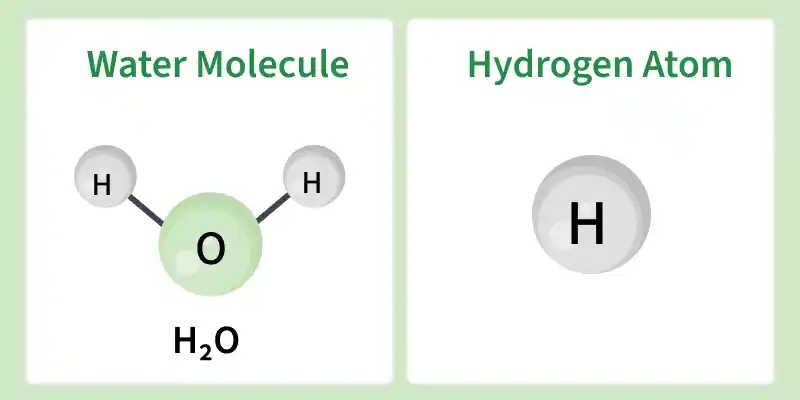
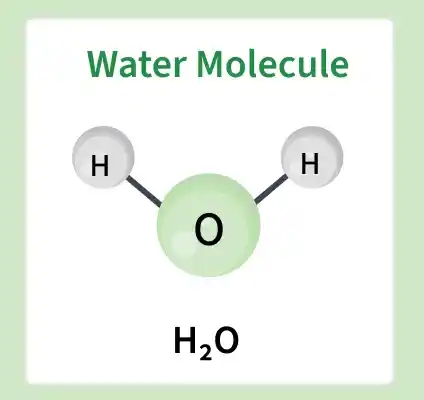
Example: A molecule of water (H₂O) is formed when two hydrogen atoms combine with one oxygen atom. Similarly, an oxygen molecule (O₂) consists of two oxygen atoms joined together.
Atoms have several important characteristics that help explain their behavior and role in chemical reactions. These characteristics describe the structure, mass, size, and composition of atoms.
Atoms are the basic fundamental building blocks of all types of matter.
Atoms are made up of even smaller particles called electrons, protons, and neutrons.
In an atom, protons and neutrons are inside its nucleus, and electrons revolve around it.
A proton in an atom is a positively charged species, an electron is a negatively charged species, and a neutron is a neutral species.
As a whole, an atom is an electrically neutral species.
An atom can donate and accept an electron.
If an atom donates an electron, it becomes positively charged, called a cation.
If an atom accepts an electron, it becomes negatively charged and is called an anion.
Atomic Size
Atomic size refers to the size or radius of an atom.
It is generally defined as the distance from the center of the nucleus to the outermost electron shell of the atom.
Since electrons do not have fixed positions and move in orbitals, it is difficult to measure the exact boundary of an atom.
Therefore, atomic size is usually estimated by measuring the distance between the nuclei of two bonded atoms.
Atomic size varies from one element to another.
It depends mainly on the number of electron shells and the nuclear charge.
When the number of electron shells increases, the size of the atom becomes larger.
Similarly, when the attraction between the nucleus and electrons increases, the atomic size becomes smaller.
Example: The atomic size increases from lithium (Li) to sodium (Na) because sodium has an extra electron shell. On the other hand, atomic size decreases across a period from carbon (C) to fluorine (F) due to the increase in nuclear charge.
Atomic Mass
Atomic mass refers to the mass of an atom.
It is mainly determined by the number of protons and neutrons present in the nucleus.
Since electrons have a tiny mass compared to protons and neutrons, their contribution to atomic mass is usually neglected.
Atomic mass is expressed in atomic mass units (amu).
One atomic mass unit is defined as one-twelfth of the mass of a carbon-12 atom.
The atomic mass of an element represents the average mass of all its naturally occurring isotopes.
Example: The atomic mass of carbon is about 12 amu, which means a carbon atom is twelve times heavier than one-twelfth of a carbon-12 atom.
Law of Chemical Combination
The laws of chemical combination explain how atoms combine to form compounds. These laws support the idea that matter is made of atoms, which combine in definite proportions to form molecules.
2)Law of Constant Proportions: A chemical compound always contains the same elements in a fixed ratio by mass.
Molecules
A molecule is the smallest unit of a substance that can exist independently and retain its chemical properties.
Molecules are formed when two or more atoms combine chemically through chemical bonds.
They can be made of atoms of the same or different elements.
Molecules are important because they make up all the substances we see around us, and understanding them helps explain chemical reactions and the properties of matter.
Examples:
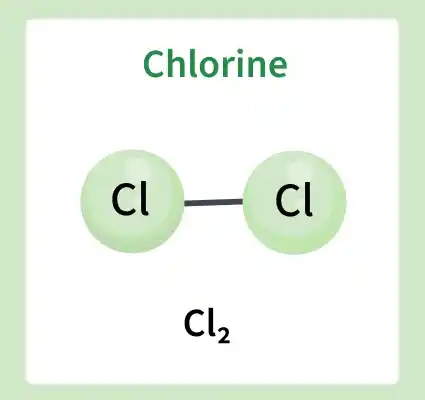
Oxygen molecule (O2): Made of two oxygen atoms.
Water molecule (H2O): Made of two hydrogen atoms and one oxygen atom.
Characteristics of a Molecule
Molecules are the basic units of chemical substances, and they have several important characteristics that help explain the properties of matter.
A molecule can exist in a solid, liquid, or gaseous state.
A molecule is formed by combining two or more atoms in a fixed ratio.
Various atoms in any molecule combined using different types of bonds
For a molecule, the ratio of combining different atoms never changes.
Some examples of the molecules are, H2O (Water molecule), O₂ (Oxygen molecule), NH₃ (Ammonia molecule), etc.
Molecular Mass
Molecular mass (also called molecular weight) is the sum of the atomic masses of all the atoms present in a molecule.
It tells us how heavy a molecule is compared to one-twelfth of a carbon-12 atom.
Molecular mass is usually expressed in atomic mass units (amu).
Knowing the molecular mass is important for calculating quantities in chemical reactions and understanding the properties of substances.
Example : Water (H₂O)
Hydrogen (H) = 1 amu × 2 = 2
Oxygen (O) = 16 amu × 1 = 16
Molecular Mass of H₂O = 2 + 16 = 18 amu
Types
Molecules can be classified based on the number of atoms they contain.
1) Monoatomic Molecules
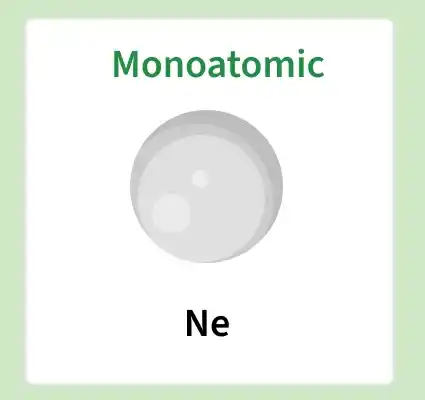
Monoatomic molecules are made of single atoms that exist independently.
They are usually noble gases because their outer electron shell is complete, making them stable and unreactive.