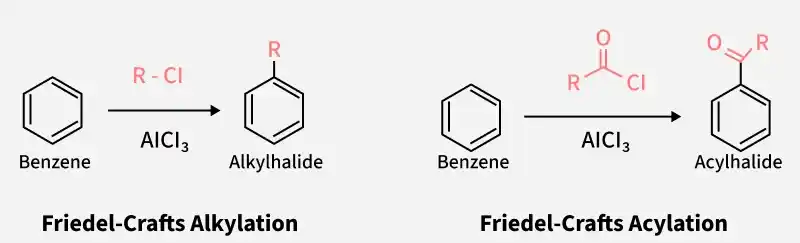
Aromatic compounds such as benzene undergo electrophilic substitution reactions in which a hydrogen atom of the ring is replaced by another group. Friedel–Crafts reaction is one such important reaction in which an alkyl or acyl group is introduced into the benzene ring in the presence of a Lewis acid catalyst such as anhydrous AlCl3.
These reactions are broadly classified into two types: Friedel–Crafts alkylation and Friedel–Crafts acylation.
1. Friedel–Crafts Alkylation
In Friedel–Crafts alkylation, an alkyl group (–R) is introduced into the benzene ring. The reaction takes place when an alkyl halide reacts with benzene in the presence of a Lewis acid catalyst. The catalyst helps in generating a strong electrophile, which attacks the aromatic ring.
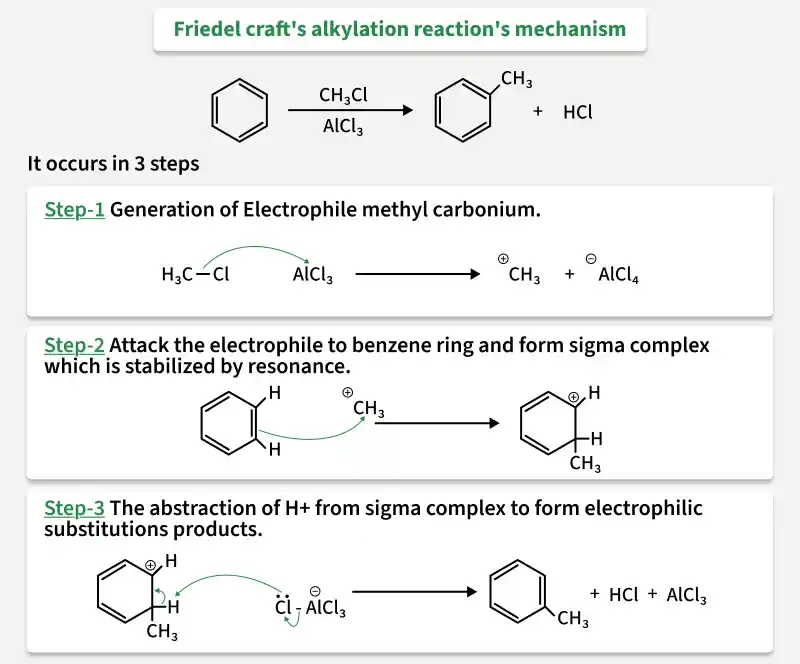
Example: Benzene reacts with methyl chloride (CH3Cl) in the presence of anhydrous AlCl3 to form toluene.
Mechanism of Friedel–Crafts Alkylation
The reaction proceeds through the following steps:
The alkyl halide reacts with AlCl3 to form a carbocation (R⁺).
This carbocation acts as the electrophile.
Step 2: Electrophilic Attack
The benzene ring, which is rich in π electrons, attacks the carbocation.
This results in the formation of a positively charged intermediate (arenium ion). In this step, the aromaticity of benzene is temporarily lost.
Step 3: Deprotonation
The intermediate loses a proton (H⁺), and the aromaticity of the ring is restored.
This gives the final alkylated product.
Arenium ion + AlCl4- → alkylbenzene + HCl + AlCl3
Limitations of Alkylation
Polyalkylation: The alkyl group introduced into the ring activates it, making it more reactive. As a result, multiple alkyl groups may enter the ring, leading to polyalkylation.
Carbocation Rearrangement: The initially formed carbocation may rearrange to a more stable carbocation, resulting in unexpected products.
Deactivated Rings Do Not React: Aromatic rings having strong electron-withdrawing groups such as –NO₂ do not undergo this reaction easily.
2. Friedel-Crafts Acylation
In Friedel-Crafts acylation, an acyl group (–CO–R) is introduced into the benzene ring using an acyl chloride or acid anhydride in the presence of AlCl3. This reaction is useful for preparing aromatic ketones.
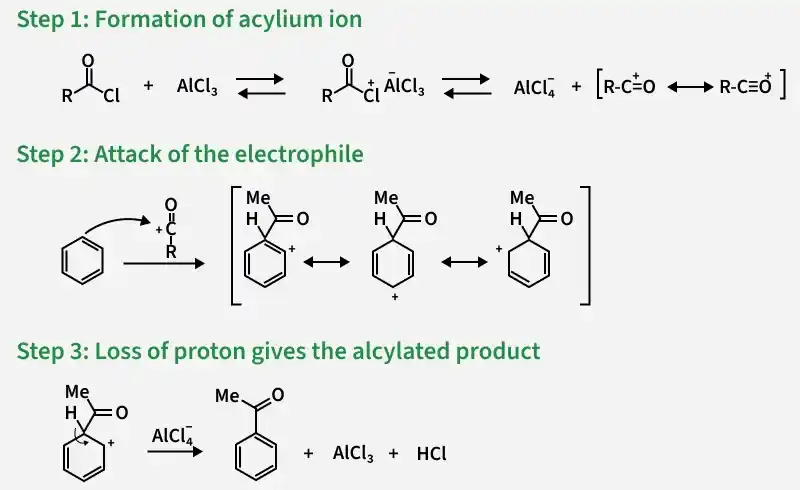
Example: Benzene reacts with acetyl chloride (CH3COCl) in the presence of AlCl3 to form acetophenone.
The acyl chloride reacts with AlCl3 to form an acylium ion (RCO⁺), which is stabilized by resonance.
This makes it a strong electrophile.
Step 2: Electrophilic Attack
The benzene ring attacks the acylium ion, forming a positively charged intermediate (arenium ion).
Aromaticity is temporarily lost in this step.
Step 3: Deprotonation
The intermediate loses a proton (H⁺), restoring aromaticity and forming the final acylated product.
Limitations of Acylation
Deactivated Rings Do Not React: Aromatic rings containing strong electron-withdrawing groups such as (−NO2) do not undergo Friedel–Crafts acylation easily because the ring becomes less reactive towards electrophilic substitution.
Lewis Base Groups Interfere with Reaction: Compounds containing groups such as (−NH2)and (−OH) form complexes with the Lewis acid catalyst (AlCl3), thereby preventing the reaction.
Requirement of Anhydrous Conditions: The reaction requires strictly anhydrous conditions because moisture reacts with the catalyst (AlCl3)and decreases its effectiveness.