|
VOOZH | about |
|
VOOZH | about |
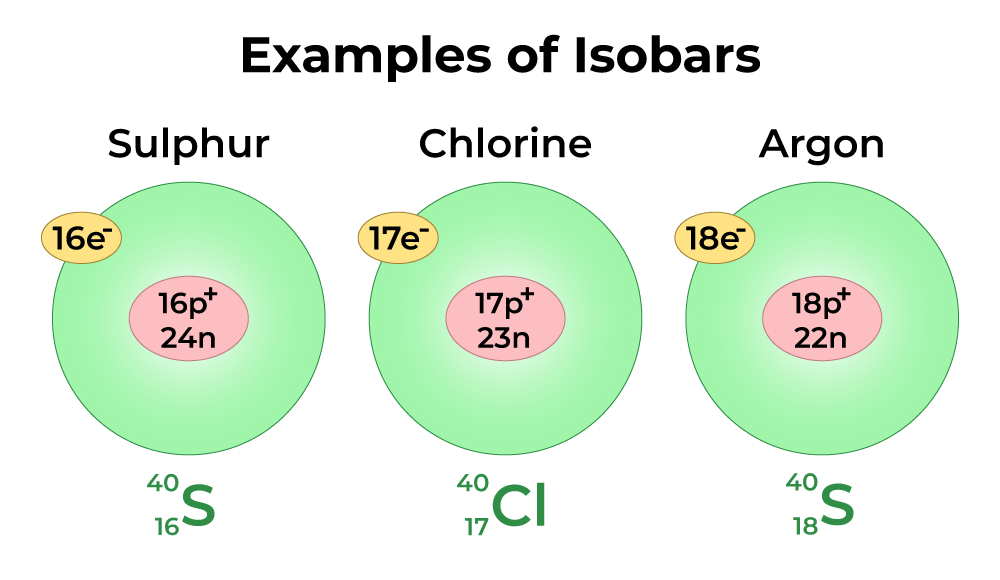
Isobars are atoms of different elements that have the same mass number but different atomic numbers. This means that isobars contain a different number of protons and electrons, but the total number of protons and neutrons (mass number) is the same. Isobars have different chemical properties since chemical behavior depends on the atomic number and electronic configuration.
These properties helps in understanding how isobars differ from isotopes and how they behave in atoms and chemical reaction.
There are several examples of Isobars in chemistry. These examples help us understand how atoms of different elements can have the same mass number but different atomic numbers
1) Argon, Calcium, and Potassium
| Atom | Atomic Number | Number of Neutrons | Mass Number |
|---|---|---|---|
| Argon(Ar) | 18 | 22 | 40 |
| Potassium(K) | 19 | 21 | 40 |
| Calcium(Ca) | 20 | 20 | 40 |
2) Sodium and Magnesium
| Atom | Atomic Number | Number of Neutrons | Mass Number |
|---|---|---|---|
| Sodium(Na) | 11 | 13 | 24 |
| Magnesium(Mg) | 12 | 12 | 24 |
3) Aluminium and Silicon
| Atom | Atomic Number | Number of Neutrons | Mass Number |
|---|---|---|---|
| Aluminium(Al) | 13 | 14 | 27 |
| Silicon(Si) | 14 | 13 | 27 |
4) Sulphur and Chlorine
| Atom | Atomic Number | Number of Neutrons | Mass Number |
|---|---|---|---|
| Sulphur(S) | 16 | 18 | 34 |
| Chlorine(Cl) | 17 | 17 | 34 |
5) Iron and Nickel
| Atom | Atomic Number | Number of Neutrons | Mass Number |
|---|---|---|---|
| Iron(Fe) | 26 | 32 | 58 |
| Nickel(Ni) | 27 | 31 | 58 |
Isobars are important in nuclear chemistry and scientific studies. The study of isobars helps scientists understand atomic structure, nuclear reactions, and the behavior of different elements.