|
VOOZH | about |
|
VOOZH | about |
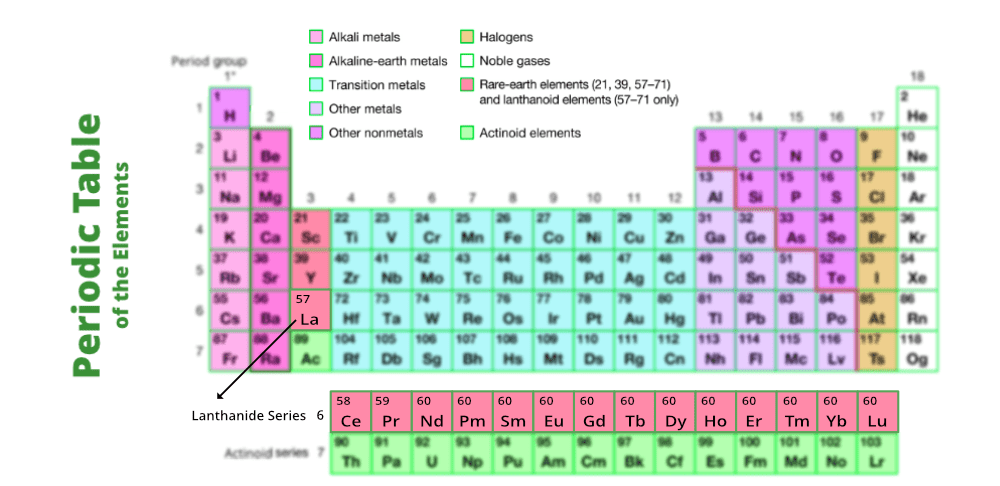
Lanthanides are the contemporary periodic table's rare earth elements, with atomic numbers ranging from 58 to 71 after Lanthanum. Rare earth metals are so-called because these elements are extremely rare (3 × 10⁻⁴ % of the Earth's crust). As lanthanide orthophosphates, they are accessible in 'monazite' sand.
Victor Goldschmidt, a Norwegian mineralogist, coined the name lanthanide in 1925. The lanthanide family is made up of fifteen metallic elements (ranging from lanthanum to lutetium), all of which are f-block elements except for one.
These elements' valence electrons are found in the 4f orbital. Lanthanum, on the other hand, is a d-block element with a [Xe] 5d1 6s2 electronic configuration.
Lanthanides are extremely dense elements, with densities varying between 6.1 and 9.8 grams per cubic centimetre. These elements, like other metals, have extremely high melting points (varying from 800 to 1600 degrees Celsius) and extremely high boiling points (ranging from roughly 1200 to 3500 degrees Celsius). Lanthanides are all known to generate Ln3+ cations. Lanthanides are extremely dense metals with melting values that are even higher than those of the d-block elements. They combine with other metals to make alloys. These are the f block elements, often known as the inner transition metals. Inner transition elements/ions may have electrons in the s, d, and f- orbitals.
Lanthanides of the first f-block have a terminal electronic configuration of [Xe] 4f1-14 5d0-1 6s2. Promethium (Pm), with atomic number 61, is the sole synthetic radioactive element among the fourteen lanthanides. Because the energies of 4f and 5d electrons are so similar, the 5d orbital remains unoccupied and the electrons enter the 4f orbital.
Exceptions: Gadolinium, Gd (Z = 64), where the electron enters the 5d orbital due to the existence of a half-filled d-orbital, and lutetium (Z = 71), where the electron enters the 5d orbital due to the presence of a half-filled d-orbital.
Because of the increasing nuclear charge and electrons entering the inner (n-2) f orbitals, the atomic size or ionic radius of tri positive lanthanide ions decreases steadily from La to Lu. Lanthanide contraction refers to the steady decrease in size with increasing atomic number. Its ramifications are as follows:
The lanthanide series elements all have an oxidation state of +3. Previously, some metals (samarium, europium, and ytterbium) were thought to have +2 oxidation states. Further study of these metals and their compounds has revealed that all lanthanide metals have a +2 oxidation state in their solution complexes. A few metals in the lanthanide class exhibit +4 oxidation states on occasion. The high stability of empty, half-filled, or fully filled f-subshells is attributable to the metals' unequal distribution of oxidation state. The oxidation state of lanthanides is affected by the stability of the f-subshell in such a way that the +4 oxidation state of cerium is preferred because it acquires a noble gas configuration, but it reverts to a +3 oxidation state and acts as a strong oxidant that can even oxidise water, albeit slowly.
Oxidation state in Aqueous Solution:Sm2+, Eu2+, and Yb2+ lose electrons in aqueous solution and oxidise, making them good reducing agents. Ce4+, Pr4+, and Tb4+, on the other hand, gain electrons and are good oxidising agents. Only oxides can achieve higher oxidation states (+4) of elements. As an example, consider the elements Pr, Nd, Tb, and Dy.
The reactivity of all lanthanides is similar, however it is larger than that of the transition elements. This is owing to the outer 5s, 5p, and 5d orbitals protecting unpaired electrons from the inner 4f-orbital. Except for CeO2, which interacts with hydrogen to generate solid hydrides at 300-400 C, the oxides of M2O3 are easily tarnished with oxygen. Water breaks down hydrides. Heat the metal with halogen or the oxide with ammonium halide to produce halides. Fluorides are insoluble, but chlorides are deliquescent. Nitrates, acetates, and sulphates are soluble in water, but carbonate, phosphate, chromates, and oxalates are not.
Formation of Coloured Ions
Lanthanides ions, like d-block elements, can have electrons in f-orbitals as well as empty orbitals. When a frequency of light is absorbed, the light is transmitted as a complementary colour to the absorbed frequency. Ions in the inner transition zone can absorb visible frequency and utilise it for f-f electron transitions and visible colour. The colour of several lanthanide metals is silver-white. Lanthanide ions with an oxidation state of +3 appear coloured in both solid and aqueous solutions.
Question 1: What are lanthanide series? The lanthanide series has how many elements?
Answer:
The lanthanide series refers to a chemical element in row 6 between groups 3 and 4 of a periodic table. The lanthanide family consists of 15 chemical elements with atomic numbers ranging from 57 to 71.
Question 2: What is lanthanide contraction?
Answer:
Because of the growing nuclear charge and electrons entering the inner (n-2) f orbital, the ionic radii or atomic size of tripositive lanthanide ions decrease continuously from La to Lu. Lanthanides compress as their size gradually decreases with increasing atomic number.
Question 3: What are ceramic applications of lanthanides?
Answer:
Ce(III), Ce(IV) oxides are employed in glass polishing powders, whereas Nd and Pr oxides are widely used in glass colouring and the fabrication of standard light filters.
Question 4: Why is separation of lanthanides elements difficult in the pure state?
Answer:
Because there is only a slight difference in the ionic radii of the Lanthanides and their chemical characteristics are the same, separation of lanthanides elements in the pure state is challenging.
Question 5: What is the effect on the basic strength of hydroxides in lanthanides?
Answer:
The basic strength of lanthanides decreases as their size decreases from La to Lu and the covalent nature of the hydroxides increases.