|
VOOZH | about |
|
VOOZH | about |
Alcohols, ethers, and phenols are the categories of organic compounds. These compounds are used extensively in various household businesses.
The organic compounds with the "hydroxyl" (–OH) as a functional group are termed alcohols. The "carbonyl" carbon atom is the carbon atom that is directly bound to the -OH group. However, the carbonyl carbon (carbon bonded to OH) is what distinguishes "primary," "secondary," and "tertiary" alcohols.
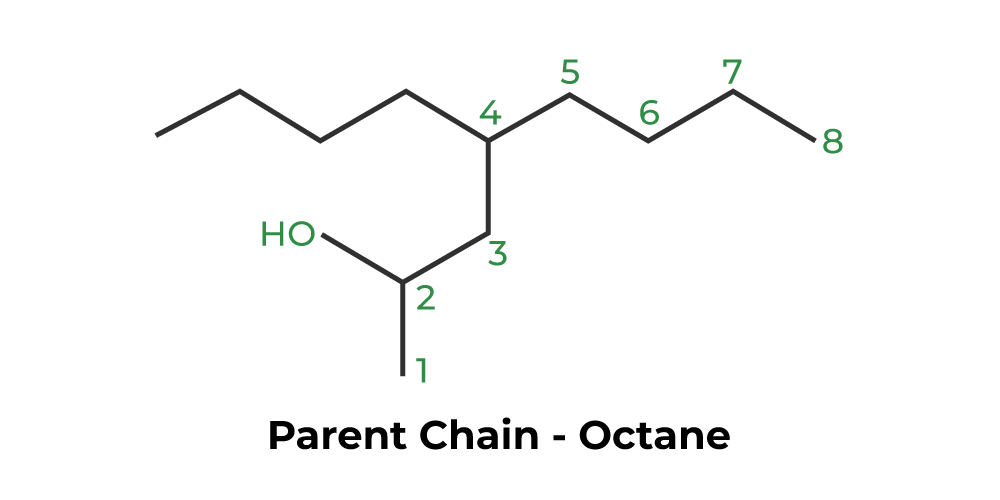
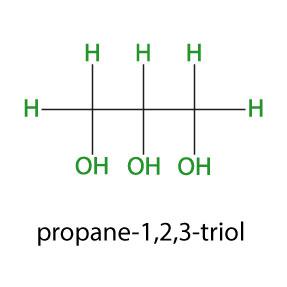
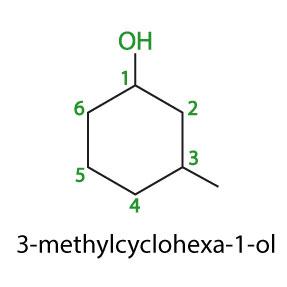
Alcohol is referenced by the name of its parent alkane. -A mole and a number designating the position of the -OH group on the chain are used in place of the -ane suffix of the parent hydrocarbon chain. Whereas this saturated carbon atom is joined to a hydroxyl (-OH) group, alcohol is created.
Alkanols, which have the general formula R-OH, is the generic name for alcohol according to the IUPAC nomenclature.
Alcohol occurs frequently in nature, with ethyl alcohol (ethanol), the primary component of alcoholic beverages, being the most well-known. In the homologous sequence of alcohols, methanol (CH₃OH) and ethanol (CH₃CH₂OH) are the first two compounds.
Common names for alcohols with one to four carbon atoms typically include the word alcohol after the name of the alkyl group.
The International Union of Pure and Applied Chemistry (IUPAC) states that. -anol replaces the parent hydrocarbon chain's -ane suffix. Basic IUPAC guidelines for identifying alcohol include:
Common System: Alkyl alcohol is the common name for monohydric alcohols. After the name of the alkyl group is present in the molecule, we can add the name "alcohol" to get their names. For instance, the CH₃-OH molecule combines an alcohol group and one methyl group. As a result, we refer to it as methyl alcohol.
Phenols are organic compounds that have an aromatic ring of carbon atoms linked to a hydroxyl (-OH) group. Ar-OH is the designation for phenols. It can be divided into mono-, di-, tri-, or polyhydric phenols depending on how many hydroxyl groups are joined to the aryl group.
When the -OH group replaces the hydrogen atom in a benzene molecule, phenol is created.
Similar to how the names for aliphatic alcohols are generated, the IUPAC term for phenol is hydroxybenzene. It is usually referred to as carbolic acid.
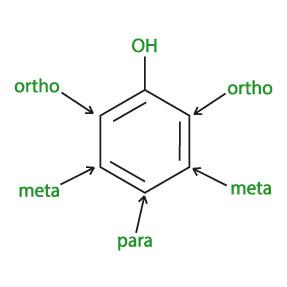
Common system: The prefixes ortho (o-), meta (m-), and para (p-) are used in the common system to denote the position of the substituent relative to the -OH group on the benzene ring.
Ethers are organic molecules in which two hydrocarbon groups are linked to both ends of the oxygen atom (alkyl or aryl). The general formula for ether is R-O-R′. The hydrocarbon group may be the same as R or different, represented by the R′ in the formula.
Common System: The two aryl or alkyl groups connected to the oxygen atoms can be named separately in alphabetical sequence, and then we can add the suffix "ether" to create the common names of ethers. We employ the "di" prefix before the alkyl or aryl group name in the case of symmetrical ethers.
The prefix "di-" is used for symmetrical ethers. If the names of the alkyl groups are different, spaces should be left between them and before the term ether.
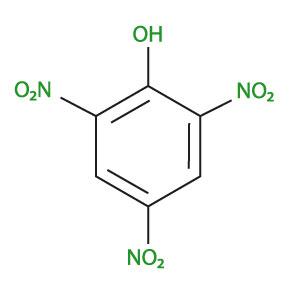
Example 1: What is the IUPAC name of the given compound?
Solution:
The prefix tri- is chosen because there are three -NO2 groups. Considering all things, the provided compound's IUPAC name is 2,4,6-trinitrophenol.
Example 2: What is the IUPAC name of the given compound?
Solution:
The parent chain includes five carbon atoms, and at positions 1, 2, and 4 there are -OH, ethyl, and methyl groups. Therefore, the provided compound's IUPAC name is 2-Ethyl-4-methyl-1-pentanol.
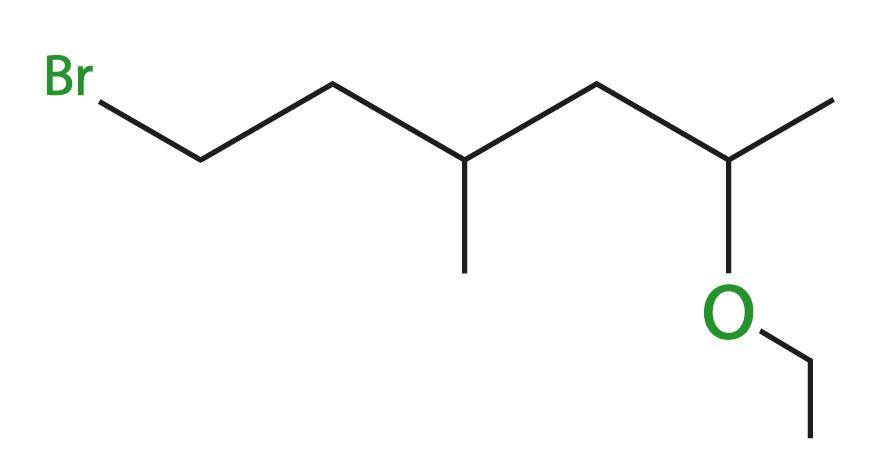
Example 3: What is the IUPAC name of the given compound?
Solution:
The shorter alkyl group on the oxygen atom's end forms the alkoxy substituent. The alkoxy group gets the lowest locant in the parent chain because of how the locants are numbered. The IUPAC name is written with numbers and words separated by hyphens, and the substitutes are listed alphabetically (-). The specified compound's IUPAC name is 1-bromo-5-ethoxyl-3-methylhexane.