|
VOOZH | about |
|
VOOZH | about |
Alcohols, Phenol, and Ethers have several applications in business and everyday life. Alcohols and phenols are hydroxyl organic substances. The wood polish we use to polish our furniture comprises alcohol, which is mostly ethanol. Menthol, derived from peppermint oil, is used to flavour cigarettes and food. Furthermore, starting with alcohols, a variety of organic compounds such as alkyl halides, alkenes, aldehydes, ketones, carboxylic acids, ethers, and so on can be synthesized. Organic hydroxy compounds are found in cane sugar, cotton clothing, and writing paper.
Because ethers are chemically inert, they are often utilized as solvents in a wide range of chemical processes. Di-ethyl ether, the most frequent member of the ether family, was used as a surgical anaesthetic for many years until being superseded by safer non-inflammable alternatives. In perfumery, anisole, a pleasant-smelling aromatic ether, is utilized.
Ethers are hydrocarbon derivatives in which an alkoxy (- OR) or aryloxy (-OAr) group replaces a hydrogen atom. Ethers are also substances created by replacing the hydrogen atom of the hydroxyl group of an alcohol or phenol with an alkyl or aryl group.
- Ethers are organic water derivatives with two alkyl or aryl groups linked to an oxygen atom. Ethers are also known as alkyl oxides (R2O) or aryl oxides (AR2O).
- The general formula of aliphatic ether is CnH2n+2O.
- It is the same as that of monohydric alcohols. Hence, aliphatic ethers are isomeric with monohydric alcohols.
Ethers are basically classified into two groups simple or mixed ethers.
eg: Dimethyl ether (CH3 - O - CH3), Diphenyl ether (CH6 - O - CH6) etc.
eg: Ethyl methyl ether (CH3 - O - C2H5). etc.
Ethers also have the same tetrahedral geometry as water. The oxygen atom is sp3 hybridized. Due to repulsive interaction between the two bulkier alkyl groups, the C - O - C bond angle is slightly greater than the tetrahedral angle.
e.g.: CH3 - CH2 - O - CH2 - CH3 (dimethyl ether) and CH3 - O - CH2 - CH2 - CH3 (methyl n-propyl ether).
By Inter-molecular Dehydration:
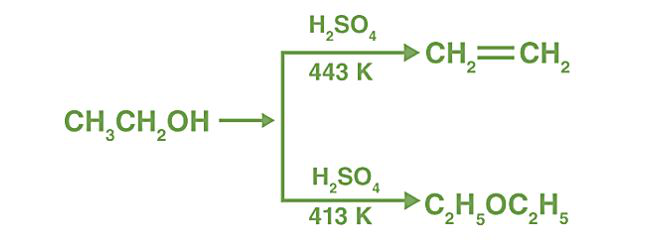
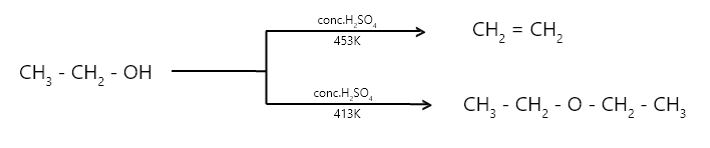
When an excess of ethyl alcohol is distilled with concentrated sulphuric acid at 413 K, diethyl ether is produced. i.e., from alcohols also called inter-molecular dehydration.
If seen experimentally then,
C2H5−OH + H−O−SO3H ⟶ C2H5−O−SO3H + H2O
C2H5−O−SO3H + H−O−C2H5 ⟶ C2H5−O−C2H5 + H2SO4
It is also known as the continuous etherification process because a tiny quantity of sulphuric acid turns a significant volume of ethyl alcohol into diethyl ether and the process continues.
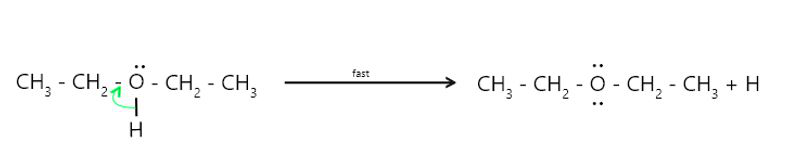
Reaction Mechanism:
Limitations of the above reaction are:
Now, these two competing reactions can be controlled, As the temperature rises, the temperature becomes more conducive to elimination (453 K and above). But at 413 K and lower, substitution is preferred.
Williamson Synthesis
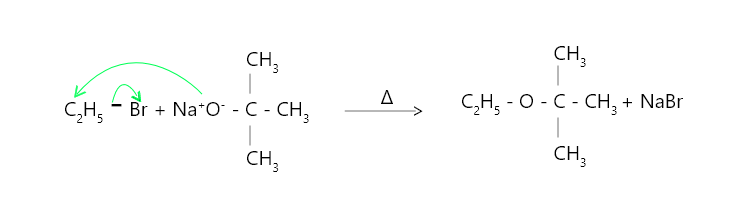
By using Williamson`s synthesis, simple as well as mixed ethers can be prepared, using an alkyl halide. When alkyl halide is heated with alcoholic sodium or potassium alkoxide it gives ether.
The general form is written as,
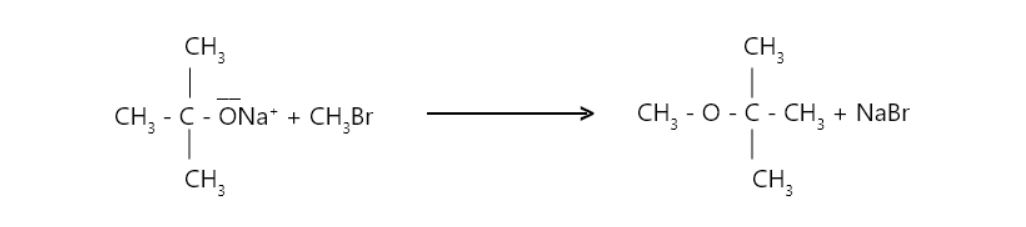
Some of the important examples of Williamson`s synthesis are as follows:
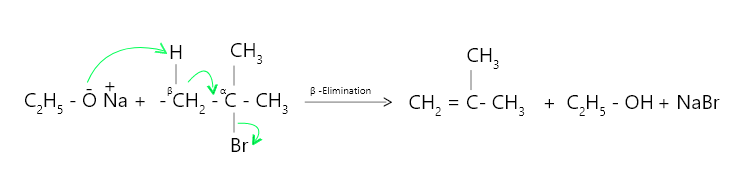
Though using Williamson synthesis we can obtain simply as well as mixed ethers but there are limitations too,
Limitations:
Question 1: Give examples of simple and mixed ethers?
Answer:
- Simple ether: C2H5 - O - C2H5 Diethyl ether
- Mixed ether: CH3 - O - C2H5 Ethyl methyl ether
Question 2: Give the structure of the following compound:
Answer:
- 1 - Methoxy ethane
CH3 - O -C2H5
- 1 - Ethoxy ethane
C2H5 - O - C2H5
Question 3: What is metamerism? Explain with reference to Ethers.
Answer:
Metamerism is a type of structural isomerism in which two or more compounds have the same chemical formula but have a polyvalent functional group linked to separate alkyl groups.
The various compounds are referred to as metamers.
e.g.: The formula C4H10O represents two different ethers which are the metamers.
- Diethylether: CH3 - CH2 - O -CH2 - CH3
- Methyl-n-propylether: CH3 - O - CH2 - CH2 - CH3
Question 4: Write a note on the continuous etherification process.
Answer:
When an excess of a lower alcohol is heated with concentrated H2SO4 at 413 K, an intermediate is generated, which interacts with the second molecule of alcohol to give ether. Diethyl ether is generated when an excess of ethyl alcohol is heated with conc. H2SO4 at 413 K.
H2SO4 is regenerated in this technique, and it combines with increasing amounts of alcohol to make ether. As a result, it is known as the continuous etherification process.
However, this approach is only suited for the synthesis of simple ethers, preferably from primary alcohol.