|
VOOZH | about |
|
VOOZH | about |
Protons are the fundamental particles that reside inside the nucleus of any atom. They are the positive charge particle and are responsible for balancing the negative charge of the electron to make the atom electrically neutral. Proton was discovered by the famous scientist Ernest Rutherford.
Atoms are made of three fundamental particles Electrons, Protons, and Neutrons. These fundamental particles carry charges such as electrons carrying a negative charge, protons carrying a positive charge and neutrons are neutral in nature.
Let's learn more about protons, their properties, discoveries, and others in this article. in detail in this article.
The proton is the positively charged subatomic particle present inside the nucleus of the atom. Proton carries a positive charge.
The mass of the proton is about 1840 times the mass of the electron and its mass is almost equal to the mass of the neutrons. The number of protons inside the nucleus of any atom is called the atomic number and the properties of any element are the periodic function of its atomic number. Generally, the number of protons and the number of electrons for any atom is equal which maintains the electrical neutrality of any atom.
The image added below shows an atom and the electron revolving around that atom. The proton is at the centre of the atom in the nucleus.
As we know that all the mass of any atom is concentrated in the nucleus of the atom as both Protons and Neutrons reside inside the nucleus. The mass of the atom is measured in amu or Atomic Mass Units.
The mass of a proton is 1.6726219 × 10⁻²⁷ kilograms or 1.6726219 × 10⁻²⁴ grams. It is slightly equal to 1 amu.
Protons are positively charged particles that have charges opposite to the charges of the electron. The charge on the protons is also called the unit positive charge. The charge on the proton is +1.6 × 10⁻¹⁹ coulombs
Protons are positively charged particles that are located inside the nucleus of any atom. They are closely packed with each other using strong nuclear forces and they contribute to the mass of an atom.
The smallest nucleus of any known element is the nucleus of Hydrogen which contains only one proton.
The number of protons and neutrons inside any nucleus is given with the help of the Atomic Number and Mass Number.
In 1886 Eugene Goldstein (1850–1930) discovered evidence for the existence of a positively charged particle. Using a cathode ray tube with holes in the cathode, he noticed that the rays were travelling in the opposite direction from the cathode rays. He called these canal rays and showed that they were composed of positively charged particles.
The nucleus of the atom was discovered by Ernest Rutherford in the year 1911 in his famous Gold Foil experiment. He concluded that all the positively charged particles in an atom were concentrated in a singular core and that most of the atom’s volume is empty. He also stated that the total number of positively charged particles in the nucleus is equal to the total number of negatively charged electrons present around it. To support his theory he performed a famous experiment known as the Gold foil experiment.
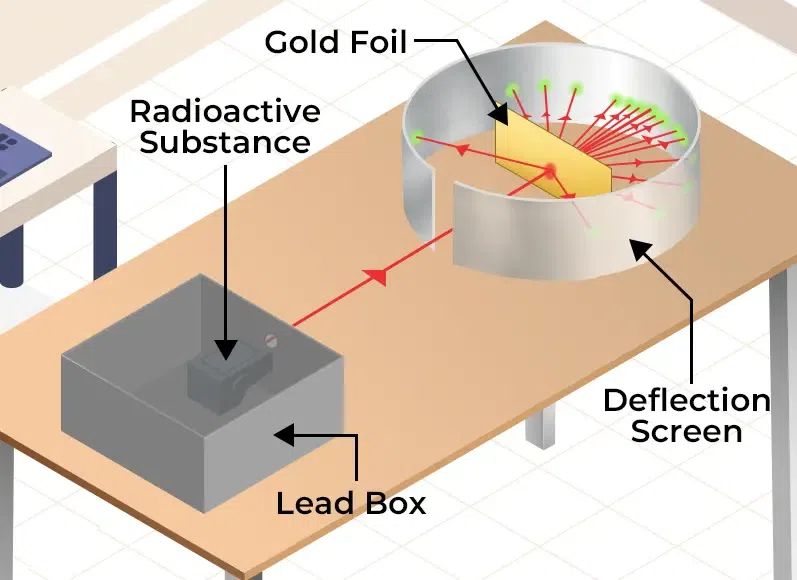
Rutherford, in his experiment, directed high-energy streams of α-particles from a radioactive source at a thin sheet (100 nm thickness) of gold. In order to study the deflection caused to the α-particles, he placed a fluorescent zinc sulfide screen around the thin gold foil. Ernest Rutherford selected a gold foil for his experiments because he wanted as thin a layer as possible, and gold is highly malleable.
The experimental set-up of the Rutherford Gold Foil experiment is shown below,
Results
The result of his Gold Foil Experiment is,
Conclusion
Based on his observations, Rutherford proposed the following structural features of an atom,
There are various properties of a proton, and some of those properties are as follows:
The comparison between subatomic particles electrons, protons, and neutrons is discussed in the table below:
Particle | Symbol | Mass | Relative Mass | Electric Charge | Relative Charge | Location |
|---|---|---|---|---|---|---|
Proton | p or (p+) | 1.67 × 10⁻²⁴ g | 1 | Positive | +1 | Inside Nucleus |
Electron | e or (e-) | 9.1 × 10⁻²⁸ g | 0.0005 | Negative | -1 | Outside Nucleus |
Neutron | n | 1.67 × 10⁻²⁴ g | 1 | Neutral | 0 | Inside Nucleus |