|
VOOZH | about |
|
VOOZH | about |
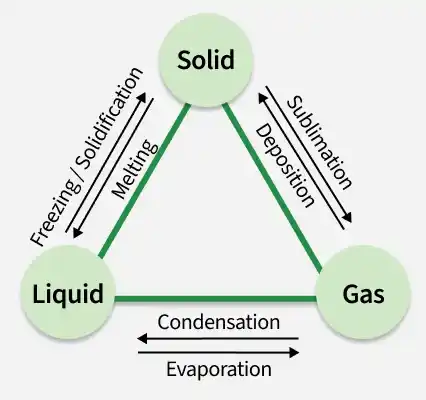
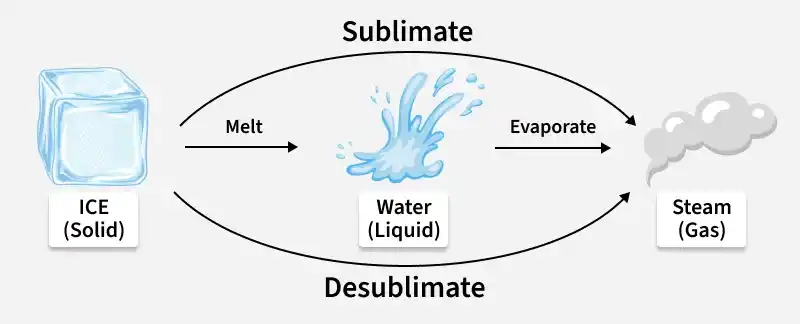
Sublimation is a physical change in which a substance directly changes from the solid state to the gaseous state without passing through the liquid state. This process takes place when the particles of a solid absorb heat energy and gain enough energy to overcome the forces of attraction between them.
As a result, the particles escape from the solid and move freely as a gas. On cooling, the gas can directly change back into a solid without becoming a liquid. This reverse process is called deposition.
👁 matterExamples:
- Camphor
- Naphthalene balls
- Ammonium chloride
Sublimation has some important features that explain this process:
The process of sublimation involves the direct change of a substance from solid to gas and back to solid.
Example: Ammonium chloride sublimes on heating and forms solid again on cooling.
Sublimation is used in many areas of daily life, laboratories, and industries:
1. Separation of Substances: Sublimation is used to separate a sublimable solid from a non-sublimable substance.
2. Purification of Solids: It is used to purify substances that can sublime. Impurities remain behind, while the pure substance vaporizes and then solidifies again.
3. Use in Moth Repellents and Fragrances: Substances like naphthalene balls and camphor sublime slowly. It protect clothes from insects, provide fragrance.
4. Freeze-Drying (Preservation): Sublimation is used in freeze-drying to preserve Food items and Medicines. Water is removed directly as vapour, keeping the material safe.
5. Printing Technology: Used in dye-sublimation printing for printing on clothes, mugs, etc. Gives high-quality and long-lasting prints.
6. Drying of Materials: Used in laboratories to dry heat-sensitive substances without turning them into liquid.
7. Space and Scientific Uses: In very low-pressure conditions (like space), substances can sublime easily, which is important in scientific studies.
Some examples where sublimation is used are,