|
VOOZH | about |
|
VOOZH | about |
Synthetic fibers are man-made materials that makeup about half of the total fiber usage. They are created from synthesized polymers, which are formed by polymerizing raw materials like petroleum-based chemicals or petrochemicals. This process involves creating chemical bonds between adjacent carbon atoms.
Synthetic fibers find their applications in fiber and textile technology. The major dominant synthetic fibers are — nylon, polyester, acrylic, and polyolefin, which account for about 98 percent by volume of synthetic fiber production. 60 percent accountability is handed over to polyester alone. Most of these fibers are recognized as potentially valuable commercial products.
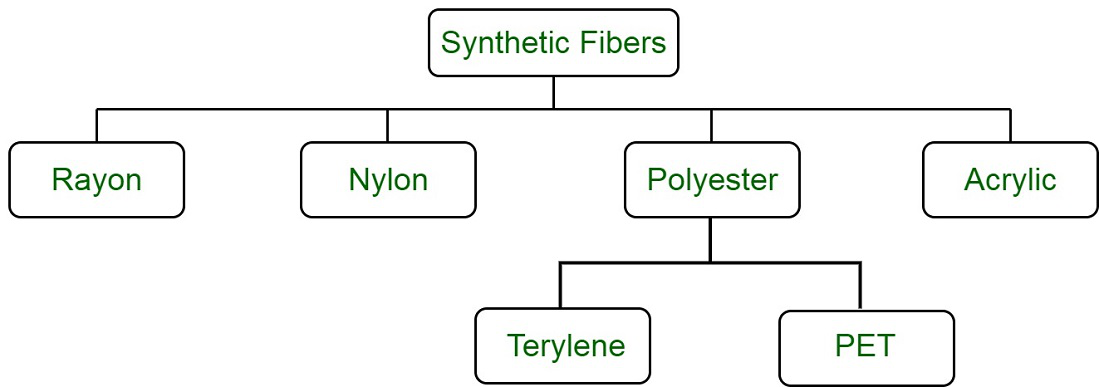
The following flowchart shows the classification of synthetic fibers:
👁 ImageRayon, also known as Regenerated Cellulose is the oldest obtained man-made fiber. It is derived primarily from purified cellulose, obtained from the wood pulp. This pulp is chemically converted into cellulose acetate, which makes the fiber easily soluble in solvents. Owing its source to naturally occurring polymers, it is sometimes also termed as semi-synthetic fiber.
There are largely different types of rayon, which include:
These varieties vary in their respective manufacturing processes along with the properties of the finished product.
In the case ofsaponified cellulose acetate - The following steps account for the complete procedure :
1. Initially, to increase the reactivity, cellulose is first treated with glacial acetic acid.
2. Acetylation with an excess of glacial acetic acid and acetic anhydride with sulphuric acid is performed.
3. De-acetylation of cellulose acetate is performed, next in the sequence by sodium hydroxide saponification under controlled conditions. During this process, the fiber was termed as Fortisan, which is now renamed Rayon, which is considered to be a truly regenerated cellulose filament.
In the case of Viscose Rayon - The following steps account for the complete procedure :
1. Reaction of cellulose with sodium hydroxide is used to produce alkali cellulose.
2. It is then subjected to a reaction with carbon disulfide (CS2) to convert it to cellulose xanthate.
3. This solution is dissolved in dilute sodium hydroxide and then extruded through spinnerets into an acid bath. This process is known as wet spinning. This fiber is termed, Viscose Rayon.
Since only 15 percent of the hydrogen of the cellulose hydroxyl groups is substituted, therefore, this variant of the fiber has excellent water absorbency.
Viscose Rayon Fiber Properties | |
Tensile Strength | Fair |
Abrasion Resistance | Fair |
Absorbency | Excellent |
Static Resistance | Excellent |
Heat Resistance | Good |
Wrinkle Resistance | Poor |
Resistance to Sunlight | Fair |
Elasticity | Poor |
Flame Resistance | Flame Resistant |
Resilience | Poor |
In the case of Bamberg - The following steps account for the complete procedure :
1. Initially, cellulose is dissolved in cupric ammonium hydroxide (ammoniacal copper oxide solution).
2. It is then dissolved and then extruded in an acid bath to coagulate the fiber. Because of its similar properties, the fiber is termed Bamberg silk.
Properties of Rayon Fibers - Rayon is a versatile fiber, displaying a variety of properties :
Advantages of Rayon fiber
Disadvantages
Nylon is the most useful synthetic material with applications varying from daily life activities to industries. It is a plastic that can be drawn into fibers or molded into daily products for making amenities. We can live our entire life with nylon on our side. You hop across the nylon carpet to the kitchen, eat your breakfast on a nylon bowl after cleaning your teeth with a toothbrush whose bristles are made of nylon. A nylon umbrella over your head is used to move out of the house in heavy sunlight or to keep out of the rain.
The chemistry behind the making of Nylon
Nylons are also known as copolymers, are basically condensation polymers. They are formed by reacting dysfunctional monomers containing equal parts of amine and carboxylic acid. The amides are obtained at both the ends of each constituent monomer. In most cases, nylons are made by reacting a dicarboxylic acid with a diamine (e.g. PA66). In this case, each repeating unit is a monomer, which is alternating in nature (similar to the ABAB polyester structure). The presence of the same reactive group on both ends support has overall directionality: C terminal → N terminal. It is a kind of copolymer, which offers a contrast to the polyamide proteins. Nylons may even be formed by the reaction of lactam or amino acid with itself (e.g. PA6). In this scenario, the repeating unit corresponds to the single monomer, denoted by the AA.
Properties of Nylon -
Uses of Nylon -
Advantages of Nylon:
Disadvantages of nylon:
Polyester is a polymer category that contains the ester functional group in every repeat unit of their main chain. These fibers along with natural fibers are spun together as a single unit to produce a cloth with blended properties. It is most commonly referred to as a polyethylene terephthalate (PET). These are mainly considered as naturally occurring chemicals, in both plants as well insects. It also includes synthetic materials such as polybutyrate.
Synthetic polyesters are most commonly used in making apparel. An amalgamation of polyester and, soft cotton to form blends is considered to be strong, wrinkle- and tear-resistant, and reduce shrinking. Synthetic fibers that use polyester have high water, wind, and environmental resistance in comparison to plant-derived fibers. They are considered to be less fire-resistant and can also melt when ignited.
Some liquid crystal polymers are among are liquid crystaline polyester. Their characteristic properties are mechanical properties and heat resistance. They are used mainly in the form of an abatable seal in jet engines.
Classification of Polyester
Polyester can further be classified into two categories, that is — Terylene and PET.
Terylene | PET |
| An artificial polyester fiber. It can be easily minutely which in turn can be further woven like any other yarn. This in accompany | A semi-crystalline thermo-plastic polyester. This is a strong lightweight clear and hence finds use in |
| Manufactured by polymerizing ethylene glycol and terephthalic acid. | Manufactured from ethylene glycol and terephthalic acid with Polyethylene terephthalate. |
| Used primarily for making apparel, since it can be easily drawn into fine quality fibers. Along with cotton called Terrycot, it is used to make clothes like sarees and many items like ropes, sheets, sails. | Used primarily for packaging foods and beverages like salad dressings, cooking oils, shampoo, liquid soap, window cleaner, tennis balls, soft drinks, juice, and water. |
Characteristics of Polyester
Uses of Polyester Fiber - The polyester fiber finds its usage in the following applications are,
Advantages of Polyester
Disadvantages of Polyester
Acrylic fabrics are synthesized from a synthetic polymer called acrylonitrile. Any authentic acrylic fiber fabric must contain at least 85% acrylonitrile. It may contain lesser amounts of synthetic compounds too. The fabric varies based on the content that acrylonitrile is mixed with. It is produced by the reaction of petroleum or coal-based chemicals with monomers. This implies that acrylic falls in the category of belonging to a fossil fuel-based fiber.
Acrylic fabric finds its usage in heat-retention applications. It is also often used in athletic equipment, as in, tracksuits, hoodies, and athletic pants. However, the fiber is considered to be carcinogenic in nature, therefore, more contact is undesirable with this fiber.
Acrylic fibers form a great cheaper alternative to natural wool. It is obtained from natural sources and is also more durable in comparison to natural wool.
How is Acrylic Fabric Made?
Manufacture of acrylic is a sequence of the following steps :
Acrylic Monomer
CH = CH + HCN ⇢ -(CH2 = CH - CN)
(Acetylene) (Hydrogen Cyanide) (Acrylonitrile)
After the reaction, we obtain the following result is: CH2 = CH - CN
Characteristics of Acrylic Fiber -
Uses of Acrylic Fiber -
Advantages:
Disadvantages:
Problem 1: Why is polyester considered suitable for making apparel?
Solution:
The polyester fiber fabrics don't get wrinkled easily. These fabrics are crisp and also easy to wash. Therefore, it is extensively used in making apparel like dress materials. Terylene is a popular type of polyester, which can be easily drawn in very fine fibers which can be woven like any other yarn.
Problem 2: Explain some features of rayon.
Solution:
Some features of rayon are:
- Because of the silk-like properties, it is considered to be suitable to make apparel.
- It can be blended with cotton to make materials, like bedsheets and dress materials.
- It can be dyed into different colors.
Problem 3: Elaborate on the differences between nylon and rayon.
Solution:
Following are the differences between nylon and rayon are:
S. no. Rayon
Nylon
1. First synthetic fiber. First truly synthetic fiber. 2. Manufactured from wood pulp. Manufactured from coal, water, and air. 3. e.g. Curtains, bedsheets, etc. e.g. Socks, rope, parachutes, etc.
Problem 4: How is artificial wool manufactured?
Solution:
Artificial wool is manufactured from a synthetic fiber called acrylic. Acrylic is preferred over natural wool The material obtained from natural sources is quite expensive whereas materials made from acrylic are relatively cheap. They are available in a variety of colors. Synthetic fibers are more durable and affordable which makes them more popular than natural fibers.
Problem 5: How is rayon manufactured?
Solution:
Rayon is a man-made fiber that is prepared by chemical treatment from a natural raw material termed cellulose. The cellulose to be used is obtained from the wooden pulp. This is converted to threads with the help of machines. These threads have extensive strength as well as shine. It is also known as synthetic or artificial silk.
Problem 6: ‘Manufacturing synthetic fibers help in the conservation of forests’. Comment.
Solution:
Synthetic fibers are man-made fibers made obtained from petrochemicals. The manufacturing is dependent on the cutting of trees and doesn't have to involve the killing of animals. Therefore, the forests can be conserved by manufacturing synthetic fibers.