|
VOOZH | about |
|
VOOZH | about |
DML stands for Data Manipulation Language. Tables and formulas are helpful when communicating with data stored up to a point in a database through SQL (Structured Query Language), but a time comes when we actually want to execute some fairly complicated data interactions. DML is a way to inform a database precisely what we want it to do by conversing in a manner that it has been built to comprehend from scratch.
There are basically two types of Data Manipulation Language. These are mentioned below. We have described them in the difference between format.
| High-Level or Non-Procedural DML | Low-level or Procedural DML |
|---|---|
It is also labelled as set-at-a-time or series oriented DML. | It is also labelled as track-at-a-time DML. |
It can be used on its own for precisely specifying complex operations in the database. | It must be integrated to a general-purpose programming language. |
It is prescriptive in nature. | It is indispensable in nature. |
It demands that a user must clearly state which data is needed without clarifying how and when to obtain those data. | It demands that a user must clearly state which data is needed and how to obtain those data. |
For Example: Every SQL statement is a prescriptive command. | For Example: DB2's SQL PL, Oracle's PL/SQL. |
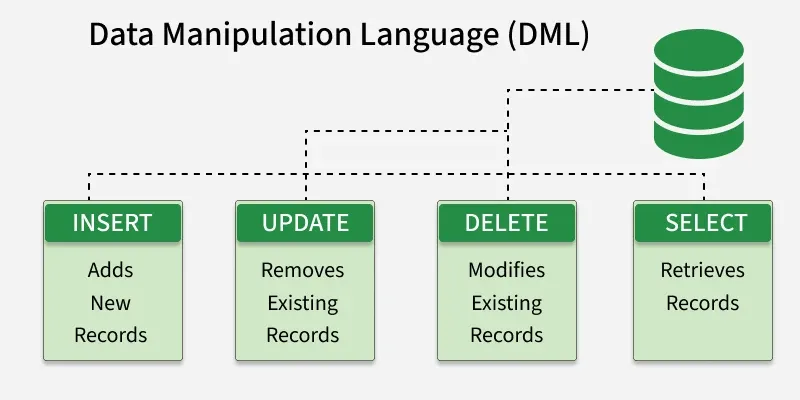
It performs interpret-only data queries. It is used in a database schema to recall and manipulate the information. DML It is a dialect which is used to select, insert, delete and update data in a database. Data Manipulation Language (DML) commands are as follows:
This command is used to get data out of the database. It helps users of the database to access from an operating system, the significant data they need. It sends a track result set from one tables or more.
Syntax :
SELECT *
FROM <table_name>;
Example:
SELECT *
FROM students;

OR

SELECT *
FROM students
where due_fees <=20000;
This command is used to enter the information or values into a row. We can connect one or more records to a single table within a repository using this instruction. This is often used to connect an unused tag to the documents.
Syntax:
INSERT INTO <table_name> ('column_name1' <datatype>, 'column_name2' <datatype>)
VALUES ('value1', 'value2');
Example :
INSERT INTO students ('stu_id' int, 'stu_name' varchar(20), 'city' varchar(20))
VALUES ('1', 'Nirmit', 'Gorakhpur');
This command is used to alter existing table records. Within a table, it modifies data from one or more records. This command is used to alter the data which is already present in a table.
Syntax:
UPDATE <table_name>
SET <column_name = value>
WHERE condition;
Example:
UPDATE students
SET due_fees = 20000
WHERE stu_name = 'Mini';
It deletes all archives from a table. This command is used to erase some or all of the previous table's records. If we do not specify the 'WHERE' condition then all the rows would be erased or deleted.
Syntax:
DELETE FROM <table_name>
WHERE <condition>;
Example:
DELETE FROM students
WHERE stu_id = '001';