How to Design a Database for Online Hotel Booking App Like MakeMyTrip
Last Updated : 23 Jul, 2025
An online hotel booking app like MakeMyTrip allows users to search for compare and book hotels easily. The success of such an application depends on a robust and well-optimized database design that efficiently handles hotel data, user information, booking transactions and real-time availability.
In this article, we will learn about How Database Design Essentials for an Online Hotel Booking App Like MakeMyTrip by understanding various aspects of the article in detail.
Database Design Essentials for an Online Hotel Booking App
Designing a database for an online hotel booking app involves various considerations such as hotel data management, user management, booking transactions, real-time availability and reviews.
The database must handle large volumes of data, ensure quick response times, and maintain data accuracy and security.
Features of Databases for Online Hotel Booking Apps
Databases for hotel booking apps like MakeMyTrip offer a range of features designed to enhance user experience and optimize platform performance. These features typically include:
Hotel Data Management: Storing detailed hotel information including amenities, room types and prices.
User Management: Managing user accounts, profiles, authentication and preferences.
Booking Management: Handling booking transactions, cancellations and modifications.
Real-time Availability: Ensuring real-time updates on room availability and prices.
Search and Filters: Providing efficient search functionality with various filters (e.g, location, price, rating).
Reviews and Ratings: Allowing users to leave reviews and ratings for hotels.
Analytics and Reporting: Generating insights and reports on user activity, booking trends and platform performance. canceled
Payment Processing: Handling secure payments for bookings.
Entities and Attributes in Databases for Online Hotel Booking Apps
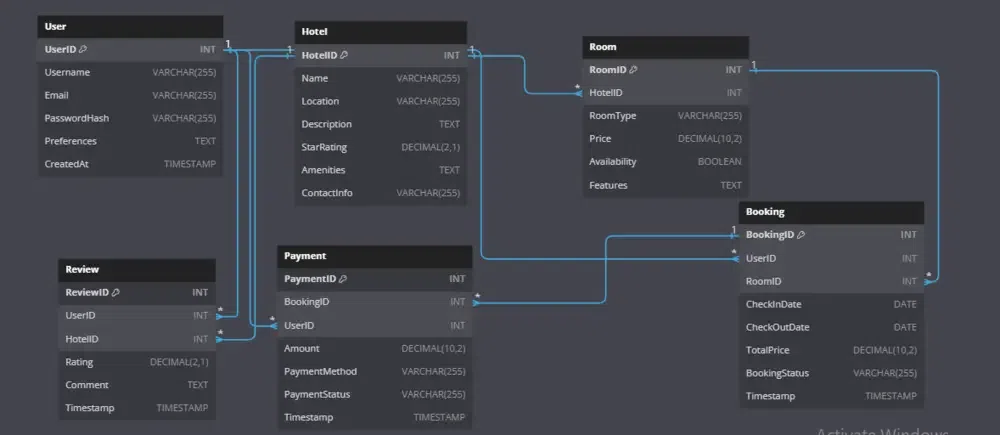
Entities in a hotel booking app database represent various aspects of hotel data, user interactions, booking transactions and reviews, while attributes describe their characteristics.
1. User Table
UserID (Primary Key): It is a Unique identifier for each user.
Username: User's display name.
Email: User's email address for contact and login.
PasswordHash: Securely hashed password for user authentication.
Preferences: User preferences for search filters and notifications.
CreatedAt: It is a Timestamp when the user account was created.
2. Hotel Table
HotelID (Primary Key): It is a Unique identifier for each hotel.
Name: Name of the hotel.
Location: Address of the hotel.
Description: Detailed description of the hotel.
StarRating: Star rating of the hotel.
Amenities: It is a List of amenities provided by the hotel.
ContactInfo: Contact information of the hotel.
3. Room Table
RoomID (Primary Key): It is a Unique identifier for each room.
HotelID: Identifier for the hotel to which the room belongs.
RoomType: Type of room (e.g., single, double, suite).
Price: Price per night for the room.
Availability: Availability status of the room.
Features: List of features specific to the room.
4. Booking Table
BookingID (Primary Key): It is a Unique identifier for each booking.
UserID: Identifier for the user who made the booking.
RoomID: Identifier for the room booked.
CheckInDate: Date of check-in.
CheckOutDate: Date of check-out.
TotalPrice: Total price of the booking.
BookingStatus: Status of the booking (e.g., confirmed, canceled).
Timestamp: Date and time of the booking.
5. Review Table
ReviewID (Primary Key): It is a Unique identifier for each review.
UserID: Identifier for the user who wrote the review.
HotelID: Identifier for the hotel being reviewed.
Rating: Rating given by the user.
Comment: Review the comment left by the user.
Timestamp: Date and time of the review.
6. Payment Table
PaymentID (Primary Key): It is a Unique identifier for each payment.
BookingID: Identifier for the associated booking.
UserID: Identifier for the user who made the payment.
Amount: Amount paid.
PaymentMethod: Method of payment (e.g., credit card, PayPal).
PaymentStatus: It is a Status of the payment (e.g., completed, pending).
Timestamp: Date and time of the payment.
Relationships Between Entities
Based on the above entities and their attributes provided let's define relationships between them can be defined to establish data flows and dependencies within the hotel booking app database.
1. One-to-Many Relationship between User and Booking:
One user can make multiple bookings.
Each booking is made by one user.
Therefore, the relationship between User and Booking is one-to-many.
2. One-to-Many Relationship between Hotel and Room:
One hotel can have multiple rooms.
Each room belongs to one hotel.
Therefore, the relationship between the Hotel and the Room is one-to-many.
3. One-to-Many Relationship between Room and Booking:
One room can be booked multiple times.
Each booking involves one room.
Therefore, the relationship between Room and Booking is one-to-many.
4. One-to-Many Relationship between Hotel and Review:
One hotel can have multiple reviews.
Each review is associated with one hotel.
Therefore, the relationship between Hotel and Review is one-to-many.
5. One-to-Many Relationship between User and Review:
One user can write multiple reviews.
Each review is written by one user.
Therefore, the relationship between the User and the Review is one-to-many.
6. One-to-One Relationship between Booking and Payment:
One booking has one corresponding payment.
Each payment is associated with one booking.
Therefore, the relationship between Booking and Payment is one-to-one.
Entities Structures in SQL Format
-- User Table CREATE TABLE User ( UserID INT PRIMARY KEY, Username VARCHAR(255), Email VARCHAR(255), PasswordHash VARCHAR(255), Preferences TEXT, CreatedAt TIMESTAMP );
-- Hotel Table CREATE TABLE Hotel ( HotelID INT PRIMARY KEY, Name VARCHAR(255), Location VARCHAR(255), Description TEXT, StarRating DECIMAL(2,1), Amenities TEXT, ContactInfo VARCHAR(255) );
The database model for an online hotel booking app revolves around efficiently managing user accounts, hotel data, room availability, booking transactions, reviews, and payments to provide a seamless and reliable booking experience.
Tips & Best Practices for Enhanced Database Design
Scalability: Design the database to scale with the growing number of users, hotels, and bookings.
Indexing: Implement indexing on frequently queried columns (e.g., UserID, HotelID, RoomID) to optimize query performance.
Caching: Use caching mechanisms to store frequently accessed data, such as hotel details and user preferences, to reduce database load.
Data Security: Implement robust security measures to protect user data, including encryption, access controls, and secure storage.
Real-time Processing: Implement real-time data processing for features such as live room availability updates and instant booking confirmations.
Data Redundancy: Use data redundancy and replication techniques to ensure high availability and reliability.
Normalization: Normalize data to eliminate redundancy and ensure data integrity while optimizing for read-heavy operations.
Conclusion
Designing a database for an online hotel booking app like MakeMyTrip is essential for managing user accounts, hotel data, room availability, booking transactions, reviews, and payments effectively. By following best practices in database design and using modern technologies, hotel booking apps can optimize operations, enhance user engagement, and ensure data security and reliability.