How to Design a Database for Railway Reservation System Like IRCTC
Last Updated : 23 Jul, 2025
A railway reservation system like IRCTC (Indian Railway Catering and Tourism Corporation) manages millions of users and transactions daily, handling bookings, cancellations, passenger information, and real-time updates. Efficient database design ensures smoothoperations, quick response times and a simple user experience.
In this article, we will learn about How Database Design Essentials for a Railway Reservation System by understanding various aspects of the article in detail.
Database Design Essentials for a Railway Reservation System
Designing a database for a railway reservation system involves considerations such as user management, train schedules, booking and cancellationprocesses, seat allocation and real-time updates.
The database must handle high transaction volumes which ensures fast response times and maintain data integrity and accuracy.
Features of Databases for Railway Reservation Systems
Databases for railway reservation systems offer a range of features designed to support user management, train schedules, booking and cancellation processes, seat allocation, and real-time updates. These features typically include:
User Management: Managing user accounts, profiles and authentication.
Train Schedules: Storing train details, routes, schedules and availability.
Booking Management: Handling ticket bookings, cancellations and payments.
Seat Allocation: Managing seat availability and assignment.
Real-time Updates: Providing real-time notifications for booking status and train schedules.
Analytics and Reporting: Generating insights and reports on booking trends, user engagement and system performance.
Entities and Attributes in Databases for Railway Reservation Systems
Entities in a railway reservation system database represent various aspects of user management, train schedules, booking and cancellation processes, seat allocation, and real-time updates, while attributes describe their characteristics:
1. User Table
UserID (Primary Key): It is an Unique identifier for each user.
Username: User's display name.
Email: User's email address for contact and login.
PasswordHash: Securely hashed password for user authentication.
PhoneNumber: User's contact number.
Address: User's address details.
CreatedAt: Timestamp when the user account was created.
2. Train Table
TrainID (Primary Key): Unique identifier for each train.
TrainNumber: Official train number.
TrainName: Name of the train.
RouteID: Identifier for the route taken by the train.
ScheduleID: Identifier for the train's schedule.
3. Route Table
RouteID (Primary Key): Unique identifier for each route.
SourceStationID: Identifier for the source station.
DestinationStationID: Identifier for the destination station.
Distance: Distance between source and destination stations.
4. Station Table
StationID (Primary Key): Unique identifier for each station.
StationName: Name of the station.
Location: Geographical location of the station.
5. Schedule Table
ScheduleID (Primary Key): Unique identifier for each schedule.
TrainID: Identifier for the train.
DepartureTime: Scheduled departure time.
ArrivalTime: Scheduled arrival time.
DaysOfOperation: Days on which the train operates.
6. Booking Table
BookingID (Primary Key): Unique identifier for each booking.
UserID: Identifier for the user who made the booking.
TrainID: Identifier for the booked train.
ScheduleID: Identifier for the train's schedule.
BookingStatus: Status of the booking (e.g., confirmed, cancelled, waitlisted).
BookingDate: Date when the booking was made.
TotalAmount: Total amount paid for the booking.
7. Seat Table
SeatID (Primary Key): Unique identifier for each seat.
TrainID: Identifier for the train.
SeatNumber: Seat number within the train.
ClassType: Type of class (e.g., sleeper, AC, general).
AvailabilityStatus: Availability status of the seat (e.g., available, booked).
Relationships Between Entities
Based on the entities and their attributes provided, relationships between them can be defined to establish data flows and dependencies within the railway reservation system database. Common relationships may include:
1. One-to-Many Relationship between User and Booking:
One user can make multiple bookings.
Each booking is made by one user.
Therefore, the relationship between User and Booking is one-to-many.
2. One-to-Many Relationship between Train and Booking:
One train can have multiple bookings.
Each booking is associated with one train.
Therefore, the relationship between Train and Booking is one-to-many.
3. One-to-Many Relationship between Route and Train:
One route can be assigned to multiple trains.
Each train follows one route.
Therefore, the relationship between Route and Train is one-to-many.
4. One-to-Many Relationship between Schedule and Train:
One schedule can be associated with multiple trains.
Each train operates according to one schedule.
Therefore, the relationship between Schedule and Train is one-to-many.
5. One-to-Many Relationship between Train and Seat:
One train can have multiple seats.
Each seat is associated with one train.
Therefore, the relationship between Train and Seat is one-to-many.
6. One-to-Many Relationship between Station and Route:
One station can be part of multiple routes.
Each route includes one source and one destination station.
Therefore, the relationship between Station and Route is one-to-many.
Entities Structures in SQL Format
Here's how the entities mentioned above can be structured in SQL format:
-- User Table CREATE TABLE User ( UserID INT PRIMARY KEY, Username VARCHAR(255) NOT NULL, Email VARCHAR(255) NOT NULL, PasswordHash VARCHAR(255) NOT NULL, PhoneNumber VARCHAR(15), Address TEXT, CreatedAt TIMESTAMP DEFAULT CURRENT_TIMESTAMP );
-- Station Table CREATE TABLE Station ( StationID INT PRIMARY KEY, StationName VARCHAR(255) NOT NULL, Location VARCHAR(255) NOT NULL );
-- Schedule Table CREATE TABLE Schedule ( ScheduleID INT PRIMARY KEY, TrainID INT, DepartureTime TIME NOT NULL, ArrivalTime TIME NOT NULL, DaysOfOperation VARCHAR(50) NOT NULL, FOREIGN KEY (TrainID) REFERENCES Train(TrainID) );
-- Booking Table CREATE TABLE Booking ( BookingID INT PRIMARY KEY, UserID INT, TrainID INT, ScheduleID INT, BookingStatus VARCHAR(50) NOT NULL, BookingDate DATE NOT NULL, TotalAmount DECIMAL(10, 2) NOT NULL, FOREIGN KEY (UserID) REFERENCES User(UserID), FOREIGN KEY (TrainID) REFERENCES Train(TrainID), FOREIGN KEY (ScheduleID) REFERENCES Schedule(ScheduleID) );
-- Seat Table CREATE TABLE Seat ( SeatID INT PRIMARY KEY, TrainID INT, SeatNumber VARCHAR(10) NOT NULL, ClassType VARCHAR(50) NOT NULL, AvailabilityStatus VARCHAR(50) NOT NULL, FOREIGN KEY (TrainID) REFERENCES Train(TrainID) );
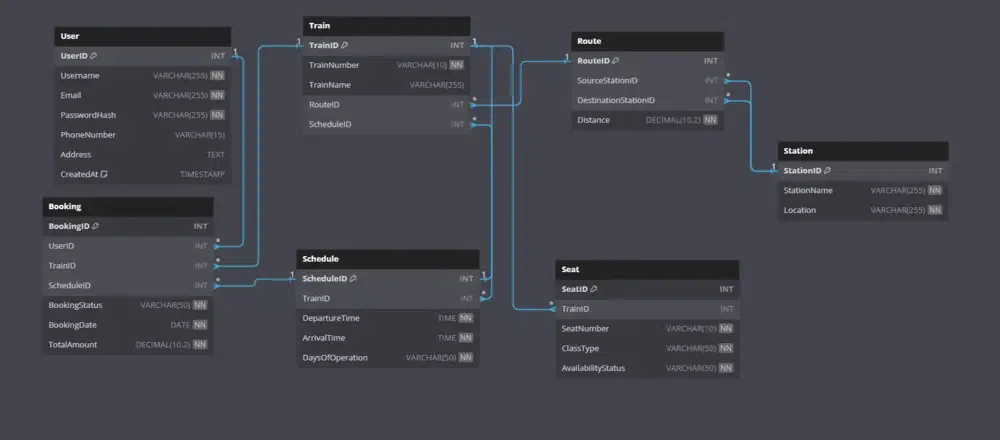
Database Model for Railway Reservation Systems
The database model for a railway reservation system revolves around efficiently managing user accounts, train schedules, booking and cancellation processes, seat allocation, and real-time updates to ensure a seamless and efficient reservation experience.
Tips & Best Practices for Enhanced Database Design
Scalability: Design the database to scale with the growing number of users, trains, and bookings.
Indexing: Implement indexing on frequently queried columns (e.g., UserID, TrainID, BookingID) to optimize query performance.
Caching: Use caching mechanisms to store frequently accessed data, such as train schedules and seat availability, to reduce database load.
Data Security: Implement robust security measures to protect user and transaction data, including encryption, access controls, and secure storage.
Real-time Processing: Implement real-time data processing for features such as live notifications and seat availability updates.
Data Redundancy: Use data redundancy and replication techniques to ensure high availability and reliability.
Conclusion
Designing a database for a railway reservation system like IRCTC is essential for managing user accounts, train schedules, booking and cancellation processes, seat allocation, and real-time updates effectively. By following best practices in database design and leveraging modern technologies, railway reservation systems can optimize operations, enhance user engagement, and ensure data security.