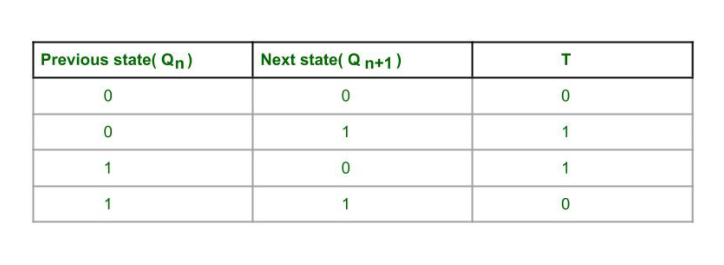
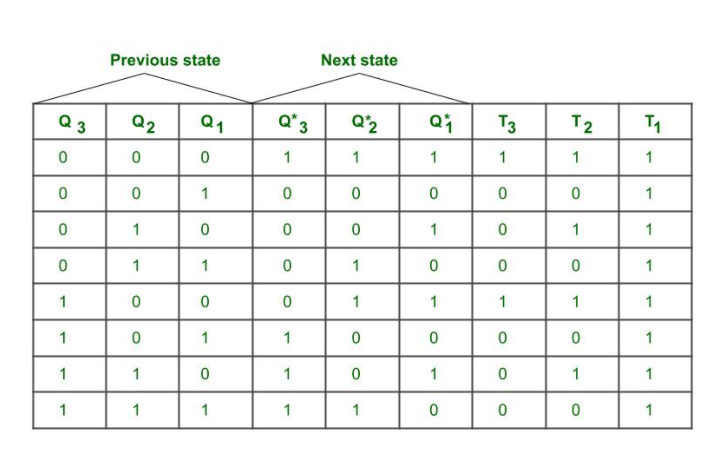
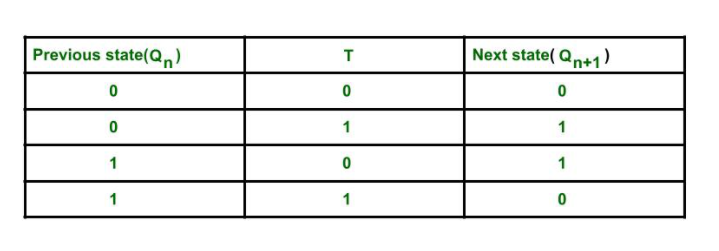
Here T = 1, then there is output state(next state changes from previous state) changes i.e Q changes from 0 to 1 or 1 to 0 T= 0 then, there is no state output state changes i.e Q remains same
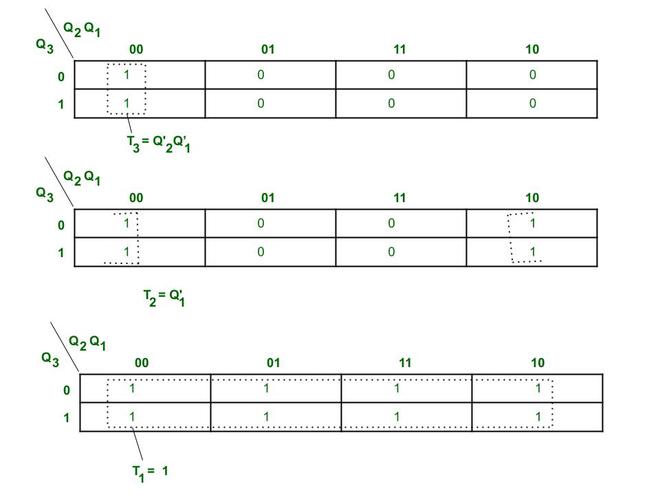
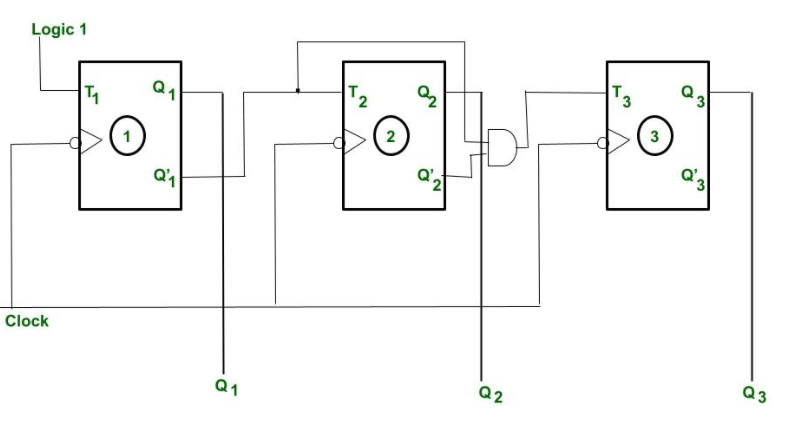
5. Create circuit diagram - The clock is provided to every Flip flop at same instant of time. The toggle(T) input is provided to every Flip flop according to the simplified equation of K map.
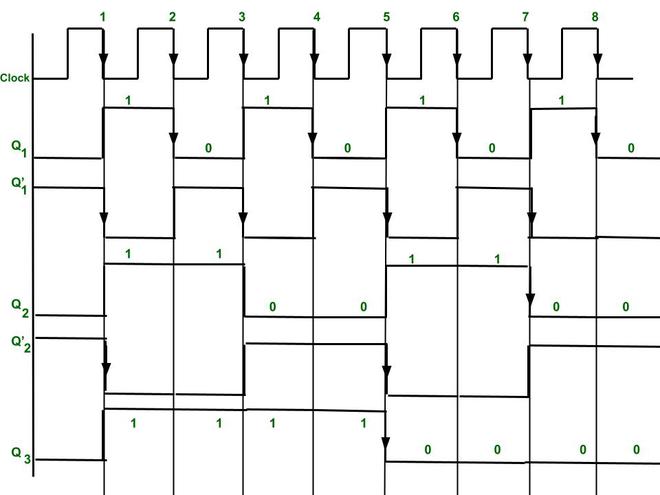
👁 Image 👁 Image Timing diagram of 3 bit synchronous Down counter.
Explanation : Here -ve edge triggered clock is used for toggling purpose.
As we see from characteristics table when T = 1, then toggling takes place and T =0 then it stores the output state.
Initially Q3 = 0, Q2= 0, Q1= 0.
In simplified equation of K map we get T1 = 1, therefore Flip flop 1 output Q1 is toggle for every negative edge(because clock is negative edge triggered). Flip-flop(FF) 2 toggle input(T2) is connected to Q'1. Therefore, Flip Flop 2 output state Q2 is toggle only when there is clock falling edge (i.e -ve edge triggering) and Q'1 =1.
Similarly, Flip flop 3 toggle input(T) is connected to Q'2 and Q'1. Therefore, Flip flop 3 output is toggle when there is clock falling edge and Q'2=1 and Q'1 = 1 .(as you can see from timing diagram)
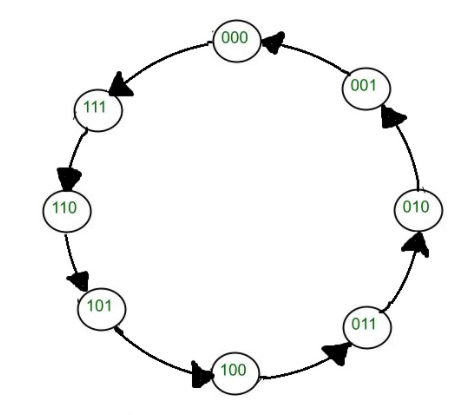
Therefore, we get output(as down counting Q3(MSB) Q2 Q1(LSB) after 8th -ve edge triggered clock the output of the three Flip flops again becomes Q3 = 0, Q2 = 0, Q1 =0.
We get output(state changes) after every -ve edge clock pulse.