|
VOOZH | about |
|
VOOZH | about |
The Quine McCluskey method, also called the tabulation method, is a very useful and convenient method for simplification of the Boolean functions for a large number of variables (greater than 4).
Note: The method requires converting decimal minterms to their binary representation for grouping.
Solution: Convert the given minterms into their binary representation and arrange them according to the number of ones present in the binary representation.
| TABLE 1 | |||||
|---|---|---|---|---|---|
| Group | Minterm | A | B | C | D |
| 0 | 0 | 0 | 0 | 0 | 0 |
| 1 | 1 2 4 8 | 0 0 0 1 | 0 0 1 0 | 0 1 0 0 | 1 0 0 0 |
| 2 | 6 9 | 0 1 | 1 0 | 1 0 | 0 1 |
| 3 | 11 13 | 1 1 | 0 1 | 1 0 | 1 1 |
| 4 | 15 | 1 | 1 | 1 | 1 |
As 0 has no 1 in its representation it is kept in one group(0). Similarly, 1 2 4, and 8 contain one 1 in their representation so it is kept in the next group(1). 6 and 9 in the next group(2), 11, and 13 in the next group(3), 15 in the last group(4).
Now, for table-2 take minterms from successive groups(simultaneous group only) which have an only a 1-bit difference in their representation and form their pair by merging them and making a group of the pairs which are from the same groups that are merged (for example 0 is from group 0 and 1 is from group 1 so it is added to the group 0. 0 belongs to group 0 in table 1 and 2 belongs to group 1 in table 1 so its kept in the same group in table 2. Similarly, make all the possible pairs with the help of the above table and mark - where there is a bit difference.
| TABLE-2 | |||||
|---|---|---|---|---|---|
| Group | Pair | A | B | C | D |
| 0 | (0,1) (0,2) (0,4) (0,8) | 0 0 0 - | 0 0 - 0 | 0 - 0 0 | - 0 0 0 |
| 1 | (1,9) (2,6) (4,6) (8,9) | - 0 0 1 | 0 - 1 0 | 0 1 - 0 | 1 0 0 - |
| 2 | (9,11) (9,13) | 1 1 | 0 - | - 0 | 1 1 |
| 3 | (11,15) (13,15) | 1 1 | - 1 | 1 - | 1 1 |
For table 3 repeat the same step by taking pairs of successive groups merging them where there is only a 1-bit difference and keeping them in groups according to the groups from where they are merged and placed - in bit difference.
| TABLE-3 | |||||
|---|---|---|---|---|---|
| Group | Quad | A | B | C | D |
| 0 | (0,1,8,9) (0,2,4,6) | - 0 | 0 - | 0 - | - 0 |
| 1 | (9,11,13,15) | 1 | - | - | 1 |
After table 3 the process is stopped as there is no 1-bit difference in the remaining group minterms in the simultaneous groups of table 3.
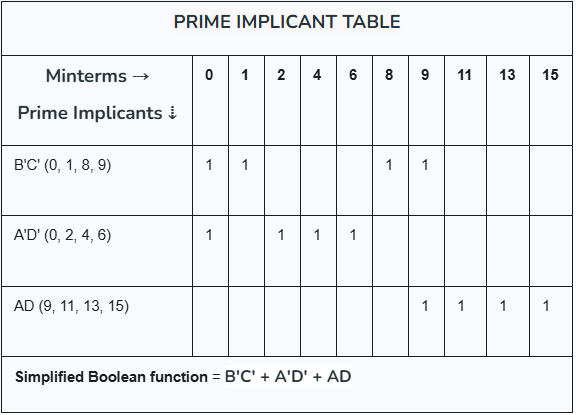
Now, the remaining quads present in table 3 represent the prime implicants for the given Boolean function. So, we construct prime implicants table which contains the obtained prime implicants as rows and the given minterms as columns. Place 1 in the corresponding place which the minterm can represent. Add the minterm to the simplified Boolean expression if the given minterm is only covered by this prime implicant.
B'C' is in simplified function as minterm 1 is only covered by B'C'. Similarly, minterms 2,4,6 are only covered by A'D' and minterms 11,13,15 are only covered by AD.
Solution: Convert the given minterms in their binary representation and arrange them according to number of one's present in the binary representation.
| TABLE-1 | ||||||||
|---|---|---|---|---|---|---|---|---|
| Group | Minterms | A | B | C | D | E | F | G |
| 0 | 20 | 0 | 0 | 1 | 0 | 1 | 0 | 0 |
| 1 | 28 52 | 0 0 | 0 1 | 1 1 | 1 0 | 1 1 | 0 0 | 0 0 |
| 2 | 60 | 0 | 1 | 1 | 1 | 1 | 0 | 0 |
As 20 has 2 1s in its representation it is kept in one group(0). Similarly, 28 and 52 contain 3 1s in their representation so it is kept in the next group(1). 60 in the next group(2).
Now, for table-2 take minterms from successive groups(simultaneous group only) which have an only a 1-bit difference in their representation and form their pair by merging them and making a group of the pairs which are from the same groups that are merged (for example 20 is from group 0 and 28 is from group 1 so it is added to the group 0. 20 belongs to group 0 in table 1 and 52 belongs to group 1 in table 1 so its kept in the same group in table 2. Similarly, make all the possible pairs with the help of the above table and mark - where it is a bit different.
| TABLE-2 | ||||||||
|---|---|---|---|---|---|---|---|---|
| Group | Pair | A | B | C | D | E | F | G |
| 0 | (20,28) (20,52) | 0 0 | 0 - | 1 1 | - 0 | 1 1 | 0 0 | 0 0 |
| 1 | (28,60) (52,60) | 0 0 | - 1 | 1 1 | 1 - | 1 1 | 0 0 | 0 0 |
For table 3 repeat the same step by taking pairs of successive groups merging them where there is only a 1-bit difference and keeping them in groups according to the groups from where they are merged and placed - in bit difference.
| TABLE-3 | ||||||||
|---|---|---|---|---|---|---|---|---|
| Group | Quad | A | B | C | D | E | F | G |
| 0 | (20,28,52,60) | 0 | - | 1 | - | 1 | 0 | 0 |
After table 3 the process is stopped as there is no 1-bit difference in the remaining group minterms in the simultaneous groups of table 3.
Now, the remaining quads present in table 3 represent the prime implicants for the given Boolean function. So, we construct prime implicants table which contains the obtained prime implicants as rows and the given minterms as columns. Place 1 in the corresponding place which the minterm can represent. Add the minterm to the simplified Boolean expression if the given minterm is only covered by this prime implicant.
A'CEF'G' is obtained from table 3 as A, F, G contains 0 so A'F'G', C, and E contain 1 so CE.
| Prime Implicants Table | |
|---|---|
Minterms ⇢ Prime Implicants ⇣ | 20 28 52 60 |
| A'CEF'G'(20,28,52,60) | 1 1 1 1 |
| Simplified Boolean Function = A'CEF'G' | |
A'CEF'G' is in simplified function as it is the only prime implicant that covers all minterms.