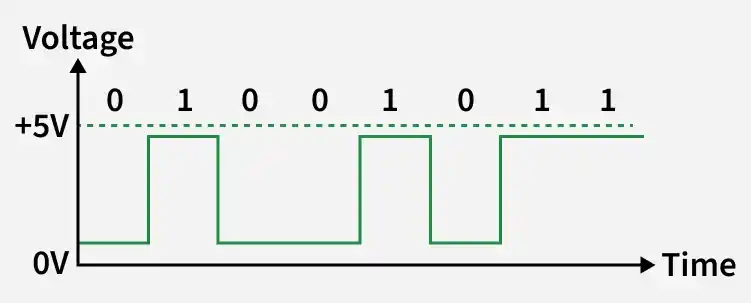
Digital signals, which are the basic encoding of modern technology and communication, represent data as a discrete binary number, 0 or 1. Digital signals are highly efficient for applications like telecommunications, computing, and multimedia.
Digital signals are implemented in a reliable binary format (0s and 1s).
They provide easier processing and better noise immunity.
They ensure better data integrity with minimal signal degradation.
It requires more bandwidth compared to analog signals
Digital signals are versatile, so it's widely used.
The accuracy of the digital signal is best than that of the analog signal.
Digital signals ensure reliable transmission and processing of information
Variable electric current or voltage.
Phase or polarization of an electromagnetic field.
This type of electronic l signals are often processed and transmitted better compared to analog signal.
The magnetization of a magnetic storage medium.
Digital signals are utilized in all digital electronics, including computing equipment and data transmission devices.
Applications
Telecommunication: Telecommunication signals allow for data transmission to be supported with effective voice communication using VoIP over a long distance without loss. They are the heart of modern communication networks.
Audio and Video Processing: Digital signals find application in audio compression, such as MP3, and video compression, for instance MPEG-4, whereby these enable the enhancement of qualities of media files while they reduce their size for streaming and storage.
Control Systems: Digital signals drive automation in industrial processes and robotics, improving efficiency and precision in manufacturing and operational processes.
Consumer Electronics: Digital signals are at the heart of image processing and audio playback in consumer electronics equipment, from cameras to smartphones.
Data Storage: Digital signals allow storage on hard drives and SSDs very reliably. An appropriate digital output will make sure that the retrieved data is correct and preserved over time.
Advantages
Digital data can be easily compressed.
Equipment that uses digital signals is more common and fewer expensive.
These signals turn the moving instruments free from errors.
Digital signals can convey information with less noise, distortion, and interference.
It can be reproduced easily in mass quantities at comparatively low costs.
As the DSP operations are often altered that's why digital signal processing is more flexible.
Digital signal processing is safer because digital information are often easily encrypted and compressed.
Disadvantage
Sampling may cause loss of information.
A/D and D/A demands mixed-signal hardware.
Processor speed is limited.
Develop quantization and round-off errors.
Systems and processing is more complex.
A higher bandwidth is required for data communication in comparison to analog transmission of an equivalent information.
Digital systems and processing are typically more complex.