VOOZH about

URL: https://www.geeksforgeeks.org/digital-logic/clock-skew-in-synchronous-digital-circuit-systems/

⇱ Clock Skew in synchronous digital circuit systems - GeeksforGeeks


  • Courses
  • Tutorials
  • Interview Prep

Clock Skew in synchronous digital circuit systems

Last Updated : 23 Jul, 2025

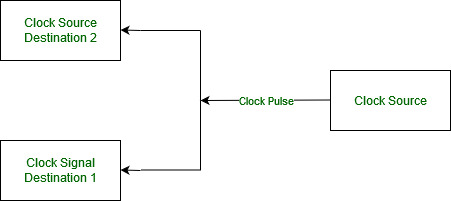
In Synchronous circuits where all the logic elements share the same clock signal, it becomes imperative to design these elements as close to the clock source as possible because a system-on-chip, FPGA, CPLD contain Billions of transistors. Even though these distances are minute due to their sheer number there is a propagation delay which leads to the clock signal arriving at different parts of the chip at different times. This is called Clock Skew. 

In Digital Circuit Design a ” Sequentially Adjacent ” circuit is one where if a pulse emitted from a common source is supposed to arrive at the same time. Using this definition we can write a mathematical expression for clock skew as 


👁 Image
Sequentially Adjacent Circuit


👁 Image
Non-Sequentially Adjacent Circuit.


Ta(Time of arrival of clock pulse at component a) 
Tb(Time of arrival of clock pulse at component b) 

Then, 
 

Clock skew Ts = Ta - Tb 


Factors causing Clock Skew : 
 

  • Interconnect Length 
     
  • Temperature Variations 
     
  • Capacitive Coupling 
     
  • Material Imperfections 
     
  • Differences in input capacitance on the clock inputs 


Types of Clock Skew : 
 

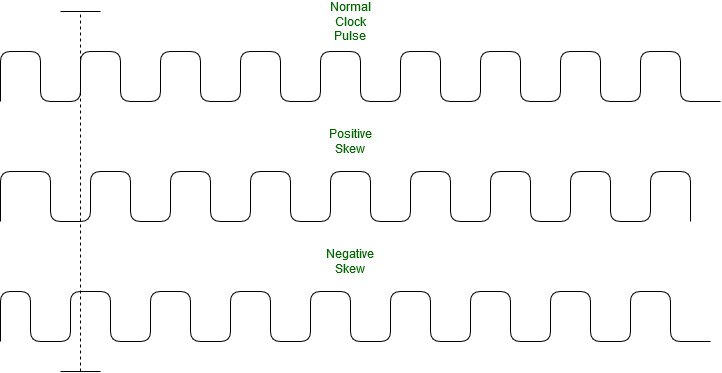
  • Positive Skew - 
    This occurs when the receiving register receives the clock pulse later than it is required. 
     
  • Negative Skew - 
    This occurs when the receiving register receives the clock pulse earlier than required. 


👁 Image
Types of Clock Skews


Comment
Article Tags:
Article Tags:

Explore