|
VOOZH | about |
|
VOOZH | about |
The Consensus Theorem is a simplification rule in Boolean algebra that helps in minimizing logical expressions by eliminating redundant terms. That is why it is also known as Redundancy Theorem.
To apply this theorem, the Boolean expression must meet following conditions:
The Consensus Theorem states that:
In a Boolean expression consisting of three terms where one term contains a variable, another contains the complement of that variable, and the third term consists of the remaining non-complemented parts from the first two terms, this third term is redundant and can be eliminated without affecting the logical equivalence of the expression.
The theorem applies in both sum-of-products and product-of-sums forms:
AB + A'C + BC = AB + A'C
(A + B)(A' + C)(B + C) = (A + B)(A' + C)
Here, A' means the complement (NOT) of A. After applying this theorem we can only take those terms which contains the complemented variable. The theorem helps eliminate the redundant term BC or (B + C) in the Boolean expression. The term BC or (B + C) does not affect the final result and can be removed to simplify the equation.
We prove the SOP form step by step:
AB + A'C + BC
AB + A'C + BC = AB + A'C + BC(A + A') (since A + A' = 1)
= AB + A'C + ABC + A'BC
= AB + ABC + A'C + A'BC
= AB + ABC + A'C + A'BC
=AB(1 + C) + A'C(1 +B)
= AB + A'C (since 1 + C = 1 and 1 + B = 1)
AB + A'C + BC = AB + A'C
Thus, the term BC is not needed.
Example 1:
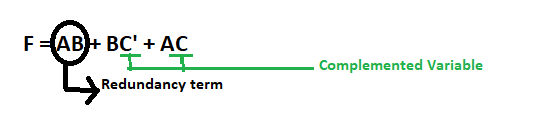
F = AB + BC' + AC
Here, we have three variables A, B and C and all are repeated twice. The variable C is present in complemented form. So, all the conditions are satisfied for applying this theorem.
👁 ImageAfter applying Redundancy theorem we can write only the terms containing complemented variables (i.e, C) and omit the Redundancy term i.e., AB.
.'. F = BC' + AC
Example 2:
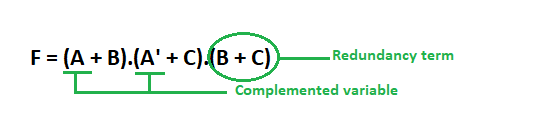
F = (A + B).(A' + C).(B + C)
Three variables are present and all are repeated twice. The variable A is present in complemented form. Thus, all the three conditions of this theorem is satisfied.
👁 ImageAfter applying Redundancy theorem we can write only the terms containing complemented variables (i.e, A) and omit the Redundancy term i.e., (B + C).
.'. F = (A + B).(A' + C)
Consider the following equation:
Y = AB + A'C + BC
The third product term BC is a redundant consensus term. If A switches from 1 to 0 while B=1 and C=1, Y remains 1. During the transition of signal A in logic gates, both the first and second term may be 0 momentarily. The third term prevents a glitch since its value of 1 in this case is not affected by the transition of signal A. Thus. it is important to remove Logic Redundancy because it causes unnecessary network complexity and raises the cost of implementation. So, in this way we can minimize a Boolean expression to solve it.
The Transposition Theorem states that in a Boolean function:
(A + B)(A' + C) = AC + A'B
This theorem helps in circuit design and simplification by showing an alternative way to express a Boolean function.