|
VOOZH | about |
|
VOOZH | about |
In communication systems, Broadband and Baseband refer to two different ways of transmitting data. They differ in how data is sent over a communication medium, the frequency range they use, and their applications.Broadband systems use modulation techniques to reduce the effect of noise in the environment. Broadband transmission employs multiple-channel unidirectional transmission using a combination of phase and amplitude modulation. Baseband is a digital signal transmitted on the medium using one of the signal codes like NRZ, RZ Manchester biphase-M code, etc. called baseband transmission.
Broadband Transmission refers to a communication method that uses a wide range of frequencies to transmit multiple signals simultaneously over a single medium. Each frequency band carries a different signal, such as voice, video, or data. This allows high-speed data transmission and maximizes the use of available bandwidth.
Examples of Broadband Systems
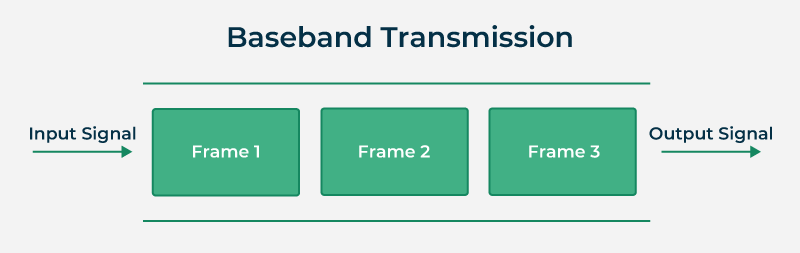
Baseband Transmission refers to a method of sending digital signals over a communication medium using a single, low-frequency channel. In this type of transmission, the entire bandwidth of the medium is used for a single signal. Unlike broadband, where multiple frequencies are used to carry different signals, baseband systems use just one channel for data transmission, meaning only one signal is sent at a time.
Examples of Baseband Systems
| Basis of Comparison | Baseband Transmission | Broadband Transmission |
|---|---|---|
| Type of Signal | In baseband transmission, the type of signaling used is digital. | In broadband transmission, the type of signaling used is analog. |
| Direction Type | Baseband Transmission is bidirectional in nature. | Broadband Transmission is unidirectional in nature. |
| Signal Transmission | The Signal can be sent in both directions. | Sending of Signal in one direction only. |
| Distance covered by the signal | Signals can only travel over short distances. For long distances, attenuation is required. | Signals can be traveled over long distances without being attenuated. |
| Topology | It works well with bus topology. | It is used with a bus as well as tree topology. |
| Device used to increase signal strength | Repeaters are used to enhance signal strength. | Amplifiers are used to enhance signal strength. |
| Type of Multiplexing used | It utilizes Time Division Multiplexing. | It utilizes Frequency Division Multiplexing. |
| Encoding Techniques | In baseband transmission, Manchester and Differential Manchester encoding are used. | Only PSK encoding is used. |
| Transfer medium | Twisted-pair cables, coaxial cables, and wires are used as a transfer medium for digital signals in baseband transmission. | Broadband signals were sent through optical fiber cables, coaxial cables, and radio waves. |
| Impedance | Baseband transmission has a 50-ohm impedance. | Broadband transmission has a 70-ohm impedance. |
| Data Streams | It can only transfer one data stream at a time in bi-directional mode. | It can send multiple signal waves at once but in one direction only. |
| Installation and Maintenance | Baseband transmission is easy to install and maintain. | Broadband transmission is difficult to install and maintain. |
| Cost | This transmission is cheaper to design. | This transmission is expensive to design. |
| Application | Typically seen in Ethernet LAN networks. | Typically found in cable and telephone networks. |
| Frequency | In this, capacity of frequency is less than 100 kHz. | In this, capacity of frequency is higher than 100 kHz. |
| Suitable for | It is best for wired networks. | It is best for non-wired networks. |
| Structure | The structure is very simple, and no special hardware is required. | The structure is complex as it needs unique hardware. |